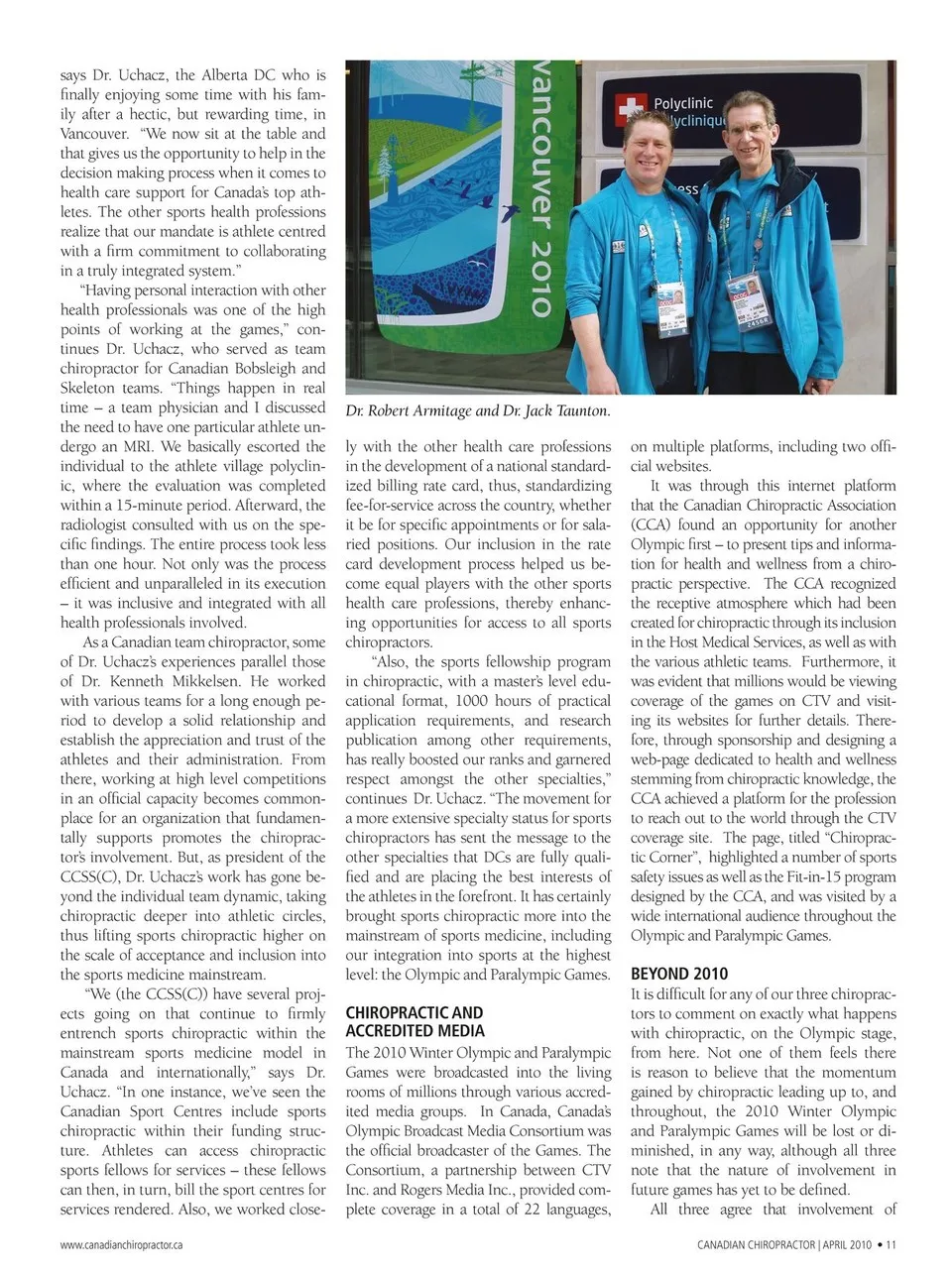
says Dr. Uchacz, the Alberta DC who is finally enjoying some time with his fam- ily after a hectic, but rewarding time, in Vancouver. “We now sit at the table and that gives us the opportunity to help in the decision making process when it comes to health care support for Canada’s top ath- letes. The other sports health professions realize that our mandate is athlete centred with a firm commitment to collaborating in a truly integrated system.” “Having personal interaction with other health professionals was one of the high points of working at the games,” con- tinues Dr. Uchacz, who served as team chiropractor for Canadian Bobsleigh and Skeleton teams. “Things happen in real time – a team physician and I discussed the need to have one particular athlete un- dergo an MRI. We basically escorted the individual to the athlete village polyclin- ic, where the evaluation was completed within a 15-minute period. Afterward, the radiologist consulted with us on the spe- cific findings. The entire process took less than one hour. Not only was the process efficient and unparalleled in its execution – it was inclusive and integrated with all health professionals involved. As a Canadian team chiropractor, some of Dr. Uchacz’s experiences parallel those of Dr. Kenneth Mikkelsen. He worked with various teams for a long enough pe- riod to develop a solid relationship and establish the appreciation and trust of the athletes and their administration. From there, working at high level competitions in an official capacity becomes common- place for an organization that fundamen- tally supports promotes the chiroprac- tor’s involvement. But, as president of the CCSS(C), Dr. Uchacz’s work has gone be- yond the individual team dynamic, taking chiropractic deeper into athletic circles, thus lifting sports chiropractic higher on the scale of acceptance and inclusion into the sports medicine mainstream. “We (the CCSS(C)) have several proj- ects going on that continue to firmly entrench sports chiropractic within the mainstream sports medicine model in Canada and internationally,” says Dr. Uchacz. “In one instance, we’ve seen the Canadian Sport Centres include sports chiropractic within their funding struc- ture. Athletes can access chiropractic sports fellows for services – these fellows can then, in turn, bill the sport centres for services rendered. Also, we worked close- www.canadianchiropractor.ca Dr. Robert Armitage and Dr. Jack Taunton. ly with the other health care professions in the development of a national standard- ized billing rate card, thus, standardizing fee-for-service across the country, whether it be for specific appointments or for sala- ried positions. Our inclusion in the rate card development process helped us be- come equal players with the other sports health care professions, thereby enhanc- ing opportunities for access to all sports chiropractors. “Also, the sports fellowship program in chiropractic, with a master’s level edu- cational format, 1000 hours of practical application requirements, and research publication among other requirements, has really boosted our ranks and garnered respect amongst the other specialties,” continues Dr. Uchacz. “The movement for a more extensive specialty status for sports chiropractors has sent the message to the other specialties that DCs are fully quali- fied and are placing the best interests of the athletes in the forefront. It has certainly brought sports chiropractic more into the mainstream of sports medicine, including our integration into sports at the highest level: the Olympic and Paralympic Games. CHIROPRACTICAND ACCREDITED MEDIA The 2010 Winter Olympic and Paralympic Games were broadcasted into the living rooms of millions through various accred- ited media groups. In Canada, Canada’s Olympic Broadcast Media Consortium was the official broadcaster of the Games. The Consortium, a partnership between CTV Inc. and Rogers Media Inc., provided com- plete coverage in a total of 22 languages, on multiple platforms, including two offi- cial websites. It was through this internet platform that the Canadian Chiropractic Association (CCA) found an opportunity for another Olympic first – to present tips and informa- tion for health and wellness from a chiro- practic perspective. The CCA recognized the receptive atmosphere which had been created for chiropractic through its inclusion in the Host Medical Services, as well as with the various athletic teams. Furthermore, it was evident that millions would be viewing coverage of the games on CTV and visit- ing its websites for further details. There- fore, through sponsorship and designing a web-page dedicated to health and wellness stemming from chiropractic knowledge, the CCA achieved a platform for the profession to reach out to the world through the CTV coverage site. The page, titled “Chiroprac- tic Corner”, highlighted a number of sports safety issues as well as the Fit-in-15 program designed by the CCA, and was visited by a wide international audience throughout the Olympic and Paralympic Games. BEYOND 2010 It is difficult for any of our three chiroprac- tors to comment on exactly what happens with chiropractic, on the Olympic stage, from here. Not one of them feels there is reason to believe that the momentum gained by chiropractic leading up to, and throughout, the 2010 Winter Olympic and Paralympic Games will be lost or di- minished, in any way, although all three note that the nature of involvement in future games has yet to be defined. All three agree that involvement of
Chiropractic + Naturopathic Doctor April 2010: Page 11