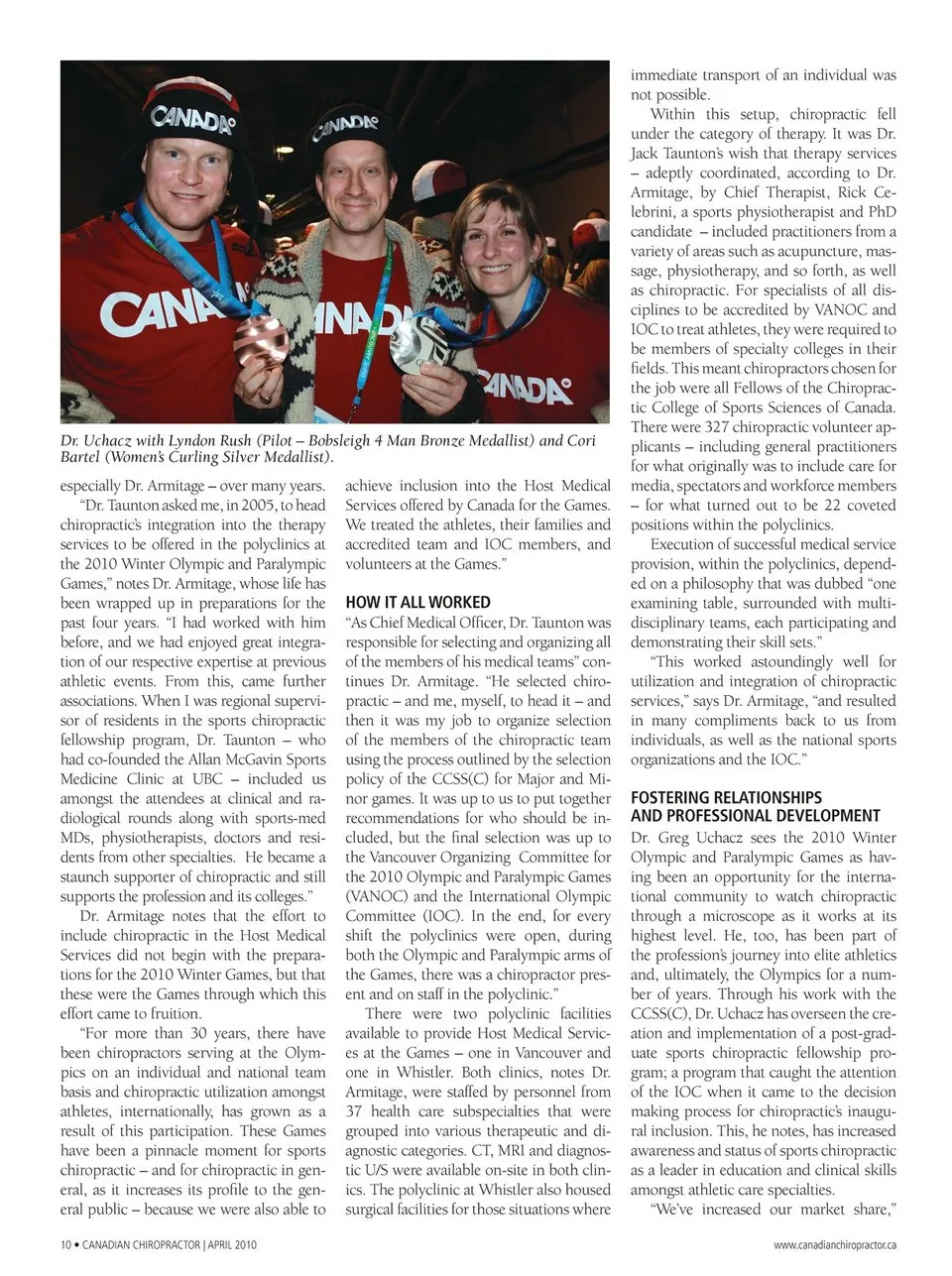
immediate transport of an individual was not possible. Within this setup, chiropractic fell Dr. Uchacz with Lyndon Rush (Pilot – Bobsleigh 4 Man Bronze Medallist) and Cori Bartel (Women’s Curling Silver Medallist). especially Dr. Armitage – over many years. “Dr. Taunton asked me, in 2005, to head chiropractic’s integration into the therapy services to be offered in the polyclinics at the 2010 Winter Olympic and Paralympic Games,” notes Dr. Armitage, whose life has been wrapped up in preparations for the past four years. “I had worked with him before, and we had enjoyed great integra- tion of our respective expertise at previous athletic events. From this, came further associations. When I was regional supervi- sor of residents in the sports chiropractic fellowship program, Dr. Taunton – who had co-founded the Allan McGavin Sports Medicine Clinic at UBC – included us amongst the attendees at clinical and ra- diological rounds along with sports-med MDs, physiotherapists, doctors and resi- dents from other specialties. He became a staunch supporter of chiropractic and still supports the profession and its colleges.” Dr. Armitage notes that the effort to include chiropractic in the Host Medical Services did not begin with the prepara- tions for the 2010 Winter Games, but that these were the Games through which this effort came to fruition. been chiropractors serving at the Olym- pics on an individual and national team basis and chiropractic utilization amongst athletes, internationally, has grown as a result of this participation. These Games have been a pinnacle moment for sports chiropractic – and for chiropractic in gen- eral, as it increases its profile to the gen- eral public – because we were also able to | APRIL 2010 achieve inclusion into the Host Medical Services offered by Canada for the Games. We treated the athletes, their families and accredited team and IOC members, and volunteers at the Games.” HOW ITALL WORKED “As Chief Medical Officer, Dr. Taunton was responsible for selecting and organizing all of the members of his medical teams” con- tinues Dr. Armitage. “He selected chiro- practic – and me, myself, to head it – and then it was my job to organize selection of the members of the chiropractic team using the process outlined by the selection policy of the CCSS(C) for Major and Mi- nor games. It was up to us to put together recommendations for who should be in- cluded, but the final selection was up to the Vancouver Organizing Committee for the 2010 Olympic and Paralympic Games (VANOC) and the International Olympic Committee (IOC). In the end, for every shift the polyclinics were open, during both the Olympic and Paralympic arms of the Games, there was a chiropractor pres- ent and on staff in the polyclinic.” There were two polyclinic facilities available to provide Host Medical Servic- es at the Games – one in Vancouver and one in Whistler. Both clinics, notes Dr. Armitage, were staffed by personnel from grouped into various therapeutic and di- agnostic categories. CT, MRI and diagnos- tic U/S were available on-site in both clin- ics. The polyclinic at Whistler also housed surgical facilities for those situations where under the category of therapy. It was Dr. Jack Taunton’s wish that therapy services – adeptly coordinated, according to Dr. Armitage, by Chief Therapist, Rick Ce- lebrini, a sports physiotherapist and PhD candidate – included practitioners from a variety of areas such as acupuncture, mas- sage, physiotherapy, and so forth, as well as chiropractic. For specialists of all dis- ciplines to be accredited by VANOC and IOC to treat athletes, they were required to be members of specialty colleges in their fields. This meant chiropractors chosen for the job were all Fellows of the Chiroprac- tic College of Sports Sciences of Canada. - plicants – including general practitioners for what originally was to include care for media, spectators and workforce members – for what turned out to be 22 coveted positions within the polyclinics. Execution of successful medical service provision, within the polyclinics, depend- ed on a philosophy that was dubbed “one examining table, surrounded with multi- disciplinary teams, each participating and demonstrating their skill sets.” “This worked astoundingly well for utilization and integration of chiropractic services,” says Dr. Armitage, “and resulted in many compliments back to us from individuals, as well as the national sports organizations and the IOC.” FOSTERING RELATIONSHIPS AND PROFESSIONAL DEVELOPMENT Dr. Greg Uchacz sees the 2010 Winter Olympic and Paralympic Games as hav- ing been an opportunity for the interna- tional community to watch chiropractic through a microscope as it works at its highest level. He, too, has been part of the profession’s journey into elite athletics and, ultimately, the Olympics for a num- ber of years. Through his work with the CCSS(C), Dr. Uchacz has overseen the cre- ation and implementation of a post-grad- uate sports chiropractic fellowship pro- gram; a program that caught the attention of the IOC when it came to the decision making process for chiropractic’s inaugu- ral inclusion. This, he notes, has increased awareness and status of sports chiropractic as a leader in education and clinical skills amongst athletic care specialties. “We’ve increased our market share,” www.canadianchiropractor.ca
Chiropractic + Naturopathic Doctor April 2010: Page 10