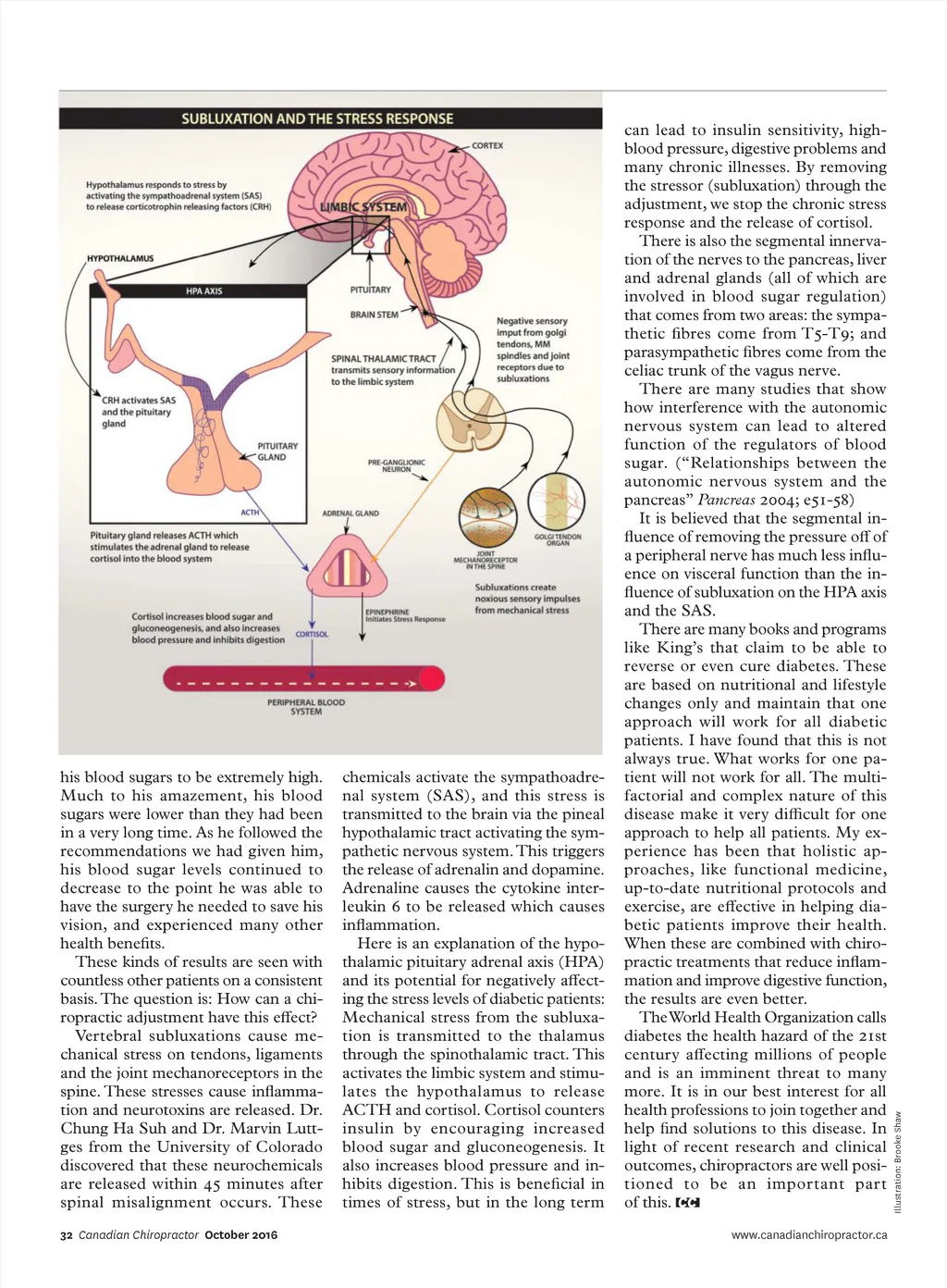
32 Canadian Chiropractor October 2016 www.canadianchiropractor.ca Illustration: Brooke Shaw his blood sugars to be extremely high. Much to his amazement, his blood sugars were lower than they had been in a very long time. As he followed the recommendations we had given him, his blood sugar levels continued to decrease to the point he was able to have the surgery he needed to save his vision, and experienced many other health benefits. These kinds of results are seen with countless other patients on a consistent basis. The question is: How can a chi-ropractic adjustment have this effect? Vertebral subluxations cause me-chanical stress on tendons, ligaments and the joint mechanoreceptors in the spine. These stresses cause inflamma-tion and neurotoxins are released. Dr. Chung Ha Suh and Dr. Marvin Lutt-ges from the University of Colorado discovered that these neurochemicals are released within 45 minutes after spinal misalignment occurs. These chemicals activate the sympathoadre-nal system (SAS), and this stress is transmitted to the brain via the pineal hypothalamic tract activating the sym-pathetic nervous system. This triggers the release of adrenalin and dopamine. Adrenaline causes the cytokine inter-leukin 6 to be released which causes inflammation. Here is an explanation of the hypo-thalamic pituitary adrenal axis (HPA) and its potential for negatively affect-ing the stress levels of diabetic patients: Mechanical stress from the subluxa-tion is transmitted to the thalamus through the spinothalamic tract. This activates the limbic system and stimu-lates the hypothalamus to release ACTH and cortisol. Cortisol counters insulin by encouraging increased blood sugar and gluconeogenesis. It also increases blood pressure and in-hibits digestion. This is beneficial in times of stress, but in the long term can lead to insulin sensitivity, high-blood pressure, digestive problems and many chronic illnesses. By removing the stressor (subluxation) through the adjustment, we stop the chronic stress response and the release of cortisol. There is also the segmental innerva-tion of the nerves to the pancreas, liver and adrenal glands (all of which are involved in blood sugar regulation) that comes from two areas: the sympa-thetic fibres come from T5-T9; and parasympathetic fibres come from the celiac trunk of the vagus nerve. There are many studies that show how interference with the autonomic nervous system can lead to altered function of the regulators of blood sugar. (“Relationships between the autonomic nervous system and the pancreas” Pancreas 2004; e51-58) It is believed that the segmental in-fluence of removing the pressure off of a peripheral nerve has much less influ-ence on visceral function than the in-fluence of subluxation on the HPA axis and the SAS. There are many books and programs like King’s that claim to be able to reverse or even cure diabetes. These are based on nutritional and lifestyle changes only and maintain that one approach will work for all diabetic patients. I have found that this is not always true. What works for one pa-tient will not work for all. The multi-factorial and complex nature of this disease make it very difficult for one approach to help all patients. My ex-perience has been that holistic ap-proaches, like functional medicine, up-to-date nutritional protocols and exercise, are effective in helping dia-betic patients improve their health. When these are combined with chiro-practic treatments that reduce inflam-mation and improve digestive function, the results are even better. The World Health Organization calls diabetes the health hazard of the 21st century affecting millions of people and is an imminent threat to many more. It is in our best interest for all health professions to join together and help find solutions to this disease. In light of recent research and clinical outcomes, chiropractors are well posi-tioned to be an important part of this.
Chiropractic + Naturopathic Doctor October 2016: Page 32