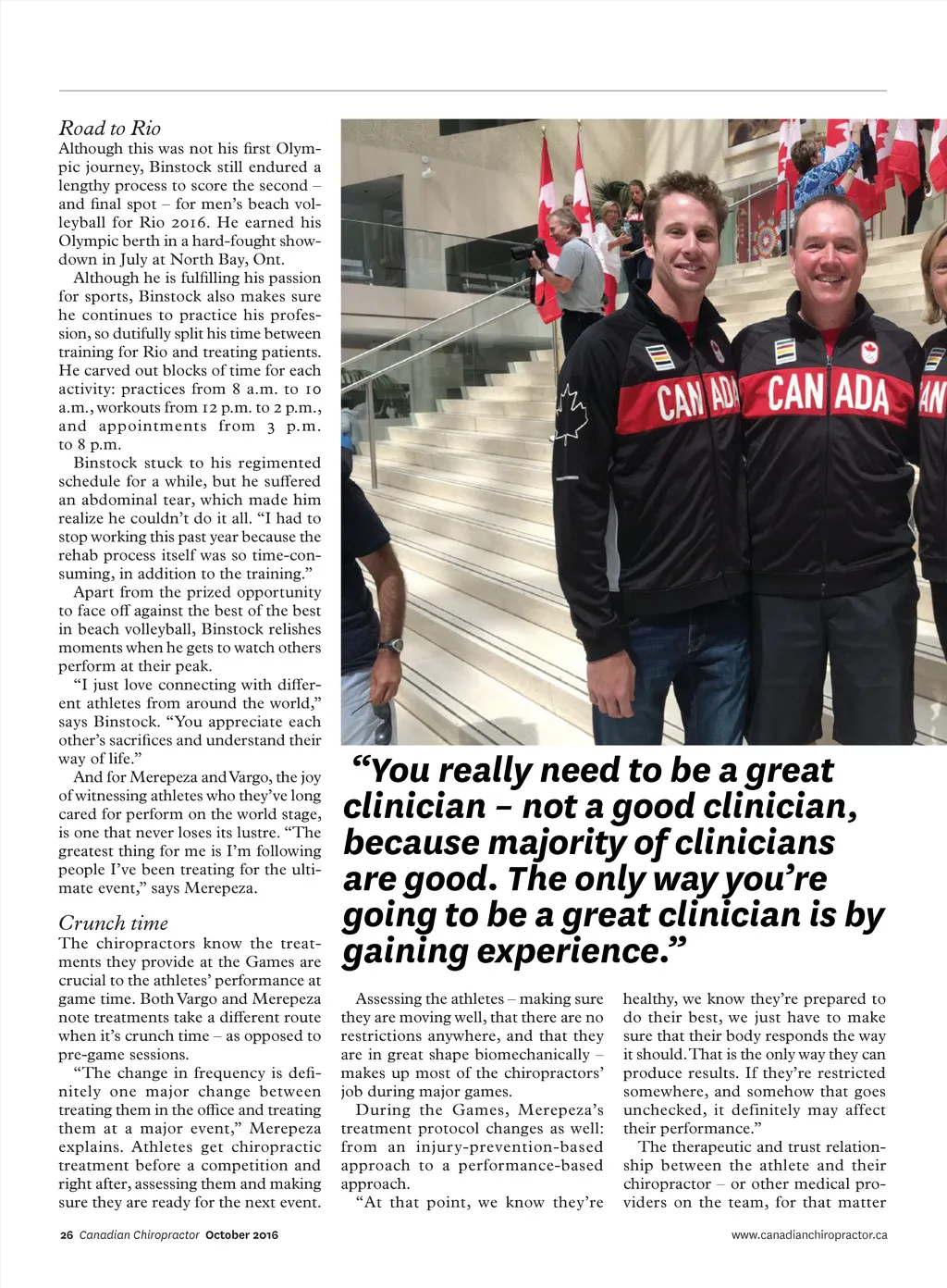
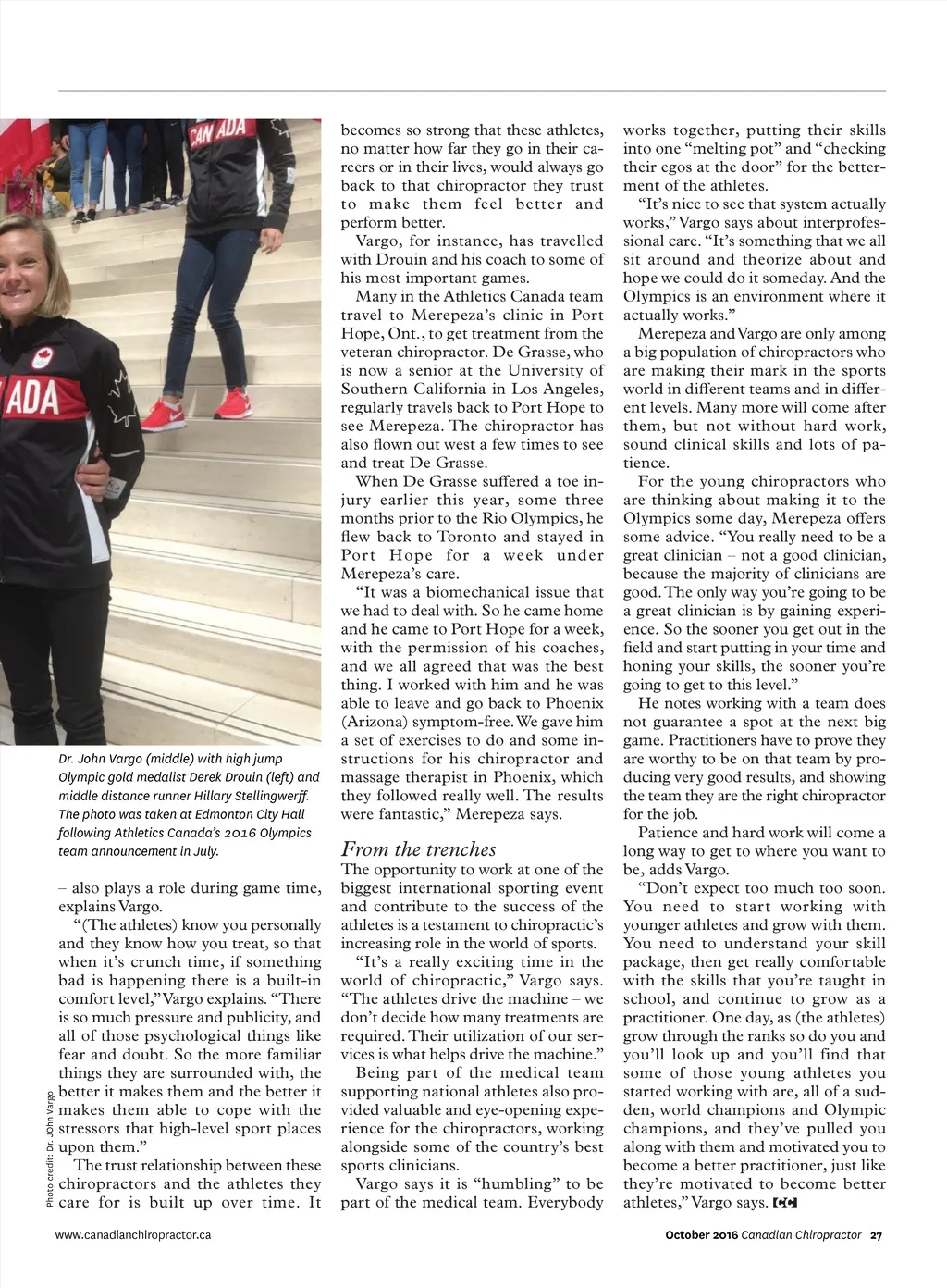
Dr. John Vargo (middle) with high jump Olympic gold medalist Derek Drouin (left) and middle distance runner Hillary Stellingwerff. The photo was taken at Edmonton City Hall following Athletics Canada’s 2016 Olympics team announcement in July. becomes so strong that these athletes, no matter how far they go in their ca-reers or in their lives, would always go back to that chiropractor they trust to make them feel better and perform better. Vargo, for instance, has travelled with Drouin and his coach to some of his most important games. Many in the Athletics Canada team travel to Merepeza’s clinic in Port Hope, Ont., to get treatment from the veteran chiropractor. De Grasse, who is now a senior at the University of Southern California in Los Angeles, regularly travels back to Port Hope to see Merepeza. The chiropractor has also flown out west a few times to see and treat De Grasse. When De Grasse suffered a toe in-jury earlier this year, some three months prior to the Rio Olympics, he flew back to Toronto and stayed in Por t Hope for a week under Merepeza’s care. “It was a biomechanical issue that we had to deal with. So he came home and he came to Port Hope for a week, with the permission of his coaches, and we all agreed that was the best thing. I worked with him and he was able to leave and go back to Phoenix (Arizona) symptom-free. We gave him a set of exercises to do and some in-structions for his chiropractor and massage therapist in Phoenix, which they followed really well. The results were fantastic,” Merepeza says. From the trenches The opportunity to work at one of the biggest international sporting event and contribute to the success of the athletes is a testament to chiropractic’s increasing role in the world of sports. “It’s a really exciting time in the world of chiropractic,” Vargo says. “The athletes drive the machine – we don’t decide how many treatments are required. Their utilization of our ser-vices is what helps drive the machine.” Being part of the medical team supporting national athletes also pro-vided valuable and eye-opening expe-rience for the chiropractors, working alongside some of the country’s best sports clinicians. Vargo says it is “humbling” to be part of the medical team. Everybody – also plays a role during game time, explains Vargo. “(The athletes) know you personally and they know how you treat, so that when it’s crunch time, if something bad is happening there is a built-in comfort level,” Vargo explains. “There is so much pressure and publicity, and all of those psychological things like fear and doubt. So the more familiar things they are surrounded with, the better it makes them and the better it makes them able to cope with the stressors that high-level sport places upon them.” The trust relationship between these chiropractors and the athletes they care for is built up over time. It www.canadianchiropractor.ca works together, putting their skills into one “melting pot” and “checking their egos at the door” for the better-ment of the athletes. “It’s nice to see that system actually works,” Vargo says about interprofes-sional care. “It’s something that we all sit around and theorize about and hope we could do it someday. And the Olympics is an environment where it actually works.” Merepeza and Vargo are only among a big population of chiropractors who are making their mark in the sports world in different teams and in differ-ent levels. Many more will come after them, but not without hard work, sound clinical skills and lots of pa-tience. For the young chiropractors who are thinking about making it to the Olympics some day, Merepeza offers some advice. “You really need to be a great clinician – not a good clinician, because the majority of clinicians are good. The only way you’re going to be a great clinician is by gaining experi-ence. So the sooner you get out in the field and start putting in your time and honing your skills, the sooner you’re going to get to this level.” He notes working with a team does not guarantee a spot at the next big game. Practitioners have to prove they are worthy to be on that team by pro-ducing very good results, and showing the team they are the right chiropractor for the job. Patience and hard work will come a long way to get to where you want to be, adds Vargo. “Don’t expect too much too soon. You need to start working with younger athletes and grow with them. You need to understand your skill package, then get really comfortable with the skills that you’re taught in school, and continue to grow as a practitioner. One day, as (the athletes) grow through the ranks so do you and you’ll look up and you’ll find that some of those young athletes you started working with are, all of a sud-den, world champions and Olympic champions, and they’ve pulled you along with them and motivated you to become a better practitioner, just like they’re motivated to become better athletes,” Vargo says. October 2016 Canadian Chiropractor 27 Photo credit: Dr. JOhn Vargo
Chiropractic + Naturopathic Doctor October 2016: Page 27