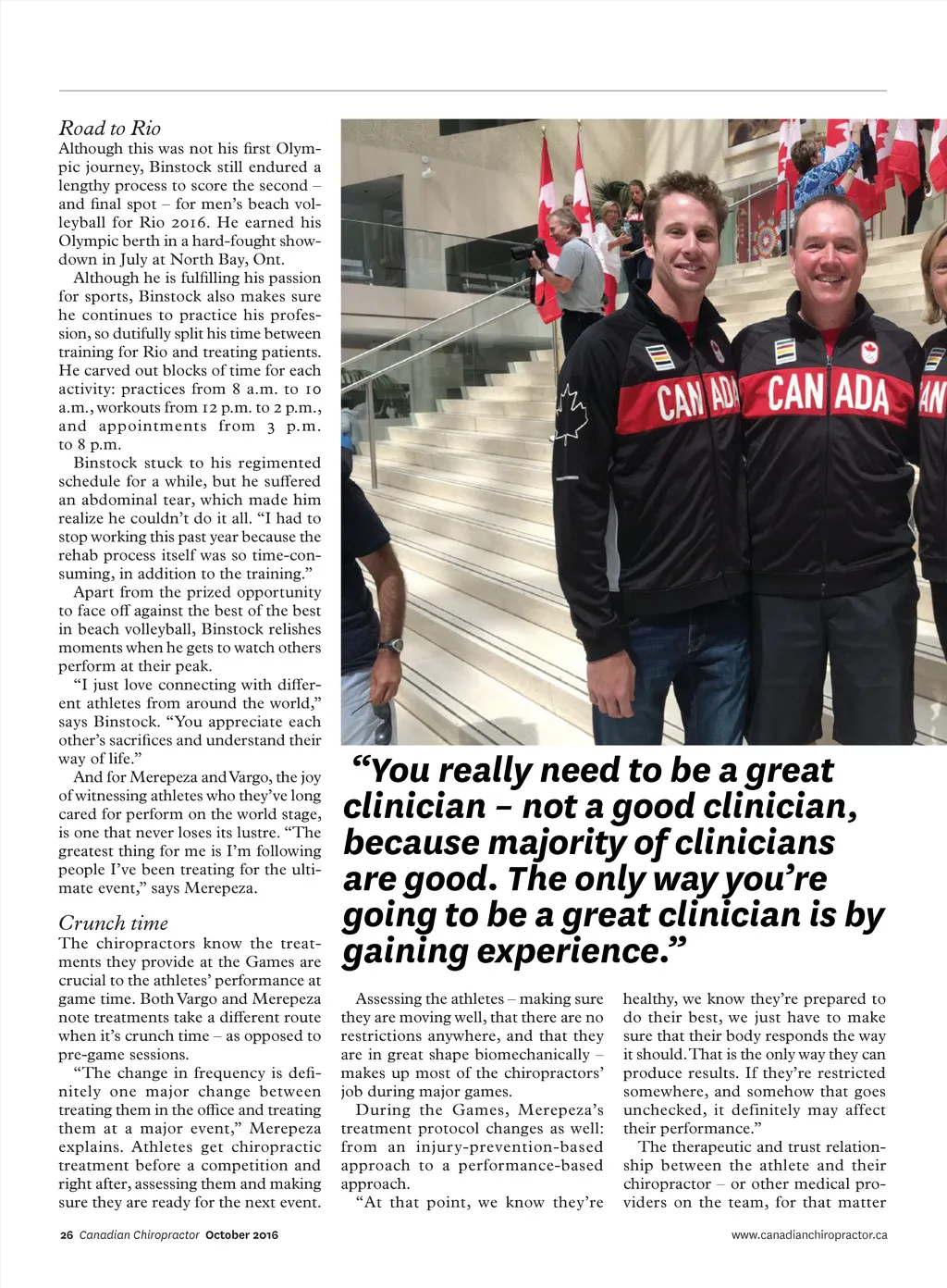
Road to Rio Although this was not his first Olym-pic journey, Binstock still endured a lengthy process to score the second – and final spot – for men’s beach vol-leyball for Rio 2016. He earned his Olympic berth in a hard-fought show-down in July at North Bay, Ont. Although he is fulfilling his passion for sports, Binstock also makes sure he continues to practice his profes-sion, so dutifully split his time between training for Rio and treating patients. He carved out blocks of time for each activity: practices from 8 a.m. to 10 a.m., workouts from 12 p.m. to 2 p.m., and appointments from 3 p.m. to 8 p.m. Binstock stuck to his regimented schedule for a while, but he suffered an abdominal tear, which made him realize he couldn’t do it all. “I had to stop working this past year because the rehab process itself was so time-con-suming, in addition to the training.” Apart from the prized opportunity to face off against the best of the best in beach volleyball, Binstock relishes moments when he gets to watch others perform at their peak. “I just love connecting with differ-ent athletes from around the world,” says Binstock. “You appreciate each other’s sacrifices and understand their way of life.” And for Merepeza and Vargo, the joy of witnessing athletes who they’ve long cared for perform on the world stage, is one that never loses its lustre. “The greatest thing for me is I’m following people I’ve been treating for the ulti-mate event,” says Merepeza. Crunch time The chiropractors know the treat-ments they provide at the Games are crucial to the athletes’ performance at game time. Both Vargo and Merepeza note treatments take a different route when it’s crunch time – as opposed to pre-game sessions. “The change in frequency is defi-nitely one major change between treating them in the office and treating them at a major event,” Merepeza explains. Athletes get chiropractic treatment before a competition and right after, assessing them and making sure they are ready for the next event. 26 Canadian Chiropractor October 2016 “You really need to be a great clinician – not a good clinician, because majority of clinicians are good. The only way you’re going to be a great clinician is by gaining experience.” Assessing the athletes – making sure they are moving well, that there are no restrictions anywhere, and that they are in great shape biomechanically – makes up most of the chiropractors’ job during major games. During the Games, Merepeza’s treatment protocol changes as well: from an injur y-prevention-based approach to a performance-based approach. “At that point, we know they’re healthy, we know they’re prepared to do their best, we just have to make sure that their body responds the way it should. That is the only way they can produce results. If they’re restricted somewhere, and somehow that goes unchecked, it definitely may affect their performance.” The therapeutic and trust relation-ship between the athlete and their chiropractor – or other medical pro-viders on the team, for that matter www.canadianchiropractor.ca
Chiropractic + Naturopathic Doctor October 2016: Page 26