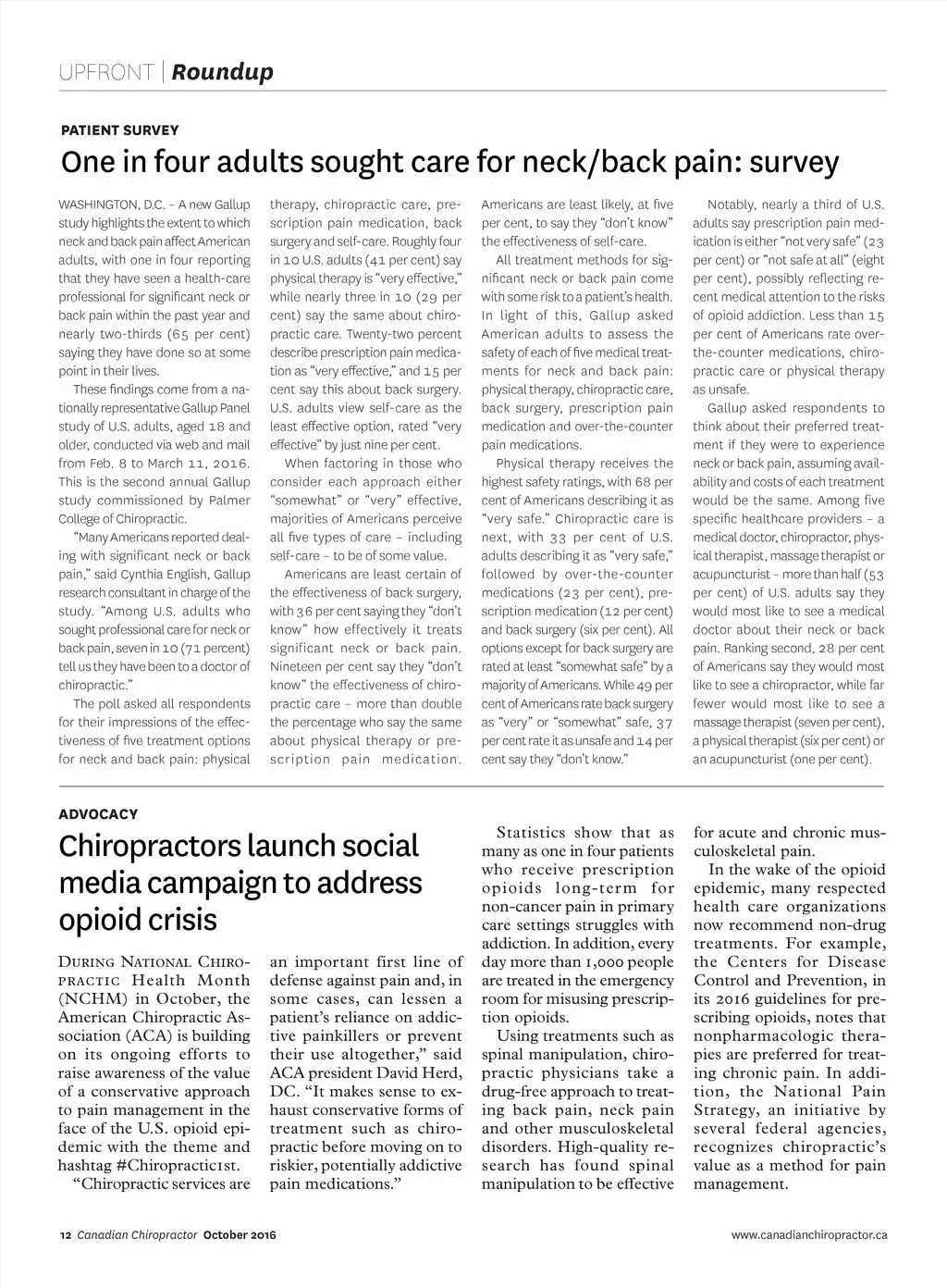
UPFRONT | Roundup PATIENT SURVEY One in four adults sought care for neck/back pain: survey WASHINGTON, D.C. – A new Gallup study highlights the extent to which neck and back pain affect American adults, with one in four reporting that they have seen a health-care professional for significant neck or back pain within the past year and nearly two-thirds (65 per cent) saying they have done so at some point in their lives. These findings come from a na-tionally representative Gallup Panel study of U.S. adults, aged 18 and older, conducted via web and mail from Feb. 8 to March 11, 2016. This is the second annual Gallup study commissioned by Palmer College of Chiropractic. “Many Americans reported deal-ing with significant neck or back pain,” said Cynthia English, Gallup research consultant in charge of the study. “Among U.S. adults who sought professional care for neck or back pain, seven in 10 (71 percent) tell us they have been to a doctor of chiropractic.” The poll asked all respondents for their impressions of the effec-tiveness of five treatment options for neck and back pain: physical therapy, chiropractic care, pre-scription pain medication, back surgery and self-care. Roughly four in 10 U.S. adults (41 per cent) say physical therapy is “very effective,” while nearly three in 10 (29 per cent) say the same about chiro-practic care. Twenty-two percent describe prescription pain medica-tion as “very effective,” and 15 per cent say this about back surgery. U.S. adults view self-care as the least effective option, rated “very effective” by just nine per cent. When factoring in those who consider each approach either “somewhat” or “very” effective, majorities of Americans perceive all five types of care – including self-care – to be of some value. Americans are least certain of the effectiveness of back surgery, with 36 per cent saying they “don’t know” how effectively it treats significant neck or back pain. Nineteen per cent say they “don’t know” the effectiveness of chiro-practic care – more than double the percentage who say the same about physical therapy or pre-scription pain medication. Americans are least likely, at five per cent, to say they “don’t know” the effectiveness of self-care. All treatment methods for sig-nificant neck or back pain come with some risk to a patient’s health. In light of this, Gallup asked American adults to assess the safety of each of five medical treat-ments for neck and back pain: physical therapy, chiropractic care, back surgery, prescription pain medication and over-the-counter pain medications. Physical therapy receives the highest safety ratings, with 68 per cent of Americans describing it as “very safe.” Chiropractic care is next, with 33 per cent of U.S. adults describing it as “very safe,” followed by over-the-counter medications (23 per cent), pre-scription medication (12 per cent) and back surgery (six per cent). All options except for back surgery are rated at least “somewhat safe” by a majority of Americans. While 49 per cent of Americans rate back surgery as “very” or “somewhat” safe, 37 per cent rate it as unsafe and 14 per cent say they “don’t know.” Notably, nearly a third of U.S. adults say prescription pain med-ication is either “not very safe” (23 per cent) or “not safe at all” (eight per cent), possibly reflecting re-cent medical attention to the risks of opioid addiction. Less than 15 per cent of Americans rate over-the-counter medications, chiro-practic care or physical therapy as unsafe. Gallup asked respondents to think about their preferred treat-ment if they were to experience neck or back pain, assuming avail-ability and costs of each treatment would be the same. Among five specific healthcare providers – a medical doctor, chiropractor, phys-ical therapist, massage therapist or acupuncturist – more than half (53 per cent) of U.S. adults say they would most like to see a medical doctor about their neck or back pain. Ranking second, 28 per cent of Americans say they would most like to see a chiropractor, while far fewer would most like to see a massage therapist (seven per cent), a physical therapist (six per cent) or an acupuncturist (one per cent). ADVOCACY Chiropractors launch social media campaign to address opioid crisis During National Chiro-practic Health Month (NCHM) in October, the American Chiropractic As-sociation (ACA) is building on its ongoing efforts to raise awareness of the value of a conservative approach to pain management in the face of the U.S. opioid epi-demic with the theme and hashtag #Chiropractic1st. “Chiropractic services are an important first line of defense against pain and, in some cases, can lessen a patient’s reliance on addic-tive painkillers or prevent their use altogether,” said ACA president David Herd, DC. “It makes sense to ex-haust conservative forms of treatment such as chiro-practic before moving on to riskier, potentially addictive pain medications.” Statistics show that as many as one in four patients who receive prescription opioids long-ter m for non-cancer pain in primary care settings struggles with addiction. In addition, every day more than 1,000 people are treated in the emergency room for misusing prescrip-tion opioids. Using treatments such as spinal manipulation, chiro-practic physicians take a drug-free approach to treat-ing back pain, neck pain and other musculoskeletal disorders. High-quality re-search has found spinal manipulation to be effective for acute and chronic mus-culoskeletal pain. In the wake of the opioid epidemic, many respected health care organizations now recommend non-drug treatments. For example, the Centers for Disease Control and Prevention, in its 2016 guidelines for pre-scribing opioids, notes that nonpharmacologic thera-pies are preferred for treat-ing chronic pain. In addi-tion, the National Pain Strategy, an initiative by several federal agencies, recognizes chiropractic’s value as a method for pain management. www.canadianchiropractor.ca 12 Canadian Chiropractor October 2016
Chiropractic + Naturopathic Doctor October 2016: Page 12