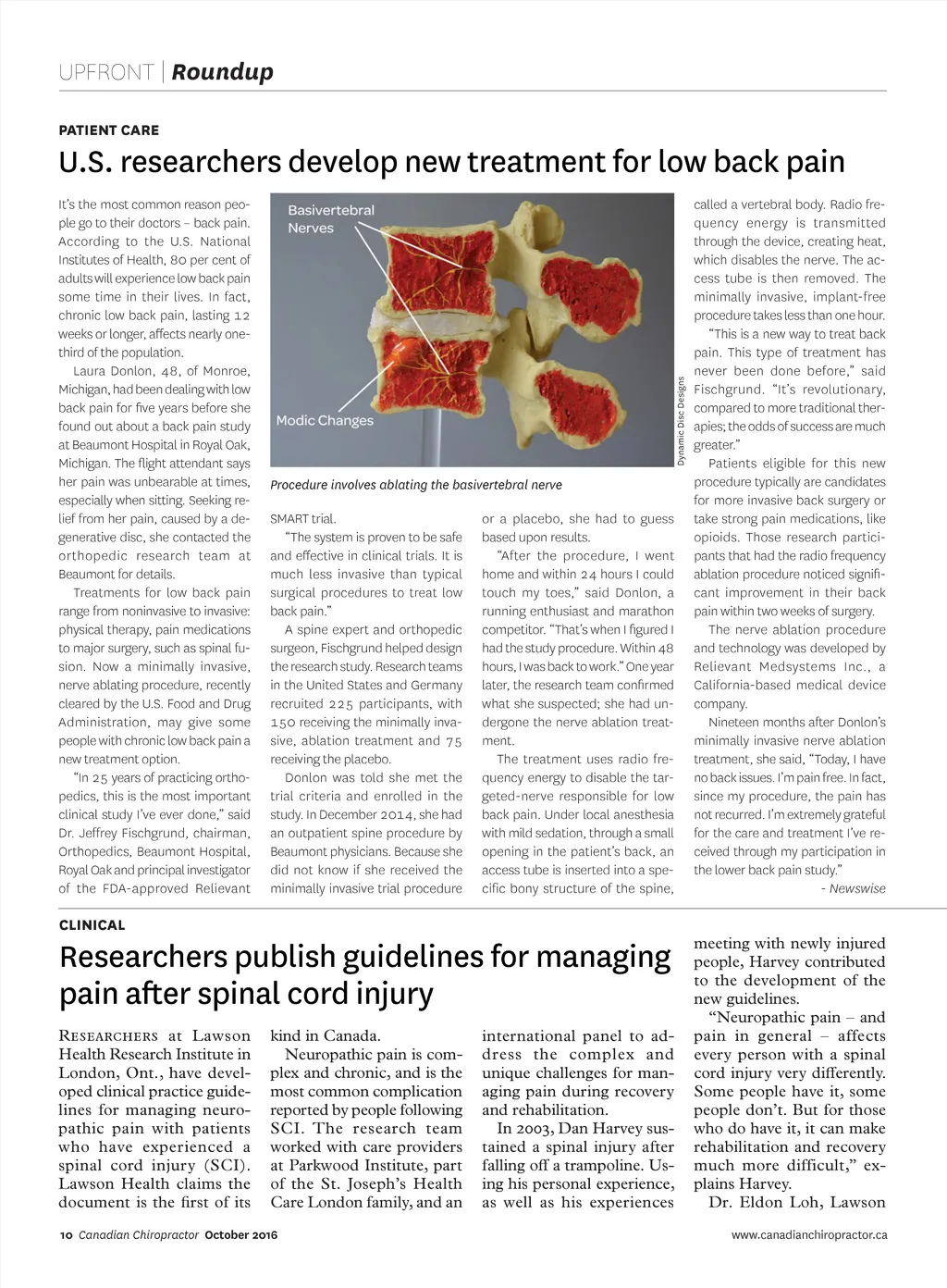
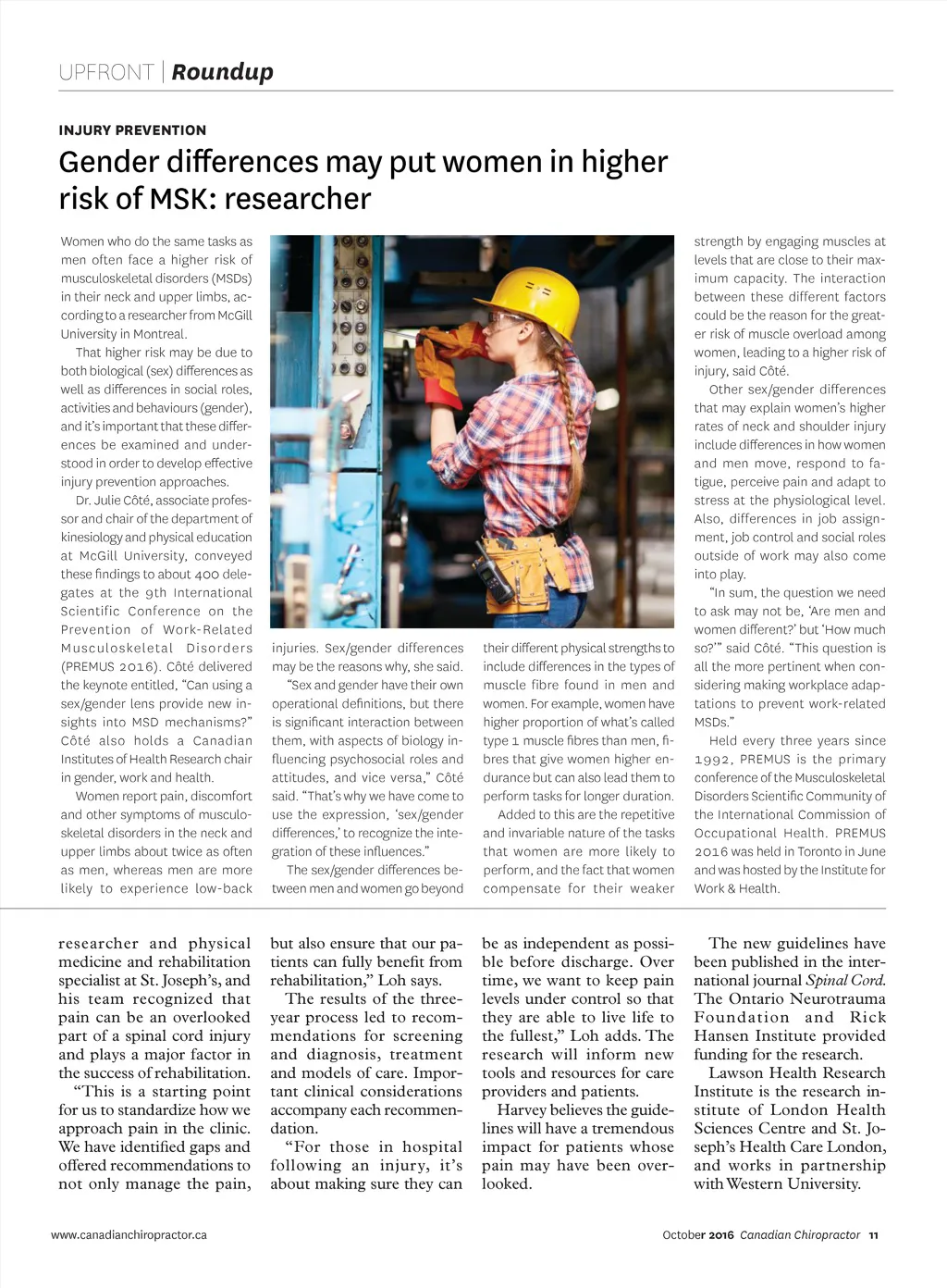
UPFRONT | Roundup INJURY PREVENTION Gender differences may put women in higher risk of MSK: researcher Women who do the same tasks as men often face a higher risk of musculoskeletal disorders (MSDs) in their neck and upper limbs, ac-cording to a researcher from McGill University in Montreal. That higher risk may be due to both biological (sex) differences as well as differences in social roles, activities and behaviours (gender), and it’s important that these differ-ences be examined and under-stood in order to develop effective injury prevention approaches. Dr. Julie Côté, associate profes-sor and chair of the department of kinesiology and physical education at McGill University, conveyed these findings to about 400 dele-gates at the 9th International Scientific Conference on the Prevention of Work-Related Musculoskeletal Disorders (PREMUS 2016). Côté delivered the keynote entitled, “Can using a sex/gender lens provide new in-sights into MSD mechanisms?” Côté also holds a Canadian Institutes of Health Research chair in gender, work and health. Women report pain, discomfort and other symptoms of musculo-skeletal disorders in the neck and upper limbs about twice as often as men, whereas men are more likely to experience low-back strength by engaging muscles at levels that are close to their max-imum capacity. The interaction between these different factors could be the reason for the great-er risk of muscle overload among women, leading to a higher risk of injury, said Côté. Other sex/gender differences that may explain women’s higher rates of neck and shoulder injury include differences in how women and men move, respond to fa-tigue, perceive pain and adapt to stress at the physiological level. Also, differences in job assign-ment, job control and social roles outside of work may also come into play. “In sum, the question we need to ask may not be, ‘Are men and women different?’ but ‘How much so?’” said Côté. “This question is all the more pertinent when con-sidering making workplace adap-tations to prevent work-related MSDs.” Held every three years since 1992, PREMUS is the primary conference of the Musculoskeletal Disorders Scientific Community of the International Commission of Occupational Health. PREMUS 2016 was held in Toronto in June and was hosted by the Institute for Work & Health. injuries. Sex/gender differences may be the reasons why, she said. “Sex and gender have their own operational definitions, but there is significant interaction between them, with aspects of biology in-fluencing psychosocial roles and attitudes, and vice versa,” Côté said. “That’s why we have come to use the expression, ‘sex/gender differences,’ to recognize the inte-gration of these influences.” The sex/gender differences be-tween men and women go beyond their different physical strengths to include differences in the types of muscle fibre found in men and women. For example, women have higher proportion of what’s called type 1 muscle fibres than men, fi-bres that give women higher en-durance but can also lead them to perform tasks for longer duration. Added to this are the repetitive and invariable nature of the tasks that women are more likely to perform, and the fact that women compensate for their weaker researcher and physical medicine and rehabilitation specialist at St. Joseph’s, and his team recognized that pain can be an overlooked part of a spinal cord injury and plays a major factor in the success of rehabilitation. “This is a starting point for us to standardize how we approach pain in the clinic. We have identified gaps and offered recommendations to not only manage the pain, www.canadianchiropractor.ca but also ensure that our pa-tients can fully benefit from rehabilitation,” Loh says. The results of the three-year process led to recom-mendations for screening and diagnosis, treatment and models of care. Impor-tant clinical considerations accompany each recommen-dation. “For those in hospital following an injury, it’s about making sure they can be as independent as possi-ble before discharge. Over time, we want to keep pain levels under control so that they are able to live life to the fullest,” Loh adds. The research will inform new tools and resources for care providers and patients. Harvey believes the guide-lines will have a tremendous impact for patients whose pain may have been over-looked. The new guidelines have been published in the inter-national journal Spinal Cord. The Ontario Neurotrauma Foundation and Rick Hansen Institute provided funding for the research. Lawson Health Research Institute is the research in-stitute of London Health Sciences Centre and St. Jo-seph’s Health Care London, and works in partnership with Western University. Octobe r 2016 Canadian Chiropractor 11
Chiropractic + Naturopathic Doctor October 2016: Page 11