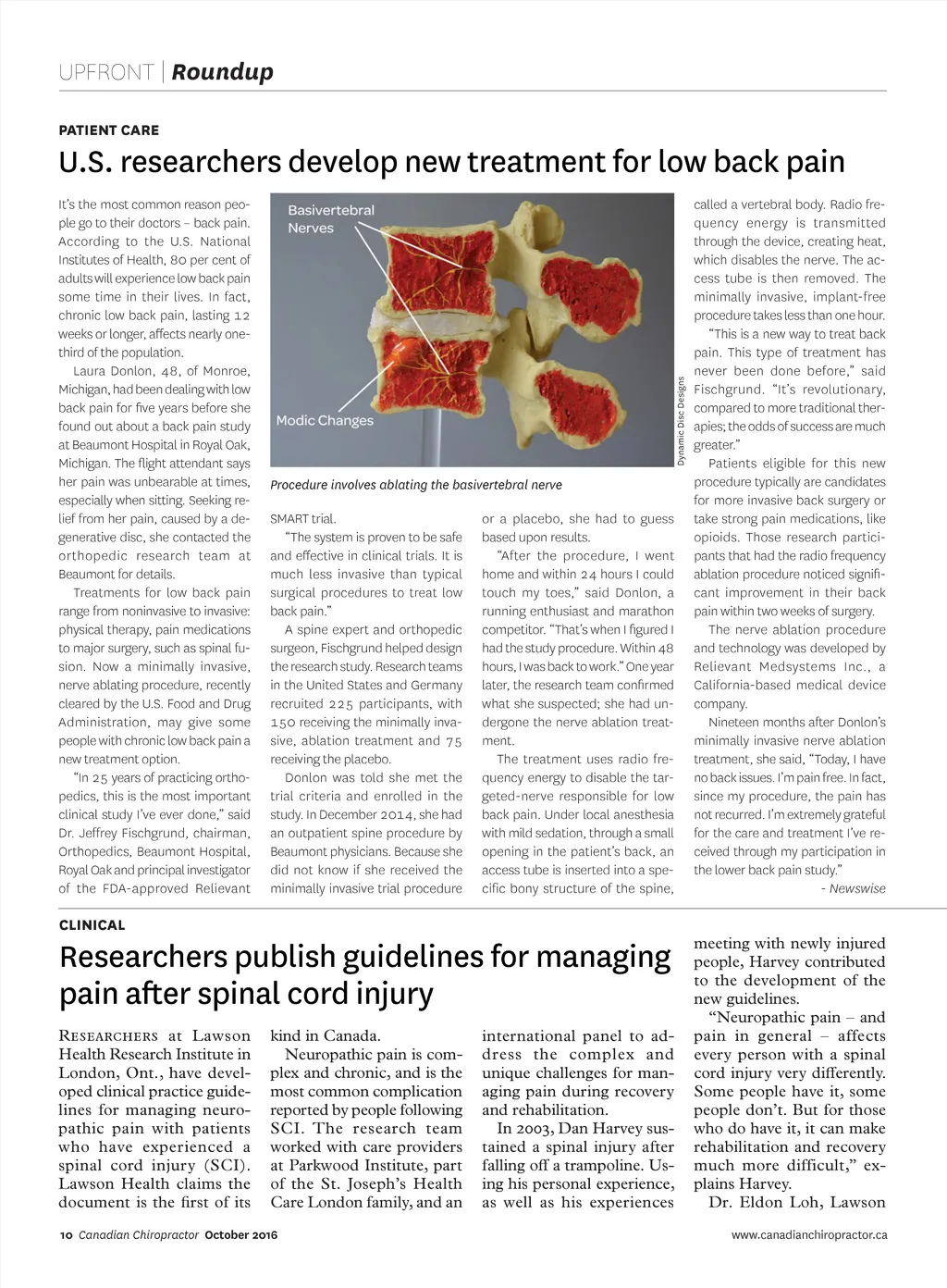
UPFRONT | Roundup PATIENT CARE U.S. researchers develop new treatment for low back pain It’s the most common reason peo-ple go to their doctors – back pain. According to the U.S. National Institutes of Health, 80 per cent of adults will experience low back pain some time in their lives. In fact, chronic low back pain, lasting 12 weeks or longer, affects nearly one-third of the population. Laura Donlon, 48, of Monroe, Michigan, had been dealing with low back pain for five years before she found out about a back pain study at Beaumont Hospital in Royal Oak, Michigan. The flight attendant says her pain was unbearable at times, especially when sitting. Seeking re-lief from her pain, caused by a de-generative disc, she contacted the orthopedic research team at Beaumont for details. Treatments for low back pain range from noninvasive to invasive: physical therapy, pain medications to major surgery, such as spinal fu-sion. Now a minimally invasive, nerve ablating procedure, recently cleared by the U.S. Food and Drug Administration, may give some people with chronic low back pain a new treatment option. “In 25 years of practicing ortho-pedics, this is the most important clinical study I’ve ever done,” said Dr. Jeffrey Fischgrund, chairman, Orthopedics, Beaumont Hospital, Royal Oak and principal investigator of the FDA-approved Relievant called a vertebral body. Radio fre-quency energy is transmitted through the device, creating heat, which disables the nerve. The ac-cess tube is then removed. The minimally invasive, implant-free procedure takes less than one hour. “This is a new way to treat back pain. This type of treatment has never been done before,” said Fischgrund. “It’s revolutionary, compared to more traditional ther-apies; the odds of success are much greater.” Patients eligible for this new procedure typically are candidates for more invasive back surgery or take strong pain medications, like opioids. Those research partici-pants that had the radio frequency ablation procedure noticed signifi-cant improvement in their back pain within two weeks of surgery. The nerve ablation procedure and technology was developed by Relievant Medsystems Inc., a California-based medical device company. Nineteen months after Donlon’s minimally invasive nerve ablation treatment, she said, “Today, I have no back issues. I’m pain free. In fact, since my procedure, the pain has not recurred. I’m extremely grateful for the care and treatment I’ve re-ceived through my participation in the lower back pain study.” -Newswise Procedure involves ablating the basivertebral nerve SMART trial. “The system is proven to be safe and effective in clinical trials. It is much less invasive than typical surgical procedures to treat low back pain.” A spine expert and orthopedic surgeon, Fischgrund helped design the research study. Research teams in the United States and Germany recruited 225 participants, with 150 receiving the minimally inva-sive, ablation treatment and 75 receiving the placebo. Donlon was told she met the trial criteria and enrolled in the study. In December 2014, she had an outpatient spine procedure by Beaumont physicians. Because she did not know if she received the minimally invasive trial procedure or a placebo, she had to guess based upon results. “After the procedure, I went home and within 24 hours I could touch my toes,” said Donlon, a running enthusiast and marathon competitor. “That’s when I figured I had the study procedure. Within 48 hours, I was back to work.” One year later, the research team confirmed what she suspected; she had un-dergone the nerve ablation treat-ment. The treatment uses radio fre-quency energy to disable the tar-geted-nerve responsible for low back pain. Under local anesthesia with mild sedation, through a small opening in the patient’s back, an access tube is inserted into a spe-cific bony structure of the spine, CLINICAL Dynamic Disc Designs Researchers publish guidelines for managing pain after spinal cord injury Researchers at Lawson Health Research Institute in London, Ont., have devel-oped clinical practice guide-lines for managing neuro-pathic pain with patients who have experienced a spinal cord injury (SCI). Lawson Health claims the document is the first of its kind in Canada. Neuropathic pain is com-plex and chronic, and is the most common complication reported by people following SCI. The research team worked with care providers at Parkwood Institute, part of the St. Joseph’s Health Care London family, and an international panel to ad-dress the complex and unique challenges for man-aging pain during recovery and rehabilitation. In 2003, Dan Harvey sus-tained a spinal injury after falling off a trampoline. Us-ing his personal experience, as well as his experiences meeting with newly injured people, Harvey contributed to the development of the new guidelines. “Neuropathic pain – and pain in general – affects every person with a spinal cord injury very differently. Some people have it, some people don’t. But for those who do have it, it can make rehabilitation and recovery much more difficult,” ex-plains Harvey. Dr. Eldon Loh, Lawson www.canadianchiropractor.ca 10 Canadian Chiropractor October 2016
Chiropractic + Naturopathic Doctor October 2016: Page 10