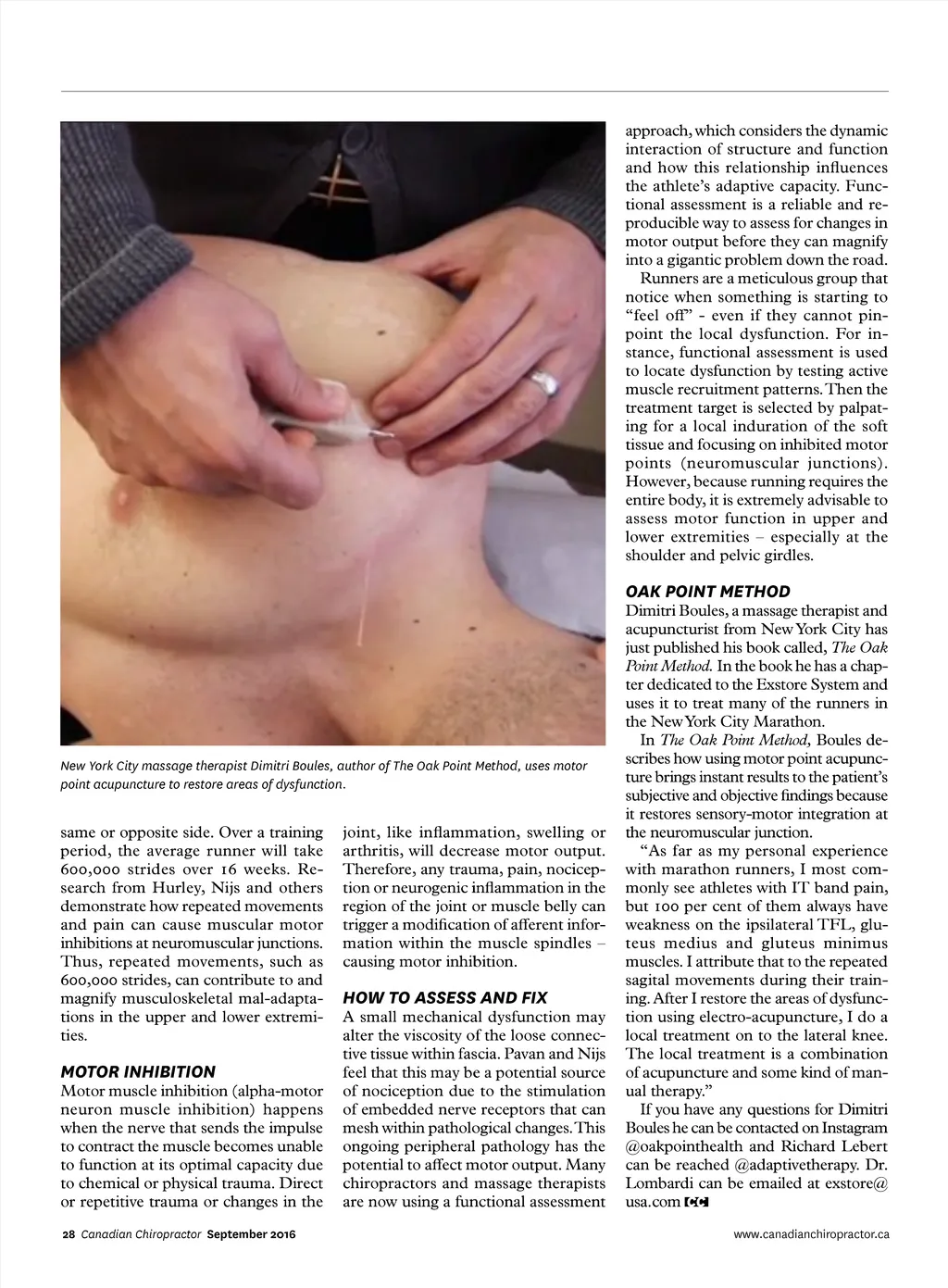
approach, which considers the dynamic interaction of structure and function and how this relationship influences the athlete’s adaptive capacity. Func-tional assessment is a reliable and re-producible way to assess for changes in motor output before they can magnify into a gigantic problem down the road. Runners are a meticulous group that notice when something is starting to “feel off” -even if they cannot pin-point the local dysfunction. For in-stance, functional assessment is used to locate dysfunction by testing active muscle recruitment patterns. Then the treatment target is selected by palpat-ing for a local induration of the soft tissue and focusing on inhibited motor points (neuromuscular junctions). However, because running requires the entire body, it is extremely advisable to assess motor function in upper and lower extremities – especially at the shoulder and pelvic girdles. OAK POINT METHOD New York City massage therapist Dimitri Boules, author of The Oak Point Method, uses motor point acupuncture to restore areas of dysfunction. same or opposite side. Over a training period, the average runner will take 600,000 strides over 16 weeks. Re-search from Hurley, Nijs and others demonstrate how repeated movements and pain can cause muscular motor inhibitions at neuromuscular junctions. Thus, repeated movements, such as 600,000 strides, can contribute to and magnify musculoskeletal mal-adapta-tions in the upper and lower extremi-ties. joint, like inflammation, swelling or arthritis, will decrease motor output. Therefore, any trauma, pain, nocicep-tion or neurogenic inflammation in the region of the joint or muscle belly can trigger a modification of afferent infor-mation within the muscle spindles – causing motor inhibition. HOW TO ASSESS AND FIX MOTOR INHIBITION Motor muscle inhibition (alpha-motor neuron muscle inhibition) happens when the nerve that sends the impulse to contract the muscle becomes unable to function at its optimal capacity due to chemical or physical trauma. Direct or repetitive trauma or changes in the 28 Canadian Chiropractor September 2016 A small mechanical dysfunction may alter the viscosity of the loose connec-tive tissue within fascia. Pavan and Nijs feel that this may be a potential source of nociception due to the stimulation of embedded nerve receptors that can mesh within pathological changes. This ongoing peripheral pathology has the potential to affect motor output. Many chiropractors and massage therapists are now using a functional assessment Dimitri Boules, a massage therapist and acupuncturist from New York City has just published his book called, The Oak Point Method. In the book he has a chap-ter dedicated to the Exstore System and uses it to treat many of the runners in the New York City Marathon. In The Oak Point Method, Boules de-scribes how using motor point acupunc-ture brings instant results to the patient’s subjective and objective findings because it restores sensory-motor integration at the neuromuscular junction. “As far as my personal experience with marathon runners, I most com-monly see athletes with IT band pain, but 100 per cent of them always have weakness on the ipsilateral TFL, glu-teus medius and gluteus minimus muscles. I attribute that to the repeated sagital movements during their train-ing. After I restore the areas of dysfunc-tion using electro-acupuncture, I do a local treatment on to the lateral knee. The local treatment is a combination of acupuncture and some kind of man-ual therapy.” If you have any questions for Dimitri Boules he can be contacted on Instagram @oakpointhealth and Richard Lebert can be reached @adaptivetherapy. Dr. Lombardi can be emailed at exstore@ usa.com www.canadianchiropractor.ca
Chiropractic + Naturopathic Doctor September 2016: Page 28