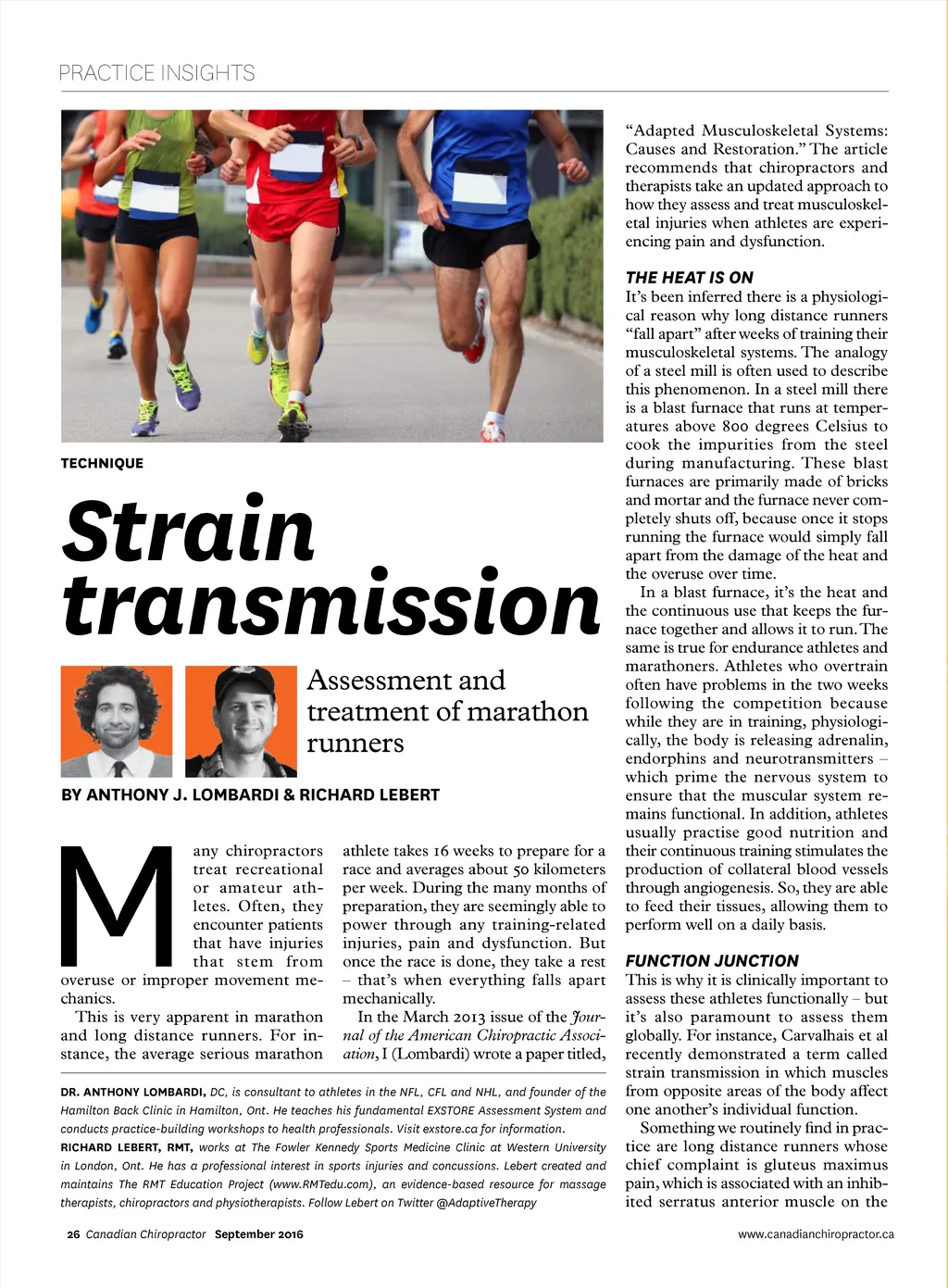
PRACTICE INSIGHTS “Adapted Musculoskeletal Systems: Causes and Restoration.” The article recommends that chiropractors and therapists take an updated approach to how they assess and treat musculoskel-etal injuries when athletes are experi-encing pain and dysfunction. THE HEAT IS ON TECHNIQUE Strain transmission Assessment and treatment of marathon runners M BY ANTHONY J. LOMBARDI & RICHARD LEBERT athlete takes 16 weeks to prepare for a race and averages about 50 kilometers per week. During the many months of preparation, they are seemingly able to power through any training-related injuries, pain and dysfunction. But once the race is done, they take a rest – that’s when everything falls apart mechanically. In the March 2013 issue of the Jour-nal of the American Chiropractic Associ-ation , I (Lombardi) wrote a paper titled, any chiropractors treat recreational or amateur ath-letes. Often, they encounter patients that have injuries that stem from overuse or improper movement me-chanics. This is very apparent in marathon and long distance runners. For in-stance, the average serious marathon It’s been inferred there is a physiologi-cal reason why long distance runners “fall apart” after weeks of training their musculoskeletal systems. The analogy of a steel mill is often used to describe this phenomenon. In a steel mill there is a blast furnace that runs at temper-atures above 800 degrees Celsius to cook the impurities from the steel during manufacturing. These blast furnaces are primarily made of bricks and mortar and the furnace never com-pletely shuts off, because once it stops running the furnace would simply fall apart from the damage of the heat and the overuse over time. In a blast furnace, it’s the heat and the continuous use that keeps the fur-nace together and allows it to run. The same is true for endurance athletes and marathoners. Athletes who overtrain often have problems in the two weeks following the competition because while they are in training, physiologi-cally, the body is releasing adrenalin, endorphins and neurotransmitters – which prime the nervous system to ensure that the muscular system re-mains functional. In addition, athletes usually practise good nutrition and their continuous training stimulates the production of collateral blood vessels through angiogenesis. So, they are able to feed their tissues, allowing them to perform well on a daily basis. This is why it is clinically important to assess these athletes functionally – but it’s also paramount to assess them globally. For instance, Carvalhais et al recently demonstrated a term called strain transmission in which muscles from opposite areas of the body affect one another’s individual function. Something we routinely find in prac-tice are long distance runners whose chief complaint is gluteus maximus pain, which is associated with an inhib-ited serratus anterior muscle on the www.canadianchiropractor.ca FUNCTION JUNCTION DR. ANTHONY LOMBARDI, DC, is consultant to athletes in the NFL, CFL and NHL, and founder of the Hamilton Back Clinic in Hamilton, Ont. He teaches his fundamental EXSTORE Assessment System and conducts practice-building workshops to health professionals. Visit exstore.ca for information. RICHARD LEBERT, RMT, works at The Fowler Kennedy Sports Medicine Clinic at Western University in London, Ont. He has a professional interest in sports injuries and concussions. Lebert created and maintains The RMT Education Project (www.RMTedu.com), an evidence-based resource for massage therapists, chiropractors and physiotherapists. Follow Lebert on Twitter @AdaptiveTherapy 26 Canadian Chiropractor September 2016
Chiropractic + Naturopathic Doctor September 2016: Page 26