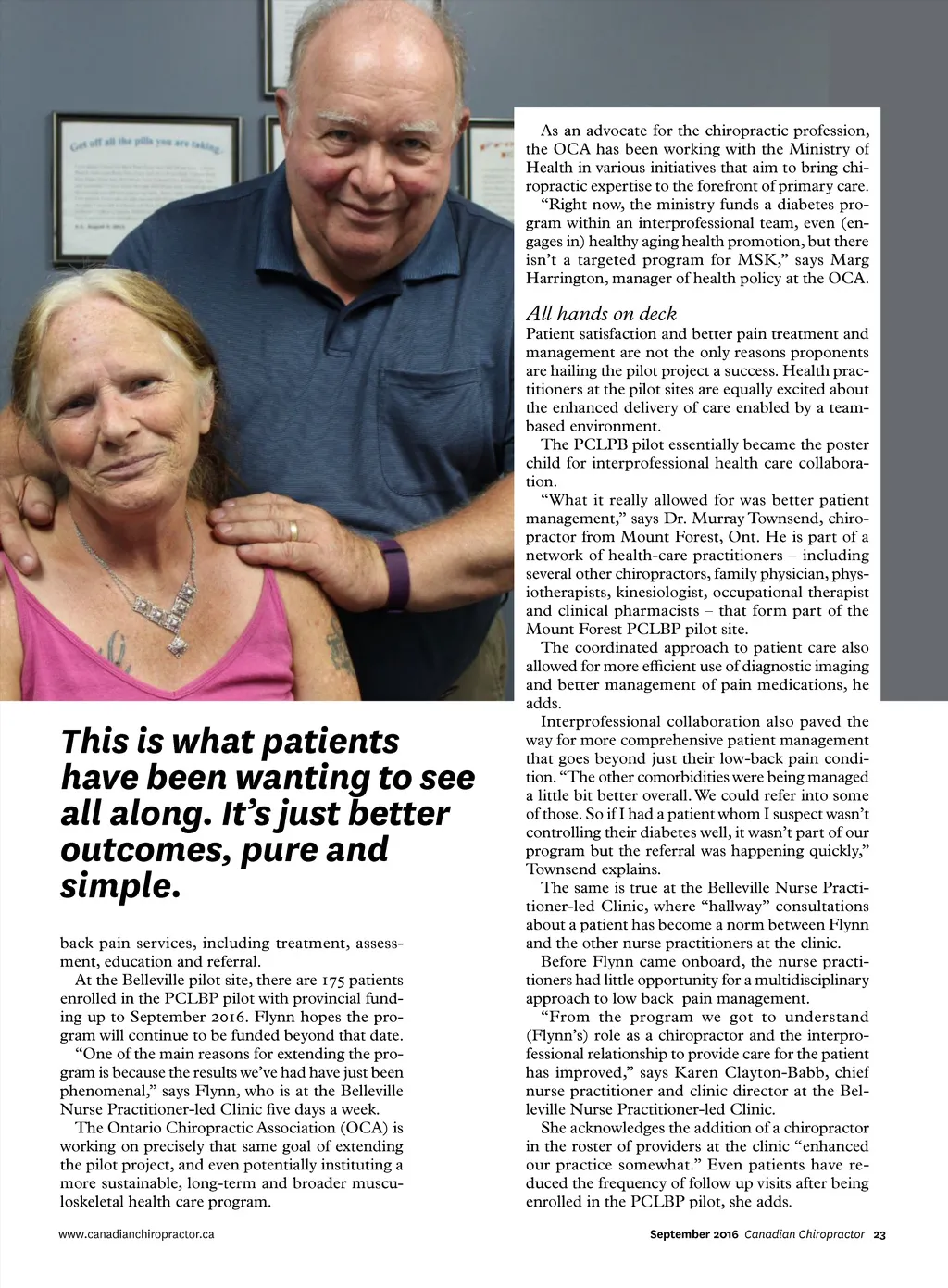
As an advocate for the chiropractic profession, the OCA has been working with the Ministry of Health in various initiatives that aim to bring chi-ropractic expertise to the forefront of primary care. “Right now, the ministry funds a diabetes pro-gram within an interprofessional team, even (en-gages in) healthy aging health promotion, but there isn’t a targeted program for MSK,” says Marg Harrington, manager of health policy at the OCA. Patient satisfaction and better pain treatment and management are not the only reasons proponents are hailing the pilot project a success. Health prac-titioners at the pilot sites are equally excited about the enhanced delivery of care enabled by a team-based environment. The PCLPB pilot essentially became the poster child for interprofessional health care collabora-tion. “What it really allowed for was better patient management,” says Dr. Murray Townsend, chiro-practor from Mount Forest, Ont. He is part of a network of health-care practitioners – including several other chiropractors, family physician, phys-iotherapists, kinesiologist, occupational therapist and clinical pharmacists – that form part of the Mount Forest PCLBP pilot site. The coordinated approach to patient care also allowed for more efficient use of diagnostic imaging and better management of pain medications, he adds. Interprofessional collaboration also paved the way for more comprehensive patient management that goes beyond just their low-back pain condi-tion. “The other comorbidities were being managed a little bit better overall. We could refer into some of those. So if I had a patient whom I suspect wasn’t controlling their diabetes well, it wasn’t part of our program but the referral was happening quickly,” Townsend explains. The same is true at the Belleville Nurse Practi-tioner-led Clinic, where “hallway” consultations about a patient has become a norm between Flynn and the other nurse practitioners at the clinic. Before Flynn came onboard, the nurse practi-tioners had little opportunity for a multidisciplinary approach to low back pain management. “From the program we got to understand (Flynn’s) role as a chiropractor and the interpro-fessional relationship to provide care for the patient has improved,” says Karen Clayton-Babb, chief nurse practitioner and clinic director at the Bel-leville Nurse Practitioner-led Clinic. She acknowledges the addition of a chiropractor in the roster of providers at the clinic “enhanced our practice somewhat.” Even patients have re-duced the frequency of follow up visits after being enrolled in the PCLBP pilot, she adds. September 2016 Canadian Chiropractor 23 All hands on deck This is what patients have been wanting to see all along. It’s just better outcomes, pure and simple. back pain services, including treatment, assess-ment, education and referral. At the Belleville pilot site, there are 175 patients enrolled in the PCLBP pilot with provincial fund-ing up to September 2016. Flynn hopes the pro-gram will continue to be funded beyond that date. “One of the main reasons for extending the pro-gram is because the results we’ve had have just been phenomenal,” says Flynn, who is at the Belleville Nurse Practitioner-led Clinic five days a week. The Ontario Chiropractic Association (OCA) is working on precisely that same goal of extending the pilot project, and even potentially instituting a more sustainable, long-term and broader muscu-loskeletal health care program. www.canadianchiropractor.ca
Chiropractic + Naturopathic Doctor September 2016: Page 23