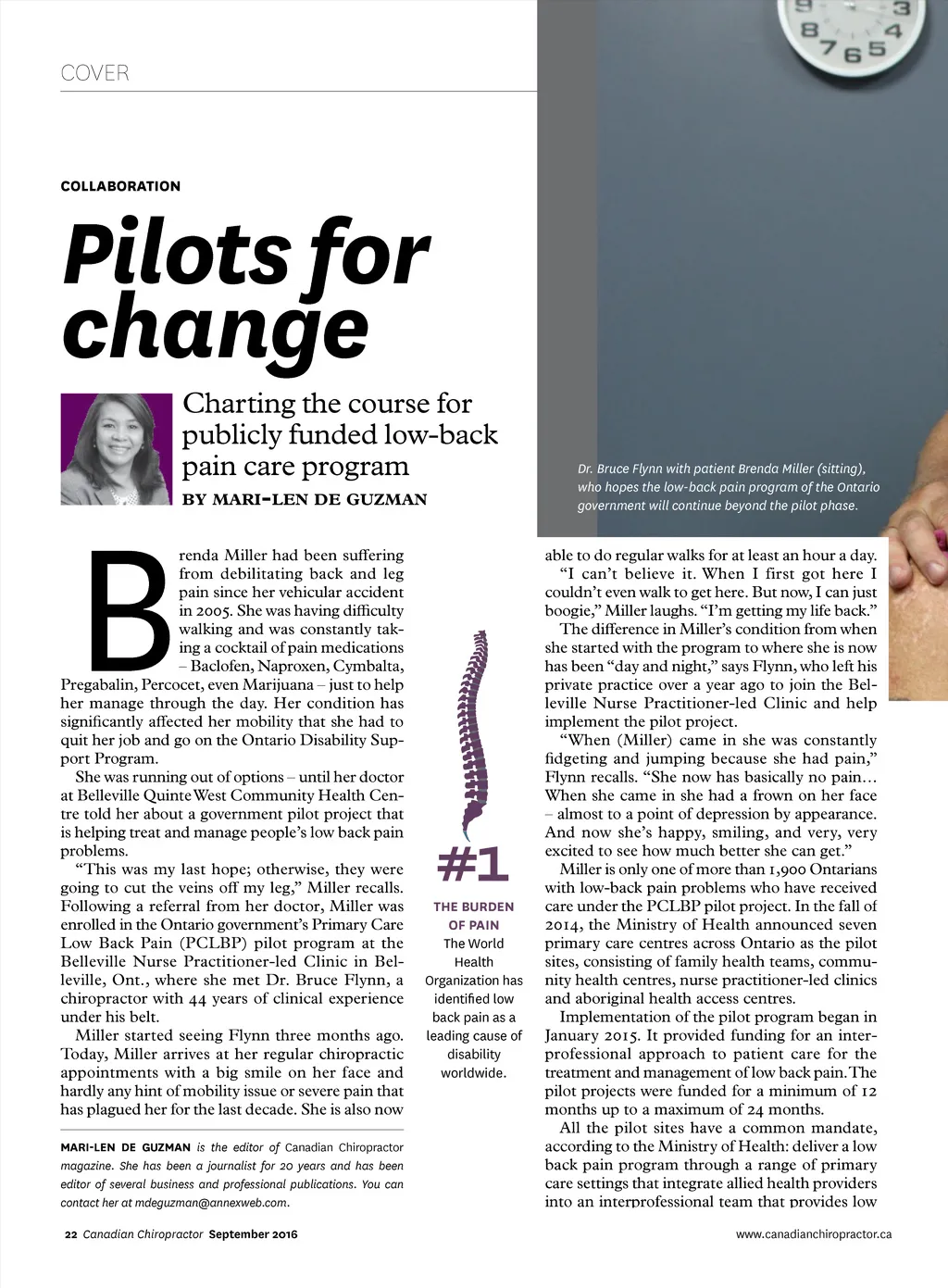
COVER COLLABORATION Pilots for change renda Miller had been suffering from debilitating back and leg pain since her vehicular accident in 2005. She was having difficulty walking and was constantly tak-ing a cocktail of pain medications – Baclofen, Naproxen, Cymbalta, Pregabalin, Percocet, even Marijuana – just to help her manage through the day. Her condition has significantly affected her mobility that she had to quit her job and go on the Ontario Disability Sup-port Program. She was running out of options – until her doctor at Belleville Quinte West Community Health Cen-tre told her about a government pilot project that is helping treat and manage people’s low back pain problems. “This was my last hope; otherwise, they were going to cut the veins off my leg,” Miller recalls. Following a referral from her doctor, Miller was enrolled in the Ontario government’s Primary Care Low Back Pain (PCLBP) pilot program at the Belleville Nurse Practitioner-led Clinic in Bel-leville, Ont., where she met Dr. Bruce Flynn, a chiropractor with 44 years of clinical experience under his belt. Miller started seeing Flynn three months ago. Today, Miller arrives at her regular chiropractic appointments with a big smile on her face and hardly any hint of mobility issue or severe pain that has plagued her for the last decade. She is also now MARI-LEN DE GUZMAN is the editor of Canadian Chiropractor magazine. She has been a journalist for 20 years and has been editor of several business and professional publications. You can contact her at [email protected]. 22 Canadian Chiropractor September 2016 B Charting the course for publicly funded low-back pain care program by mari -len de guzman Dr. Bruce Flynn with patient Brenda Miller (sitting), who hopes the low-back pain program of the Ontario government will continue beyond the pilot phase. THE BURDEN OF PAIN The World Health Organization has identified low back pain as a leading cause of disability worldwide. #1 able to do regular walks for at least an hour a day. “I can’t believe it. When I first got here I couldn’t even walk to get here. But now, I can just boogie,” Miller laughs. “I’m getting my life back.” The difference in Miller’s condition from when she started with the program to where she is now has been “day and night,” says Flynn, who left his private practice over a year ago to join the Bel-leville Nurse Practitioner-led Clinic and help implement the pilot project. “When (Miller) came in she was constantly fidgeting and jumping because she had pain,” Flynn recalls. “She now has basically no pain… When she came in she had a frown on her face – almost to a point of depression by appearance. And now she’s happy, smiling, and very, very excited to see how much better she can get.” Miller is only one of more than 1,900 Ontarians with low-back pain problems who have received care under the PCLBP pilot project. In the fall of 2014, the Ministry of Health announced seven primary care centres across Ontario as the pilot sites, consisting of family health teams, commu-nity health centres, nurse practitioner-led clinics and aboriginal health access centres. Implementation of the pilot program began in January 2015. It provided funding for an inter-professional approach to patient care for the treatment and management of low back pain. The pilot projects were funded for a minimum of 12 months up to a maximum of 24 months. All the pilot sites have a common mandate, according to the Ministry of Health: deliver a low back pain program through a range of primary care settings that integrate allied health providers into an interprofessional team that provides low www.canadianchiropractor.ca
Chiropractic + Naturopathic Doctor September 2016: Page 22