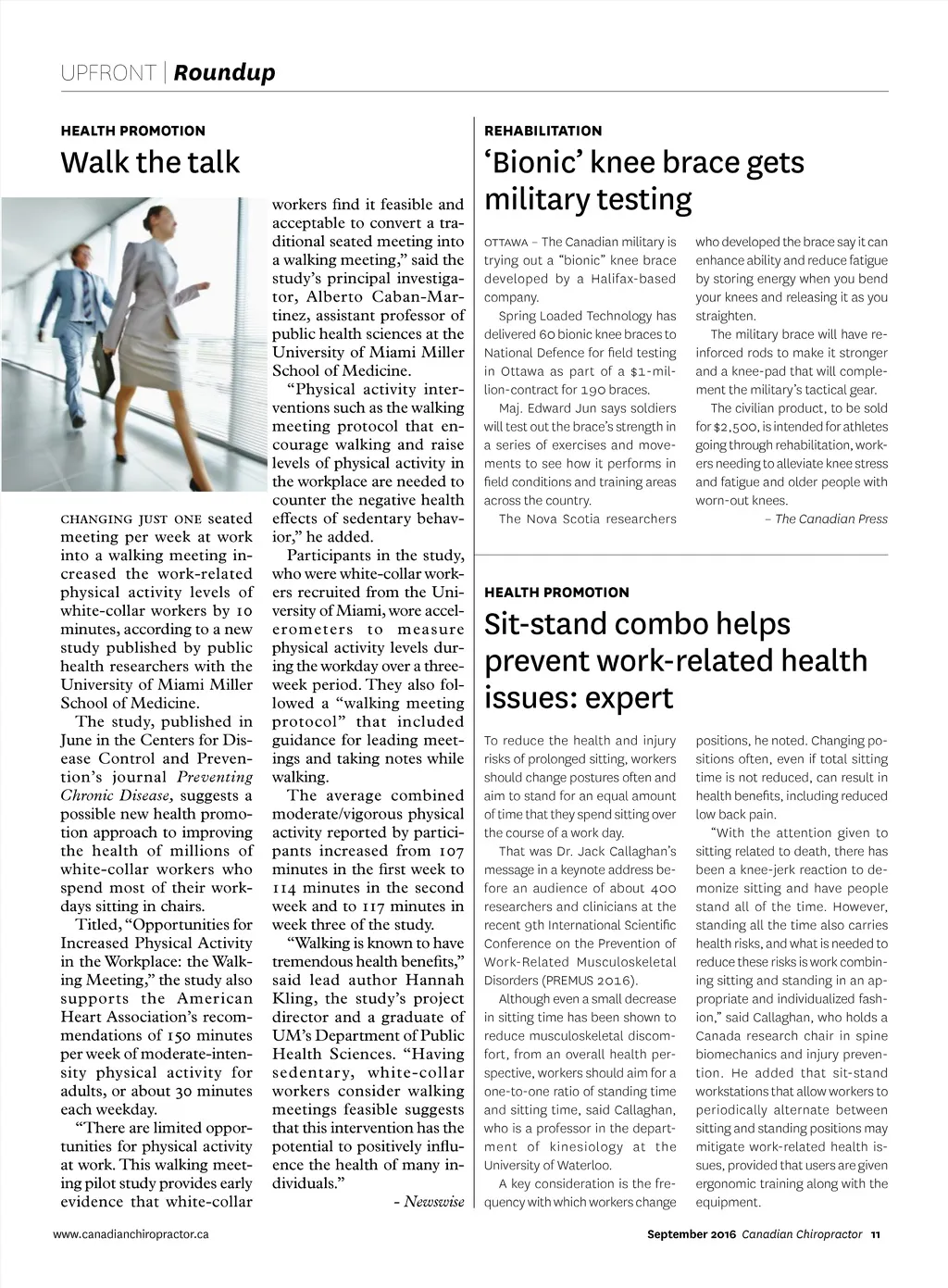
UPFRONT | Roundup HEALTH PROMOTION Walk the talk workers find it feasible and acceptable to convert a tra-ditional seated meeting into a walking meeting,” said the study’s principal investiga-tor, Alberto Caban-Mar-tinez, assistant professor of public health sciences at the University of Miami Miller School of Medicine. “Physical activity inter-ventions such as the walking meeting protocol that en-courage walking and raise levels of physical activity in the workplace are needed to counter the negative health effects of sedentary behav-ior,” he added. Participants in the study, who were white-collar work-ers recruited from the Uni-versity of Miami, wore accel-erometer s to measure physical activity levels dur-ing the workday over a three-week period. They also fol-lowed a “walking meeting protocol” that included guidance for leading meet-ings and taking notes while walking. The average combined moderate/vigorous physical activity reported by partici-pants increased from 107 minutes in the first week to 114 minutes in the second week and to 117 minutes in week three of the study. “Walking is known to have tremendous health benefits,” said lead author Hannah Kling, the study’s project director and a graduate of UM’s Department of Public Health Sciences. “Having sedentar y, white-collar workers consider walking meetings feasible suggests that this intervention has the potential to positively influ-ence the health of many in-dividuals.” -Newswise REHABILITATION ‘Bionic’ knee brace gets military testing ottawa – The Canadian military is trying out a “bionic” knee brace developed by a Halifax-based company. Spring Loaded Technology has delivered 60 bionic knee braces to National Defence for field testing in Ottawa as part of a $1-mil-lion-contract for 190 braces. Maj. Edward Jun says soldiers will test out the brace’s strength in a series of exercises and move-ments to see how it performs in field conditions and training areas across the country. The Nova Scotia researchers who developed the brace say it can enhance ability and reduce fatigue by storing energy when you bend your knees and releasing it as you straighten. The military brace will have re-inforced rods to make it stronger and a knee-pad that will comple-ment the military’s tactical gear. The civilian product, to be sold for $2,500, is intended for athletes going through rehabilitation, work-ers needing to alleviate knee stress and fatigue and older people with worn-out knees. – The Canadian Press changing just one seated meeting per week at work into a walking meeting in-creased the work-related physical activity levels of white-collar workers by 10 minutes, according to a new study published by public health researchers with the University of Miami Miller School of Medicine. The study, published in June in the Centers for Dis-ease Control and Preven-tion’s journal Preventing Chronic Disease, suggests a possible new health promo-tion approach to improving the health of millions of white-collar workers who spend most of their work-days sitting in chairs. Titled, “Opportunities for Increased Physical Activity in the Workplace: the Walk-ing Meeting,” the study also suppor ts the American Heart Association’s recom-mendations of 150 minutes per week of moderate-inten-sity physical activity for adults, or about 30 minutes each weekday. “There are limited oppor-tunities for physical activity at work. This walking meet-ing pilot study provides early evidence that white-collar www.canadianchiropractor.ca HEALTH PROMOTION Sit-stand combo helps prevent work-related health issues: expert To reduce the health and injury risks of prolonged sitting, workers should change postures often and aim to stand for an equal amount of time that they spend sitting over the course of a work day. That was Dr. Jack Callaghan’s message in a keynote address be-fore an audience of about 400 researchers and clinicians at the recent 9th International Scientific Conference on the Prevention of Work-Related Musculoskeletal Disorders (PREMUS 2016). Although even a small decrease in sitting time has been shown to reduce musculoskeletal discom-fort, from an overall health per-spective, workers should aim for a one-to-one ratio of standing time and sitting time, said Callaghan, who is a professor in the depart-ment of kinesiology at the University of Waterloo. A key consideration is the fre-quency with which workers change positions, he noted. Changing po-sitions often, even if total sitting time is not reduced, can result in health benefits, including reduced low back pain. “With the attention given to sitting related to death, there has been a knee-jerk reaction to de-monize sitting and have people stand all of the time. However, standing all the time also carries health risks, and what is needed to reduce these risks is work combin-ing sitting and standing in an ap-propriate and individualized fash-ion,” said Callaghan, who holds a Canada research chair in spine biomechanics and injury preven-tion. He added that sit-stand workstations that allow workers to periodically alternate between sitting and standing positions may mitigate work-related health is-sues, provided that users are given ergonomic training along with the equipment. September 2016 Canadian Chiropractor 11
Chiropractic + Naturopathic Doctor September 2016: Page 11