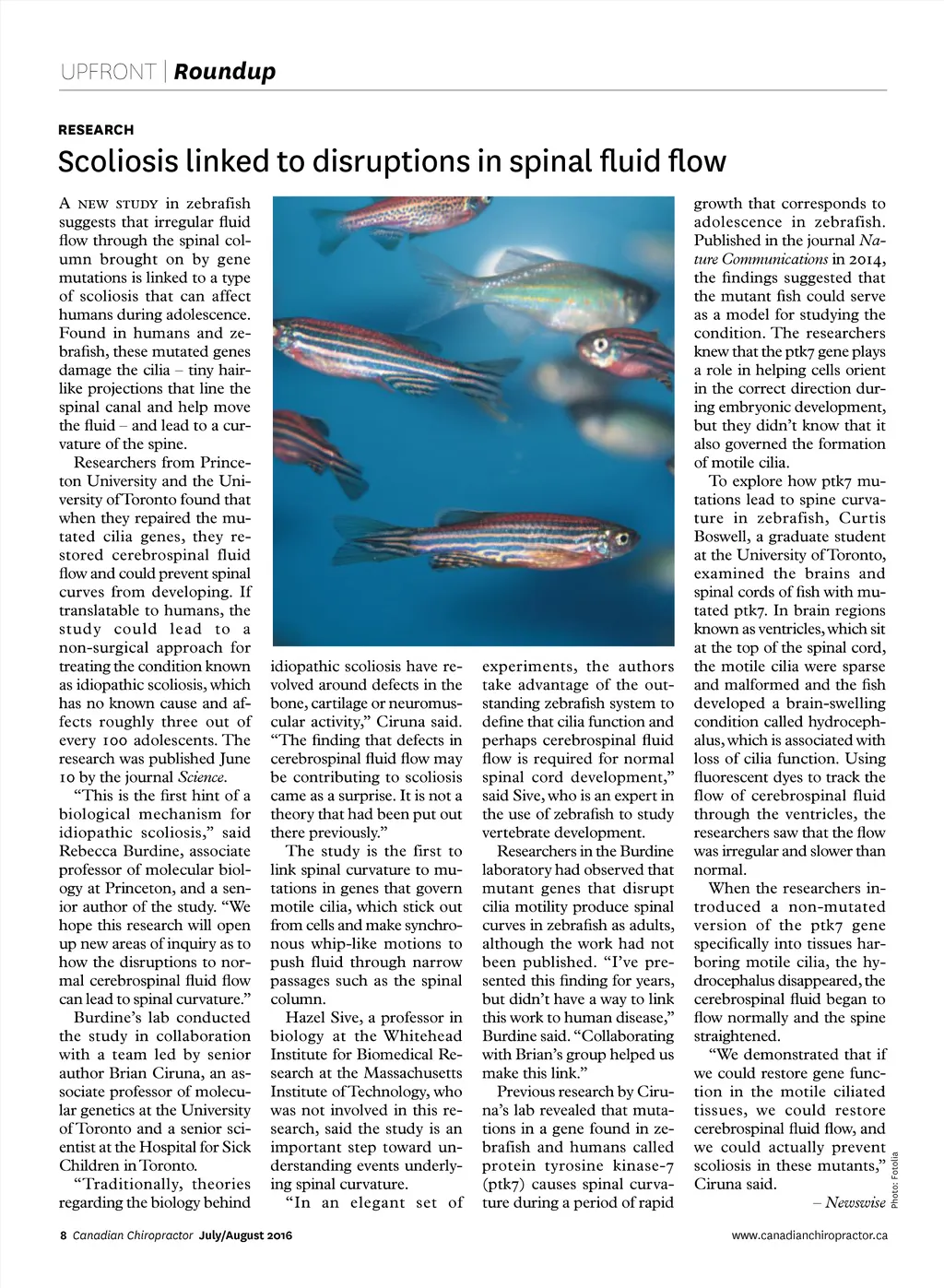
UPFRONT | Roundup RESEARCH Scoliosis linked to disruptions in spinal fluid flow A new study in zebrafish suggests that irregular fluid flow through the spinal col-umn brought on by gene mutations is linked to a type of scoliosis that can affect humans during adolescence. Found in humans and ze-brafish, these mutated genes damage the cilia – tiny hair-like projections that line the spinal canal and help move the fluid – and lead to a cur-vature of the spine. Researchers from Prince-ton University and the Uni-versity of Toronto found that when they repaired the mu-tated cilia genes, they re-stored cerebrospinal fluid flow and could prevent spinal curves from developing. If translatable to humans, the study could lead to a non-surgical approach for treating the condition known as idiopathic scoliosis, which has no known cause and af-fects roughly three out of every 100 adolescents. The research was published June 10 by the journal Science. “This is the first hint of a biological mechanism for idiopathic scoliosis,” said Rebecca Burdine, associate professor of molecular biol-ogy at Princeton, and a sen-ior author of the study. “We hope this research will open up new areas of inquiry as to how the disruptions to nor-mal cerebrospinal fluid flow can lead to spinal curvature.” Burdine’s lab conducted the study in collaboration with a team led by senior author Brian Ciruna, an as-sociate professor of molecu-lar genetics at the University of Toronto and a senior sci-entist at the Hospital for Sick Children in Toronto. “Traditionally, theories regarding the biology behind growth that corresponds to adolescence in zebrafish. Published in the journal Na-ture Communications in 2014, the findings suggested that the mutant fish could serve as a model for studying the condition. The researchers knew that the ptk7 gene plays a role in helping cells orient in the correct direction dur-ing embryonic development, but they didn’t know that it also governed the formation of motile cilia. To explore how ptk7 mu-tations lead to spine curva-ture in zebrafish, Curtis Boswell, a graduate student at the University of Toronto, examined the brains and spinal cords of fish with mu-tated ptk7. In brain regions known as ventricles, which sit at the top of the spinal cord, the motile cilia were sparse and malformed and the fish developed a brain-swelling condition called hydroceph-alus, which is associated with loss of cilia function. Using fluorescent dyes to track the flow of cerebrospinal fluid through the ventricles, the researchers saw that the flow was irregular and slower than normal. When the researchers in-troduced a non-mutated version of the ptk7 gene specifically into tissues har-boring motile cilia, the hy-drocephalus disappeared, the cerebrospinal fluid began to flow normally and the spine straightened. “We demonstrated that if we could restore gene func-tion in the motile ciliated tissues, we could restore cerebrospinal fluid flow, and we could actually prevent scoliosis in these mutants,” Ciruna said. – Newswise www.canadianchiropractor.ca idiopathic scoliosis have re-volved around defects in the bone, cartilage or neuromus-cular activity,” Ciruna said. “The finding that defects in cerebrospinal fluid flow may be contributing to scoliosis came as a surprise. It is not a theory that had been put out there previously.” The study is the first to link spinal curvature to mu-tations in genes that govern motile cilia, which stick out from cells and make synchro-nous whip-like motions to push fluid through narrow passages such as the spinal column. Hazel Sive, a professor in biology at the Whitehead Institute for Biomedical Re-search at the Massachusetts Institute of Technology, who was not involved in this re-search, said the study is an important step toward un-derstanding events underly-ing spinal curvature. “In an elegant set of experiments, the authors take advantage of the out-standing zebrafish system to define that cilia function and perhaps cerebrospinal fluid flow is required for normal spinal cord development,” said Sive, who is an expert in the use of zebrafish to study vertebrate development. Researchers in the Burdine laboratory had observed that mutant genes that disrupt cilia motility produce spinal curves in zebrafish as adults, although the work had not been published. “I’ve pre-sented this finding for years, but didn’t have a way to link this work to human disease,” Burdine said. “Collaborating with Brian’s group helped us make this link.” Previous research by Ciru-na’s lab revealed that muta-tions in a gene found in ze-brafish and humans called protein tyrosine kinase-7 (ptk7) causes spinal curva-ture during a period of rapid 8 Canadian Chiropractor July/August 2016 Photo: Fotolia
Chiropractic + Naturopathic Doctor July August 2016: Page 8