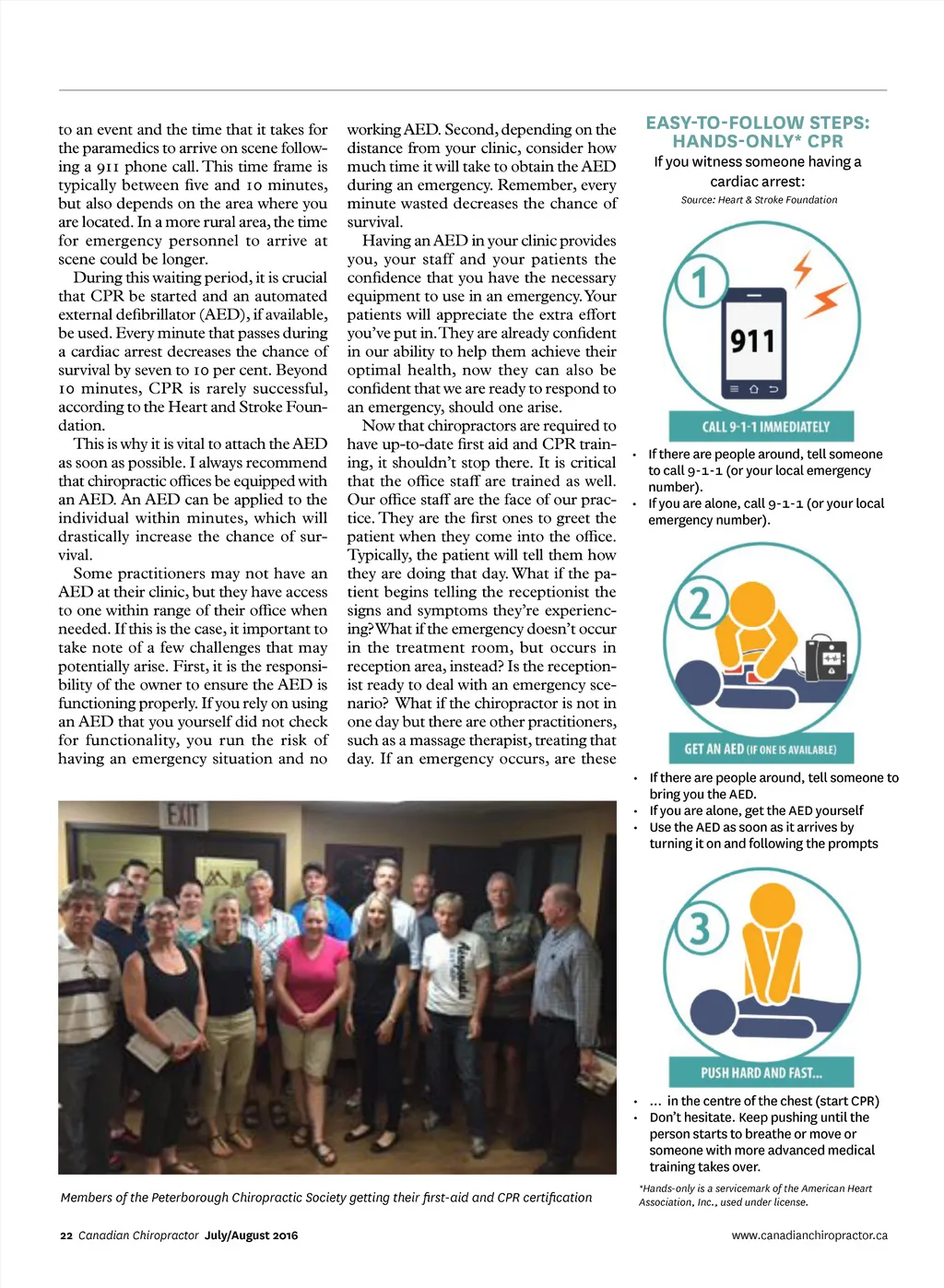
to an event and the time that it takes for the paramedics to arrive on scene follow-ing a 911 phone call. This time frame is typically between five and 10 minutes, but also depends on the area where you are located. In a more rural area, the time for emergency personnel to arrive at scene could be longer. During this waiting period, it is crucial that CPR be started and an automated external defibrillator (AED), if available, be used. Every minute that passes during a cardiac arrest decreases the chance of survival by seven to 10 per cent. Beyond 10 minutes, CPR is rarely successful, according to the Heart and Stroke Foun-dation. This is why it is vital to attach the AED as soon as possible. I always recommend that chiropractic offices be equipped with an AED. An AED can be applied to the individual within minutes, which will drastically increase the chance of sur-vival. Some practitioners may not have an AED at their clinic, but they have access to one within range of their office when needed. If this is the case, it important to take note of a few challenges that may potentially arise. First, it is the responsi-bility of the owner to ensure the AED is functioning properly. If you rely on using an AED that you yourself did not check for functionality, you run the risk of having an emergency situation and no EASY-TO-FOLLOW STEPS: working AED. Second, depending on the HANDS-ONLY* CPR distance from your clinic, consider how If you witness someone having a much time it will take to obtain the AED cardiac arrest: during an emergency. Remember, every Source: Heart & Stroke Foundation minute wasted decreases the chance of survival. Having an AED in your clinic provides you, your staff and your patients the confidence that you have the necessary equipment to use in an emergency. Your patients will appreciate the extra effort you’ve put in. They are already confident in our ability to help them achieve their optimal health, now they can also be confident that we are ready to respond to an emergency, should one arise. Now that chiropractors are required to have up-to-date first aid and CPR train-• If there are people around, tell someone ing, it shouldn’t stop there. It is critical to call 9-1-1 (or your local emergency that the office staff are trained as well. number). Our office staff are the face of our prac-• If you are alone, call 9-1-1 (or your local tice. They are the first ones to greet the emergency number). patient when they come into the office. Typically, the patient will tell them how they are doing that day. What if the pa-tient begins telling the receptionist the signs and symptoms they’re experienc-ing? What if the emergency doesn’t occur in the treatment room, but occurs in reception area, instead? Is the reception-ist ready to deal with an emergency sce-nario? What if the chiropractor is not in one day but there are other practitioners, such as a massage therapist, treating that day. If an emergency occurs, are these • If there are people around, tell someone to bring you the AED. • If you are alone, get the AED yourself • Use the AED as soon as it arrives by turning it on and following the prompts • ... in the centre of the chest (start CPR) • Don’t hesitate. Keep pushing until the person starts to breathe or move or someone with more advanced medical training takes over. Members of the Peterborough Chiropractic Society getting their first-aid and CPR certification 22 Canadian Chiropractor July/August 2016 *Hands-only is a servicemark of the American Heart Association, Inc., used under license. www.canadianchiropractor.ca
Chiropractic + Naturopathic Doctor July August 2016: Page 22