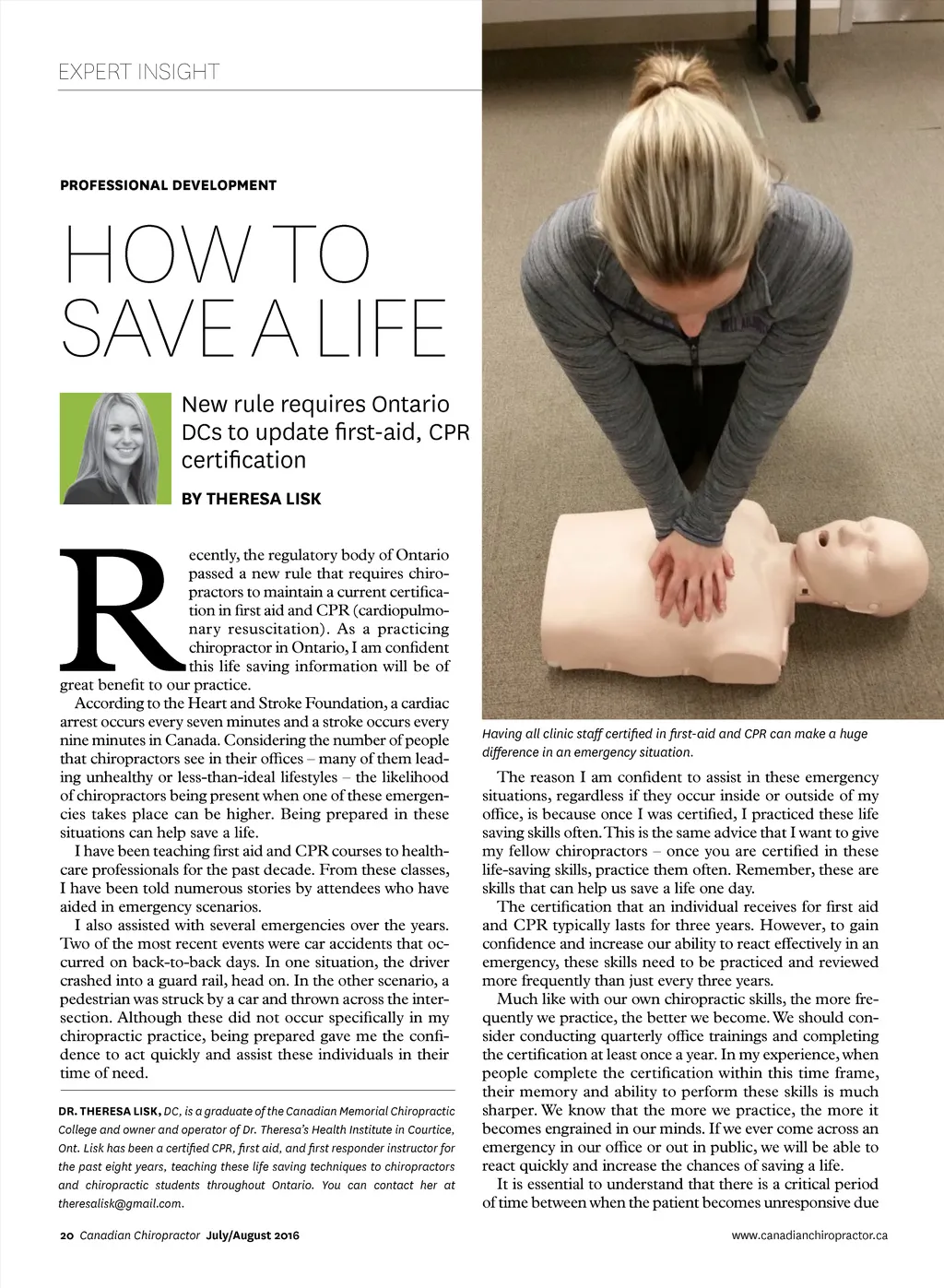
EXPERT INSIGHT PROFESSIONAL DEVELOPMENT HOW TO SAVE A LIFE New rule requires Ontario DCs to update first-aid, CPR certification R BY THERESA LISK ecently, the regulatory body of Ontario passed a new rule that requires chiro-practors to maintain a current certifica-tion in first aid and CPR (cardiopulmo-nary resuscitation). As a practicing chiropractor in Ontario, I am confident this life saving information will be of great benefit to our practice. According to the Heart and Stroke Foundation, a cardiac arrest occurs every seven minutes and a stroke occurs every nine minutes in Canada. Considering the number of people that chiropractors see in their offices – many of them lead-ing unhealthy or less-than-ideal lifestyles – the likelihood of chiropractors being present when one of these emergen-cies takes place can be higher. Being prepared in these situations can help save a life. I have been teaching first aid and CPR courses to health-care professionals for the past decade. From these classes, I have been told numerous stories by attendees who have aided in emergency scenarios. I also assisted with several emergencies over the years. Two of the most recent events were car accidents that oc-curred on back-to-back days. In one situation, the driver crashed into a guard rail, head on. In the other scenario, a pedestrian was struck by a car and thrown across the inter-section. Although these did not occur specifically in my chiropractic practice, being prepared gave me the confi-dence to act quickly and assist these individuals in their time of need. Having all clinic staff certified in first-aid and CPR can make a huge difference in an emergency situation. DR. THERESA LISK, DC, is a graduate of the Canadian Memorial Chiropractic College and owner and operator of Dr. Theresa’s Health Institute in Courtice, Ont. Lisk has been a certified CPR, first aid, and first responder instructor for the past eight years, teaching these life saving techniques to chiropractors and chiropractic students throughout Ontario. You can contact her at [email protected]. 20 Canadian Chiropractor July/August 2016 The reason I am confident to assist in these emergency situations, regardless if they occur inside or outside of my office, is because once I was certified, I practiced these life saving skills often. This is the same advice that I want to give my fellow chiropractors – once you are certified in these life-saving skills, practice them often. Remember, these are skills that can help us save a life one day. The certification that an individual receives for first aid and CPR typically lasts for three years. However, to gain confidence and increase our ability to react effectively in an emergency, these skills need to be practiced and reviewed more frequently than just every three years. Much like with our own chiropractic skills, the more fre-quently we practice, the better we become. We should con-sider conducting quarterly office trainings and completing the certification at least once a year. In my experience, when people complete the certification within this time frame, their memory and ability to perform these skills is much sharper. We know that the more we practice, the more it becomes engrained in our minds. If we ever come across an emergency in our office or out in public, we will be able to react quickly and increase the chances of saving a life. It is essential to understand that there is a critical period of time between when the patient becomes unresponsive due www.canadianchiropractor.ca
Chiropractic + Naturopathic Doctor July August 2016: Page 20