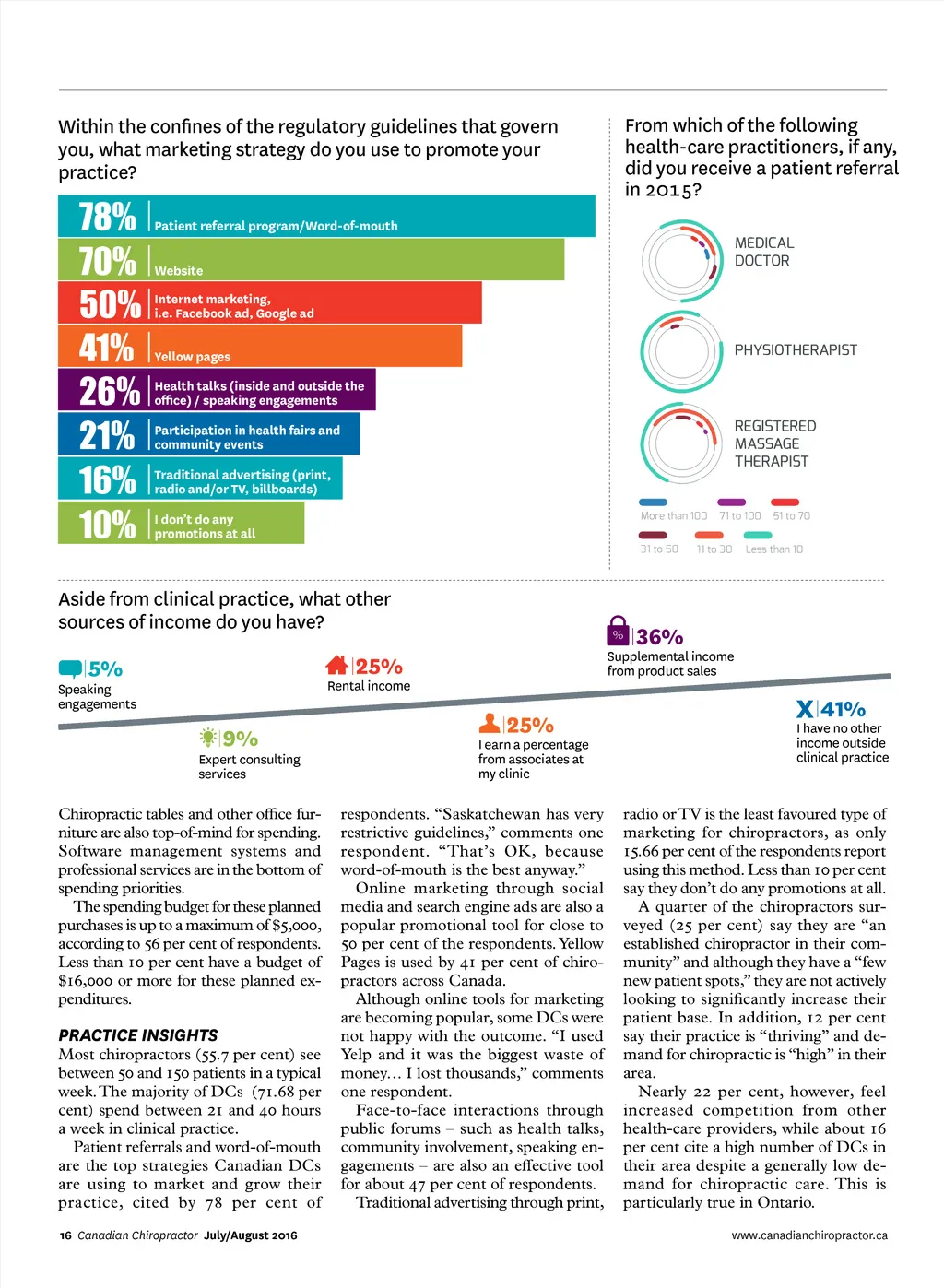
Within the confines of the regulatory guidelines that govern you, what marketing strategy do you use to promote your practice? 78% 70% 50% 41% 26% 21% 16% 10% From which of the following health-care practitioners, if any, did you receive a patient referral in 2015? MEDICAL DOCTOR Patient referral program/Word-of-mouth Website Internet marketing, i.e. Facebook ad, Google ad Yellow pages Health talks (inside and outside the office) / speaking engagements Participation in health fairs and community events Traditional advertising (print, radio and/or TV, billboards) I don’t do any promotions at all More than 100 31 to 50 PHYSIOTHERAPIST REGISTERED MASSAGE THERAPIST 71 to 100 51 to 70 11 to 30 Less than 10 Aside from clinical practice, what other sources of income do you have? Speaking engagements 5% Rental income 25% Supplemental income from product sales 36% Expert consulting services 9% I earn a percentage from associates at my clinic 25% I have no other income outside clinical practice 41% Chiropractic tables and other office fur-niture are also top-of-mind for spending. Software management systems and professional services are in the bottom of spending priorities. The spending budget for these planned purchases is up to a maximum of $5,000, according to 56 per cent of respondents. Less than 10 per cent have a budget of $16,000 or more for these planned ex-penditures. PRACTICE INSIGHTS Most chiropractors (55.7 per cent) see between 50 and 150 patients in a typical week. The majority of DCs (71.68 per cent) spend between 21 and 40 hours a week in clinical practice. Patient referrals and word-of-mouth are the top strategies Canadian DCs are using to market and grow their practice, cited by 78 per cent of 16 Canadian Chiropractor July/August 2016 respondents. “Saskatchewan has very restrictive guidelines,” comments one respondent. “That’s OK, because word-of-mouth is the best anyway.” Online marketing through social media and search engine ads are also a popular promotional tool for close to 50 per cent of the respondents. Yellow Pages is used by 41 per cent of chiro-practors across Canada. Although online tools for marketing are becoming popular, some DCs were not happy with the outcome. “I used Yelp and it was the biggest waste of money… I lost thousands,” comments one respondent. Face-to-face interactions through public forums – such as health talks, community involvement, speaking en-gagements – are also an effective tool for about 47 per cent of respondents. Traditional advertising through print, radio or TV is the least favoured type of marketing for chiropractors, as only 15.66 per cent of the respondents report using this method. Less than 10 per cent say they don’t do any promotions at all. A quarter of the chiropractors sur-veyed (25 per cent) say they are “an established chiropractor in their com-munity” and although they have a “few new patient spots,” they are not actively looking to significantly increase their patient base. In addition, 12 per cent say their practice is “thriving” and de-mand for chiropractic is “high” in their area. Nearly 22 per cent, however, feel increased competition from other health-care providers, while about 16 per cent cite a high number of DCs in their area despite a generally low de-mand for chiropractic care. This is particularly true in Ontario. www.canadianchiropractor.ca
Chiropractic + Naturopathic Doctor July August 2016: Page 16