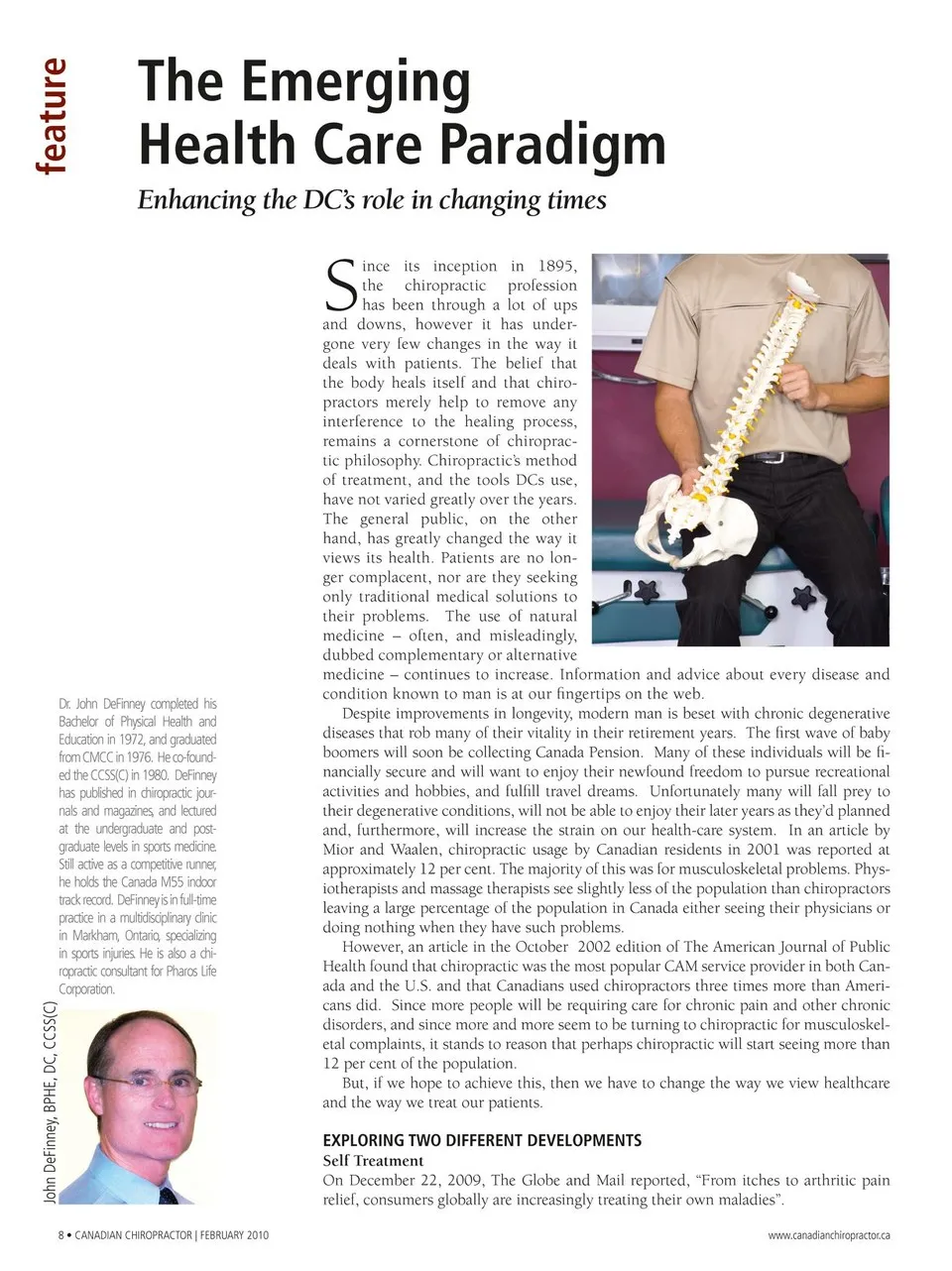
The Emerging Health Care Paradigm Enhancing the DC’s role in changing times S ince its inception in 1895, the chiropractic profession has been through a lot of ups Dr. John DeFinney completed his Bachelor of Physical Health and Education in 1972, and graduated from CMCC in 1976. He co-found- ed the CCSS(C) in 1980. DeFinney has published in chiropractic jour- nals and magazines, and lectured at the undergraduate and post- graduate levels in sports medicine. Still active as a competitive runner, he holds the Canada M55 indoor track record. DeFinney is in full-time practice in a multidisciplinary clinic in Markham, Ontario, specializing in sports injuries. He is also a chi- ropractic consultant for Pharos Life Corporation. and downs, however it has under- gone very few changes in the way it deals with patients. The belief that the body heals itself and that chiro- practors merely help to remove any interference to the healing process, remains a cornerstone of chiroprac- tic philosophy. Chiropractic’s method of treatment, and the tools DCs use, have not varied greatly over the years. The general public, on the other hand, has greatly changed the way it views its health. Patients are no lon- ger complacent, nor are they seeking only traditional medical solutions to their problems. The use of natural medicine – often, and misleadingly, dubbed complementary or alternative medicine – continues to increase. Information and advice about every disease and condition known to man is at our fingertips on the web. Despite improvements in longevity, modern man is beset with chronic degenerative diseases that rob many of their vitality in their retirement years. The first wave of baby boomers will soon be collecting Canada Pension. Many of these individuals will be fi- nancially secure and will want to enjoy their newfound freedom to pursue recreational activities and hobbies, and fulfill travel dreams. Unfortunately many will fall prey to their degenerative conditions, will not be able to enjoy their later years as they’d planned and, furthermore, will increase the strain on our health-care system. In an article by Mior and Waalen, chiropractic usage by Canadian residents in 2001 was reported at approximately 12 per cent. The majority of this was for musculoskeletal problems. Phys- iotherapists and massage therapists see slightly less of the population than chiropractors leaving a large percentage of the population in Canada either seeing their physicians or doing nothing when they have such problems. However, an article in the October 2002 edition of The American Journal of Public Health found that chiropractic was the most popular CAM service provider in both Can- ada and the U.S. and that Canadians used chiropractors three times more than Ameri- cans did. Since more people will be requiring care for chronic pain and other chronic disorders, and since more and more seem to be turning to chiropractic for musculoskel- etal complaints, it stands to reason that perhaps chiropractic will start seeing more than 12 per cent of the population. But, if we hope to achieve this, then we have to change the way we view healthcare and the way we treat our patients. ExPloring Two diffErEnT dEvEloPmEnTs Self Treatment On December 22, 2009, The Globe and Mail reported, “From itches to arthritic pain relief, consumers globally are increasingly treating their own maladies”. 8 • CANADIAN CHIROPRACTOR | FEBRUARY 2010 www.canadianchiropractor.ca John DeFinney, BPHE, DC, CCSS(C) feature
Chiropractic + Naturopathic Doctor February 2010: Page 8