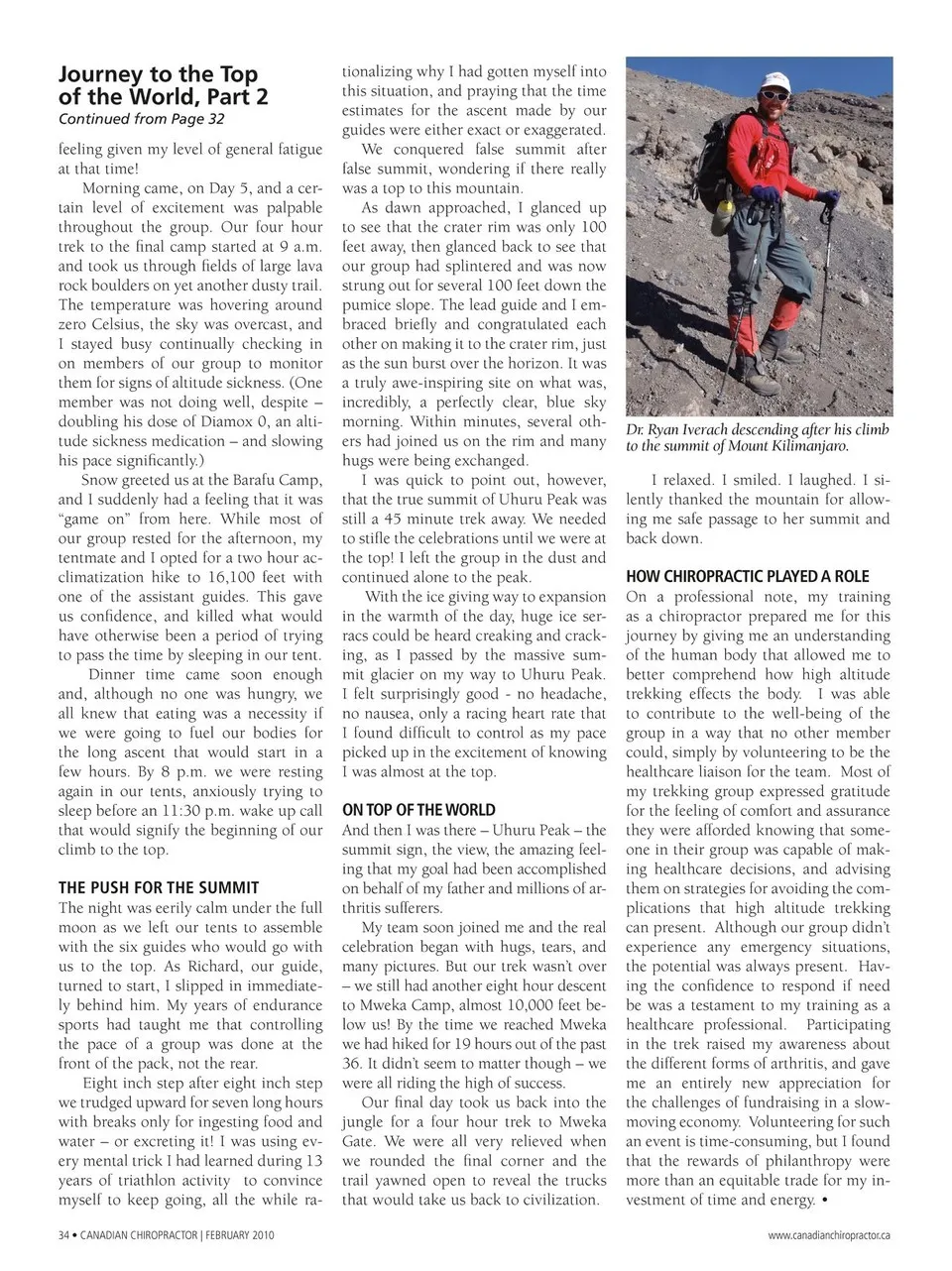
Journey to the Top of the World, Part 2 Continued from Page 32 feeling given my level of general fatigue at that time! Morning came, on Day 5, and a cer- tain level of excitement was palpable throughout the group. Our four hour trek to the final camp started at 9 a.m. and took us through fields of large lava rock boulders on yet another dusty trail. The temperature was hovering around zero Celsius, the sky was overcast, and I stayed busy continually checking in on members of our group to monitor them for signs of altitude sickness. (One member was not doing well, despite – doubling his dose of Diamox 0, an alti- tude sickness medication – and slowing his pace significantly.) Snow greeted us at the Barafu Camp, and I suddenly had a feeling that it was “game on” from here. While most of our group rested for the afternoon, my tentmate and I opted for a two hour ac- climatization hike to 16,100 feet with one of the assistant guides. This gave us confidence, and killed what would have otherwise been a period of trying to pass the time by sleeping in our tent. Dinner time came soon enough and, although no one was hungry, we all knew that eating was a necessity if we were going to fuel our bodies for the long ascent that would start in a few hours. By 8 p.m. we were resting again in our tents, anxiously trying to sleep before an 11:30 p.m. wake up call that would signify the beginning of our climb to the top. THE PUsH for THE sUmmiT The night was eerily calm under the full moon as we left our tents to assemble with the six guides who would go with us to the top. As Richard, our guide, turned to start, I slipped in immediate- ly behind him. My years of endurance sports had taught me that controlling the pace of a group was done at the front of the pack, not the rear. Eight inch step after eight inch step we trudged upward for seven long hours with breaks only for ingesting food and water – or excreting it! I was using ev- ery mental trick I had learned during 13 years of triathlon activity to convince myself to keep going, all the while ra- 34 • CANADIAN CHIROPRACTOR | FEBRUARY 2010 tionalizing why I had gotten myself into this situation, and praying that the time estimates for the ascent made by our guides were either exact or exaggerated. We conquered false summit after false summit, wondering if there really was a top to this mountain. As dawn approached, I glanced up to see that the crater rim was only 100 feet away, then glanced back to see that our group had splintered and was now strung out for several 100 feet down the pumice slope. The lead guide and I em- braced briefly and congratulated each other on making it to the crater rim, just as the sun burst over the horizon. It was a truly awe-inspiring site on what was, incredibly, a perfectly clear, blue sky morning. Within minutes, several oth- ers had joined us on the rim and many hugs were being exchanged. I was quick to point out, however, that the true summit of Uhuru Peak was still a 45 minute trek away. We needed to stifle the celebrations until we were at the top! I left the group in the dust and continued alone to the peak. With the ice giving way to expansion in the warmth of the day, huge ice ser- racs could be heard creaking and crack- ing, as I passed by the massive sum- mit glacier on my way to Uhuru Peak. I felt surprisingly good - no headache, no nausea, only a racing heart rate that I found difficult to control as my pace picked up in the excitement of knowing I was almost at the top. on ToP of THE world And then I was there – Uhuru Peak – the summit sign, the view, the amazing feel- ing that my goal had been accomplished on behalf of my father and millions of ar- thritis sufferers. My team soon joined me and the real celebration began with hugs, tears, and many pictures. But our trek wasn’t over – we still had another eight hour descent to Mweka Camp, almost 10,000 feet be- low us! By the time we reached Mweka we had hiked for 19 hours out of the past 36. It didn’t seem to matter though – we were all riding the high of success. Our final day took us back into the jungle for a four hour trek to Mweka Gate. We were all very relieved when we rounded the final corner and the trail yawned open to reveal the trucks that would take us back to civilization. Dr. Ryan Iverach descending after his climb to the summit of Mount Kilimanjaro. I relaxed. I smiled. I laughed. I si- lently thanked the mountain for allow- ing me safe passage to her summit and back down. How CHiroPraCTiC PlayEd a rolE On a professional note, my training as a chiropractor prepared me for this journey by giving me an understanding of the human body that allowed me to better comprehend how high altitude trekking effects the body. I was able to contribute to the well-being of the group in a way that no other member could, simply by volunteering to be the healthcare liaison for the team. Most of my trekking group expressed gratitude for the feeling of comfort and assurance they were afforded knowing that some- one in their group was capable of mak- ing healthcare decisions, and advising them on strategies for avoiding the com- plications that high altitude trekking can present. Although our group didn’t experience any emergency situations, the potential was always present. Hav- ing the confidence to respond if need be was a testament to my training as a healthcare professional. Participating in the trek raised my awareness about the different forms of arthritis, and gave me an entirely new appreciation for the challenges of fundraising in a slow- moving economy. Volunteering for such an event is time-consuming, but I found that the rewards of philanthropy were more than an equitable trade for my in- vestment of time and energy. • www.canadianchiropractor.ca
Chiropractic + Naturopathic Doctor February 2010: Page 34