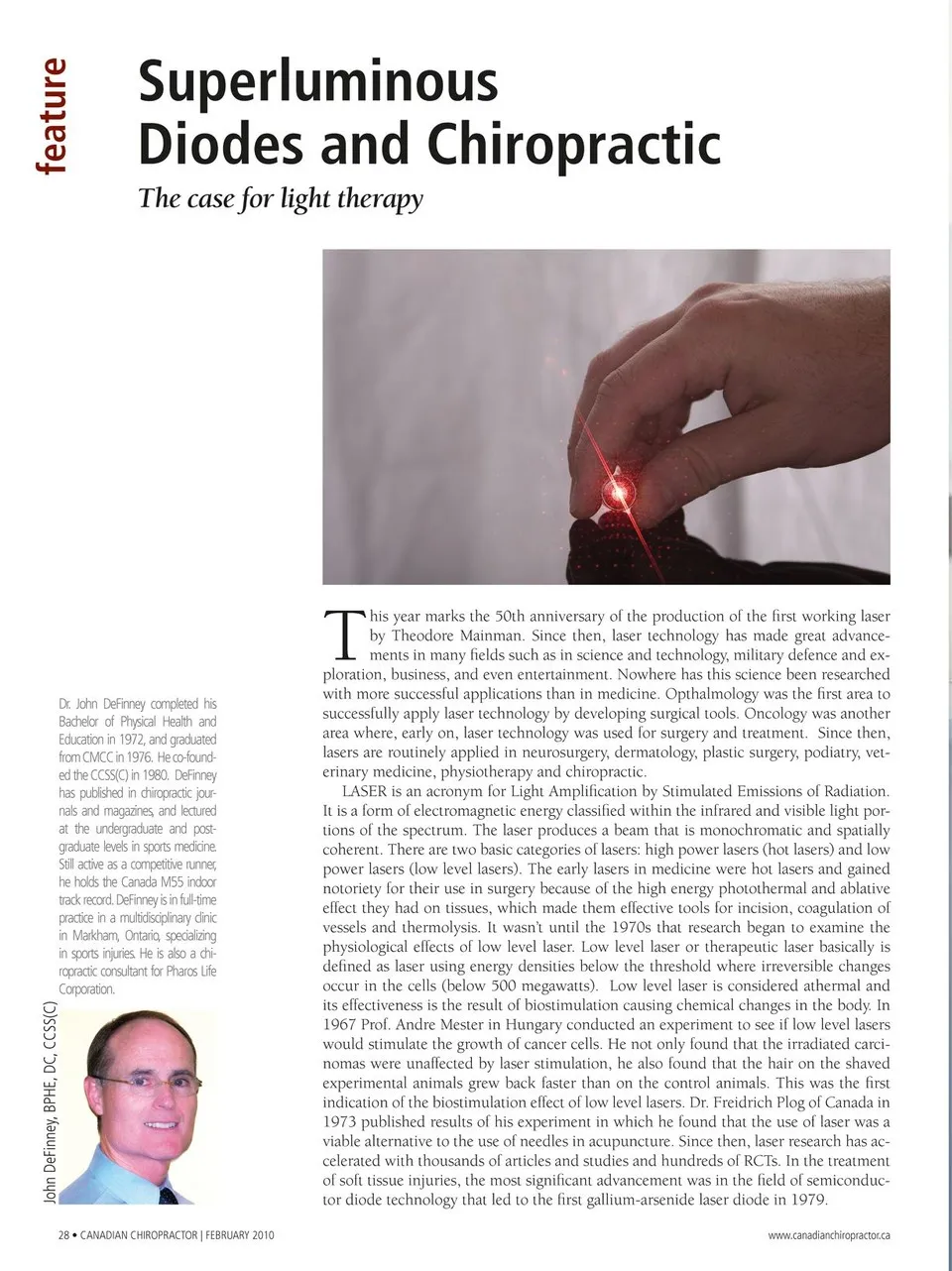
superluminous diodes and Chiropractic The case for light therapy Dr. John DeFinney completed his Bachelor of Physical Health and Education in 1972, and graduated from CMCC in 1976. He co-found- ed the CCSS(C) in 1980. DeFinney has published in chiropractic jour- nals and magazines, and lectured at the undergraduate and post- graduate levels in sports medicine. Still active as a competitive runner, he holds the Canada M55 indoor track record. DeFinney is in full-time practice in a multidisciplinary clinic in Markham, Ontario, specializing in sports injuries. He is also a chi- ropractic consultant for Pharos Life Corporation. ploration, business, and even entertainment. Nowhere has this science been researched with more successful applications than in medicine. Opthalmology was the first area to successfully apply laser technology by developing surgical tools. Oncology was another area where, early on, laser technology was used for surgery and treatment. Since then, lasers are routinely applied in neurosurgery, dermatology, plastic surgery, podiatry, vet- erinary medicine, physiotherapy and chiropractic. LASER is an acronym for Light Amplification by Stimulated Emissions of Radiation. T It is a form of electromagnetic energy classified within the infrared and visible light por- tions of the spectrum. The laser produces a beam that is monochromatic and spatially coherent. There are two basic categories of lasers: high power lasers (hot lasers) and low power lasers (low level lasers). The early lasers in medicine were hot lasers and gained notoriety for their use in surgery because of the high energy photothermal and ablative effect they had on tissues, which made them effective tools for incision, coagulation of vessels and thermolysis. It wasn’t until the 1970s that research began to examine the physiological effects of low level laser. Low level laser or therapeutic laser basically is defined as laser using energy densities below the threshold where irreversible changes occur in the cells (below 500 megawatts). Low level laser is considered athermal and its effectiveness is the result of biostimulation causing chemical changes in the body. In 1967 Prof. Andre Mester in Hungary conducted an experiment to see if low level lasers would stimulate the growth of cancer cells. He not only found that the irradiated carci- nomas were unaffected by laser stimulation, he also found that the hair on the shaved experimental animals grew back faster than on the control animals. This was the first indication of the biostimulation effect of low level lasers. Dr. Freidrich Plog of Canada in 1973 published results of his experiment in which he found that the use of laser was a viable alternative to the use of needles in acupuncture. Since then, laser research has ac- celerated with thousands of articles and studies and hundreds of RCTs. In the treatment of soft tissue injuries, the most significant advancement was in the field of semiconduc- tor diode technology that led to the first gallium-arsenide laser diode in 1979. 28 • CANADIAN CHIROPRACTOR | FEBRUARY 2010 www.canadianchiropractor.ca his year marks the 50th anniversary of the production of the first working laser by Theodore Mainman. Since then, laser technology has made great advance- ments in many fields such as in science and technology, military defence and ex- John DeFinney, BPHE, DC, CCSS(C) feature
Chiropractic + Naturopathic Doctor February 2010: Page 28