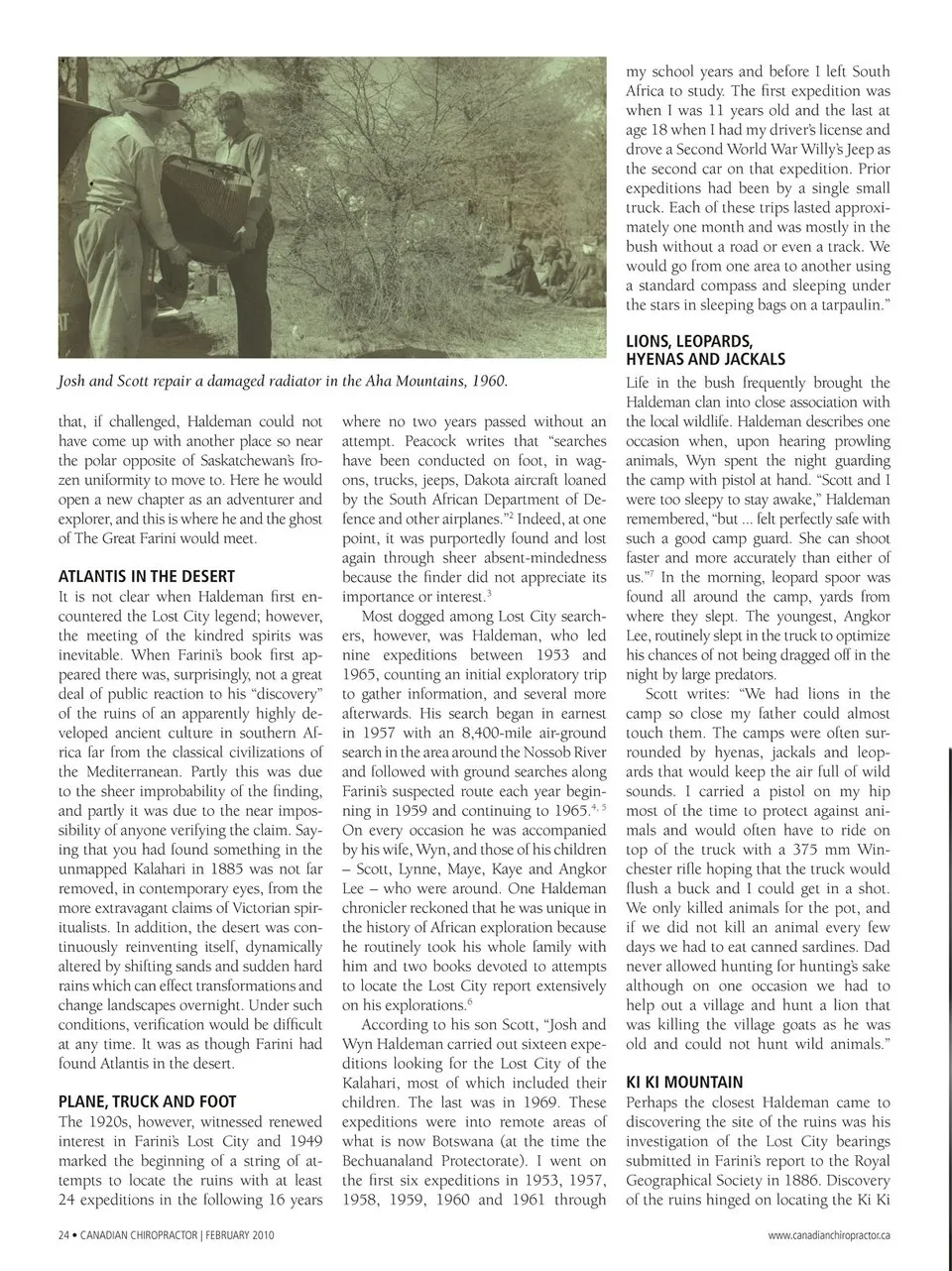
my school years and before I left South Africa to study. The first expedition was when I was 11 years old and the last at age 18 when I had my driver’s license and drove a Second World War Willy’s Jeep as the second car on that expedition. Prior expeditions had been by a single small truck. Each of these trips lasted approxi- mately one month and was mostly in the bush without a road or even a track. We would go from one area to another using a standard compass and sleeping under the stars in sleeping bags on a tarpaulin.” lions, lEoPards, HyEnas and JaCKals Josh and Scott repair a damaged radiator in the Aha Mountains, 1960. that, if challenged, Haldeman could not have come up with another place so near the polar opposite of Saskatchewan’s fro- zen uniformity to move to. Here he would open a new chapter as an adventurer and explorer, and this is where he and the ghost of The Great Farini would meet. aTlanTis in THE dEsErT It is not clear when Haldeman first en- countered the Lost City legend; however, the meeting of the kindred spirits was inevitable. When Farini’s book first ap- peared there was, surprisingly, not a great deal of public reaction to his “discovery” of the ruins of an apparently highly de- veloped ancient culture in southern Af- rica far from the classical civilizations of the Mediterranean. Partly this was due to the sheer improbability of the finding, and partly it was due to the near impos- sibility of anyone verifying the claim. Say- ing that you had found something in the unmapped Kalahari in 1885 was not far removed, in contemporary eyes, from the more extravagant claims of Victorian spir- itualists. In addition, the desert was con- tinuously reinventing itself, dynamically altered by shifting sands and sudden hard rains which can effect transformations and change landscapes overnight. Under such conditions, verification would be difficult at any time. It was as though Farini had found Atlantis in the desert. PlanE, TrUCK and fooT The 1920s, however, witnessed renewed interest in Farini’s Lost City and 1949 marked the beginning of a string of at- tempts to locate the ruins with at least 24 expeditions in the following 16 years 24 • CANADIAN CHIROPRACTOR | FEBRUARY 2010 where no two years passed without an attempt. Peacock writes that “searches have been conducted on foot, in wag- ons, trucks, jeeps, Dakota aircraft loaned by the South African Department of De- fence and other airplanes.”2 Indeed, at one point, it was purportedly found and lost again through sheer absent-mindedness because the finder did not appreciate its importance or interest.3 Most dogged among Lost City search- ers, however, was Haldeman, who led nine expeditions between 1953 and 1965, counting an initial exploratory trip to gather information, and several more afterwards. His search began in earnest in 1957 with an 8,400-mile air-ground search in the area around the Nossob River and followed with ground searches along Farini’s suspected route each year begin- ning in 1959 and continuing to 1965.4, 5 On every occasion he was accompanied by his wife, Wyn, and those of his children – Scott, Lynne, Maye, Kaye and Angkor Lee – who were around. One Haldeman chronicler reckoned that he was unique in the history of African exploration because he routinely took his whole family with him and two books devoted to attempts to locate the Lost City report extensively on his explorations.6 According to his son Scott, “Josh and Wyn Haldeman carried out sixteen expe- ditions looking for the Lost City of the Kalahari, most of which included their children. The last was in 1969. These expeditions were into remote areas of what is now Botswana (at the time the Bechuanaland Protectorate). I went on the first six expeditions in 1953, 1957, 1958, 1959, 1960 and 1961 through Life in the bush frequently brought the Haldeman clan into close association with the local wildlife. Haldeman describes one occasion when, upon hearing prowling animals, Wyn spent the night guarding the camp with pistol at hand. “Scott and I were too sleepy to stay awake,” Haldeman remembered, “but ... felt perfectly safe with such a good camp guard. She can shoot faster and more accurately than either of us.”7 In the morning, leopard spoor was found all around the camp, yards from where they slept. The youngest, Angkor Lee, routinely slept in the truck to optimize his chances of not being dragged off in the night by large predators. Scott writes: “We had lions in the camp so close my father could almost touch them. The camps were often sur- rounded by hyenas, jackals and leop- ards that would keep the air full of wild sounds. I carried a pistol on my hip most of the time to protect against ani- mals and would often have to ride on top of the truck with a 375 mm Win- chester rifle hoping that the truck would flush a buck and I could get in a shot. We only killed animals for the pot, and if we did not kill an animal every few days we had to eat canned sardines. Dad never allowed hunting for hunting’s sake although on one occasion we had to help out a village and hunt a lion that was killing the village goats as he was old and could not hunt wild animals.” Ki Ki moUnTain Perhaps the closest Haldeman came to discovering the site of the ruins was his investigation of the Lost City bearings submitted in Farini’s report to the Royal Geographical Society in 1886. Discovery of the ruins hinged on locating the Ki Ki www.canadianchiropractor.ca
Chiropractic + Naturopathic Doctor February 2010: Page 24