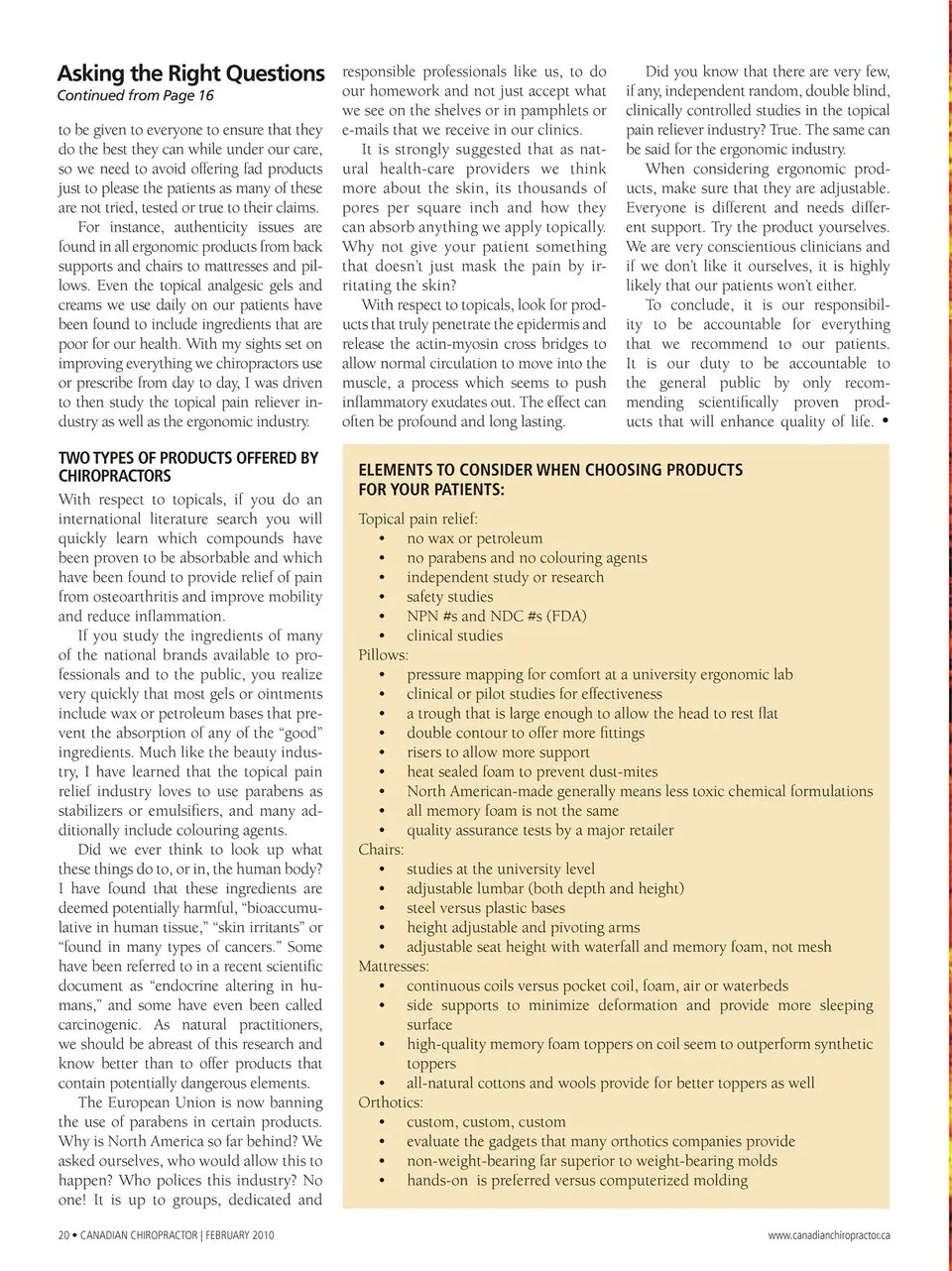
Asking the Right Questions Continued from Page 16 to be given to everyone to ensure that they do the best they can while under our care, so we need to avoid offering fad products just to please the patients as many of these are not tried, tested or true to their claims. For instance, authenticity issues are found in all ergonomic products from back supports and chairs to mattresses and pil- lows. Even the topical analgesic gels and creams we use daily on our patients have been found to include ingredients that are poor for our health. With my sights set on improving everything we chiropractors use or prescribe from day to day, I was driven to then study the topical pain reliever in- dustry as well as the ergonomic industry. Two TyPEs of ProdUCTs offErEd By CHiroPraCTors With respect to topicals, if you do an international literature search you will quickly learn which compounds have been proven to be absorbable and which have been found to provide relief of pain from osteoarthritis and improve mobility and reduce inflammation. If you study the ingredients of many of the national brands available to pro- fessionals and to the public, you realize very quickly that most gels or ointments include wax or petroleum bases that pre- vent the absorption of any of the “good” ingredients. Much like the beauty indus- try, I have learned that the topical pain relief industry loves to use parabens as stabilizers or emulsifiers, and many ad- ditionally include colouring agents. Did we ever think to look up what these things do to, or in, the human body? I have found that these ingredients are deemed potentially harmful, “bioaccumu- lative in human tissue,” “skin irritants” or “found in many types of cancers.” Some have been referred to in a recent scientific document as “endocrine altering in hu- mans,” and some have even been called carcinogenic. As natural practitioners, we should be abreast of this research and know better than to offer products that contain potentially dangerous elements. The European Union is now banning the use of parabens in certain products. Why is North America so far behind? We asked ourselves, who would allow this to happen? Who polices this industry? No one! It is up to groups, dedicated and 20 • CANADIAN CHIROPRACTOR | FEBRUARY 2010 responsible professionals like us, to do our homework and not just accept what we see on the shelves or in pamphlets or e-mails that we receive in our clinics. It is strongly suggested that as nat- ural health-care providers we think more about the skin, its thousands of pores per square inch and how they can absorb anything we apply topically. Why not give your patient something that doesn’t just mask the pain by ir- ritating the skin? With respect to topicals, look for prod- ucts that truly penetrate the epidermis and release the actin-myosin cross bridges to allow normal circulation to move into the muscle, a process which seems to push inflammatory exudates out. The effect can often be profound and long lasting. Did you know that there are very few, if any, independent random, double blind, clinically controlled studies in the topical pain reliever industry? True. The same can be said for the ergonomic industry. When considering ergonomic prod- ucts, make sure that they are adjustable. Everyone is different and needs differ- ent support. Try the product yourselves. We are very conscientious clinicians and if we don’t like it ourselves, it is highly likely that our patients won’t either. To conclude, it is our responsibil- ity to be accountable for everything that we recommend to our patients. It is our duty to be accountable to the general public by only recom- mending scientifically proven prod- ucts that will enhance quality of life. • ElEmEnTs To ConsidEr wHEn CHoosing ProdUCTs for yoUr PaTiEnTs: Topical pain relief: • no wax or petroleum • no parabens and no colouring agents • independent study or research • safety studies • NPN #s and NDC #s (FDA) • clinical studies Pillows: • pressure mapping for comfort at a university ergonomic lab • clinical or pilot studies for effectiveness • a trough that is large enough to allow the head to rest flat • double contour to offer more fittings • risers to allow more support • heat sealed foam to prevent dust-mites • North American-made generally means less toxic chemical formulations • all memory foam is not the same • quality assurance tests by a major retailer Chairs: • studies at the university level • adjustable lumbar (both depth and height) • steel versus plastic bases • height adjustable and pivoting arms • adjustable seat height with waterfall and memory foam, not mesh Mattresses: • continuous coils versus pocket coil, foam, air or waterbeds • side supports to minimize deformation and provide more sleeping surface • high-quality memory foam toppers on coil seem to outperform synthetic toppers • all-natural cottons and wools provide for better toppers as well Orthotics: • custom, custom, custom • evaluate the gadgets that many orthotics companies provide • non-weight-bearing far superior to weight-bearing molds • hands-on is preferred versus computerized molding www.canadianchiropractor.ca
Chiropractic + Naturopathic Doctor February 2010: Page 20