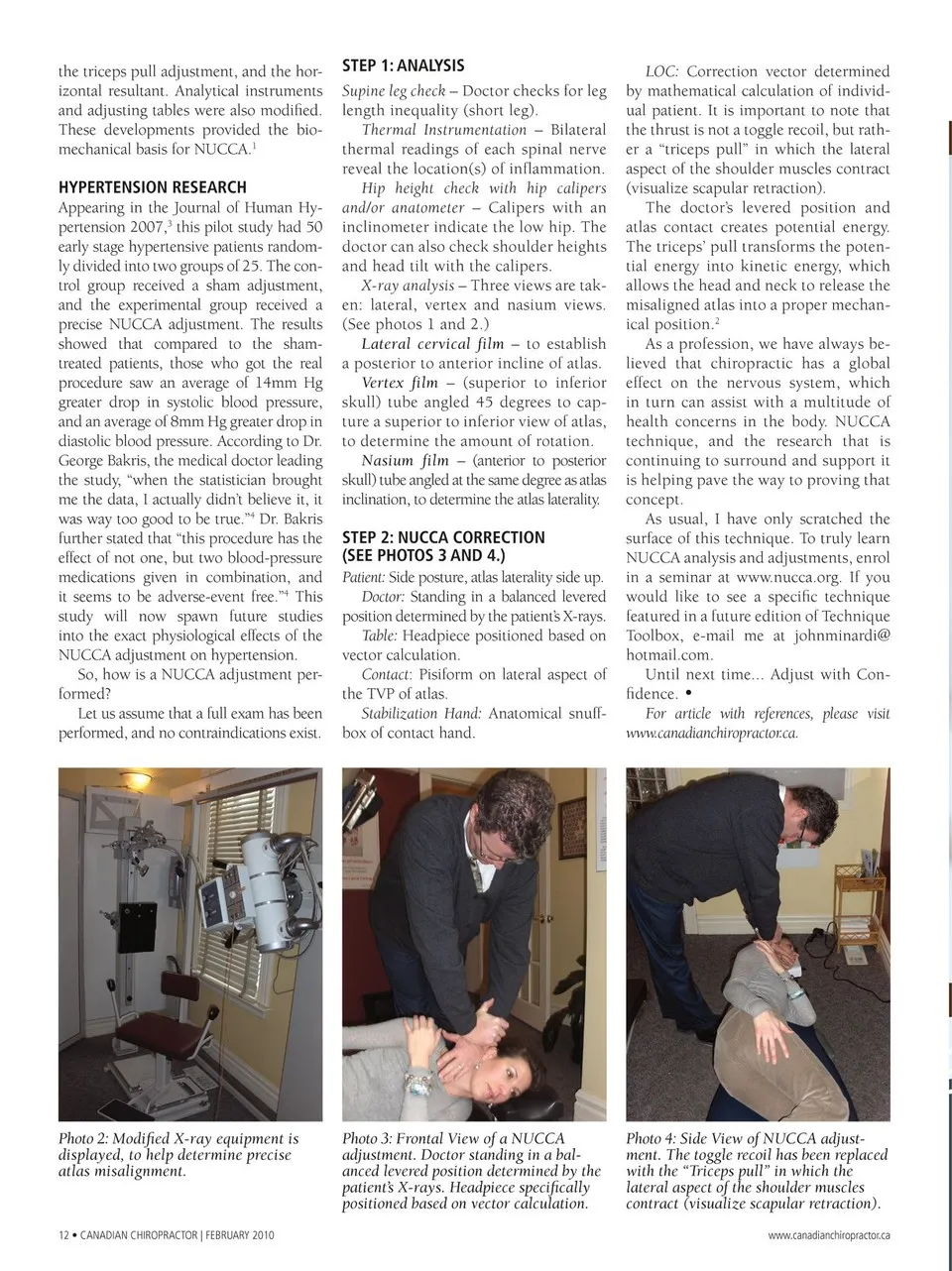
the triceps pull adjustment, and the hor- izontal resultant. Analytical instruments and adjusting tables were also modified. These developments provided the bio- mechanical basis for NUCCA.1 HyPErTEnsion rEsEarCH Appearing in the Journal of Human Hy- pertension 2007,3 this pilot study had 50 early stage hypertensive patients random- ly divided into two groups of 25. The con- trol group received a sham adjustment, and the experimental group received a precise NUCCA adjustment. The results showed that compared to the sham- treated patients, those who got the real procedure saw an average of 14mm Hg greater drop in systolic blood pressure, and an average of 8mm Hg greater drop in diastolic blood pressure. According to Dr. George Bakris, the medical doctor leading the study, “when the statistician brought me the data, I actually didn’t believe it, it was way too good to be true.”4 Dr. Bakris further stated that “this procedure has the effect of not one, but two blood-pressure medications given in combination, and it seems to be adverse-event free.”4 This study will now spawn future studies into the exact physiological effects of the NUCCA adjustment on hypertension. So, how is a NUCCA adjustment per- formed? Let us assume that a full exam has been performed, and no contraindications exist. sTEP 2: nUCCa CorrECTion (sEE PHoTos 3 and 4.) Patient: Side posture, atlas laterality side up. Doctor: Standing in a balanced levered position determined by the patient’s X-rays. Table: Headpiece positioned based on vector calculation. Contact: Pisiform on lateral aspect of the TVP of atlas. Stabilization Hand: Anatomical snuff- box of contact hand. sTEP 1: analysis Supine leg check – Doctor checks for leg length inequality (short leg). Thermal Instrumentation – Bilateral thermal readings of each spinal nerve reveal the location(s) of inflammation. Hip height check with hip calipers and/or anatometer – Calipers with an inclinometer indicate the low hip. The doctor can also check shoulder heights and head tilt with the calipers. X-ray analysis – Three views are tak- en: lateral, vertex and nasium views. (See photos 1 and 2.) Lateral cervical film – to establish a posterior to anterior incline of atlas. Vertex film – (superior to inferior skull) tube angled 45 degrees to cap- ture a superior to inferior view of atlas, to determine the amount of rotation. Nasium film – (anterior to posterior skull) tube angled at the same degree as atlas inclination, to determine the atlas laterality. LOC: Correction vector determined by mathematical calculation of individ- ual patient. It is important to note that the thrust is not a toggle recoil, but rath- er a “triceps pull” in which the lateral aspect of the shoulder muscles contract (visualize scapular retraction). The doctor’s levered position and atlas contact creates potential energy. The triceps’ pull transforms the poten- tial energy into kinetic energy, which allows the head and neck to release the misaligned atlas into a proper mechan- ical position.2 As a profession, we have always be- lieved that chiropractic has a global effect on the nervous system, which in turn can assist with a multitude of health concerns in the body. NUCCA technique, and the research that is continuing to surround and support it is helping pave the way to proving that concept. As usual, I have only scratched the surface of this technique. To truly learn NUCCA analysis and adjustments, enrol in a seminar at www.nucca.org. If you would like to see a specific technique featured in a future edition of Technique Toolbox, e-mail me at johnminardi@ hotmail.com. Until next time... Adjust with Con- fidence. • For article with references, please visit www.canadianchiropractor.ca. Photo 2: Modified X-ray equipment is displayed, to help determine precise atlas misalignment. 12 • CANADIAN CHIROPRACTOR | FEBRUARY 2010 Photo 3: Frontal View of a NUCCA adjustment. Doctor standing in a bal- anced levered position determined by the patient’s X-rays. Headpiece specifically positioned based on vector calculation. Photo 4: Side View of NUCCA adjust- ment. The toggle recoil has been replaced with the “Triceps pull” in which the lateral aspect of the shoulder muscles contract (visualize scapular retraction). www.canadianchiropractor.ca
Chiropractic + Naturopathic Doctor February 2010: Page 12