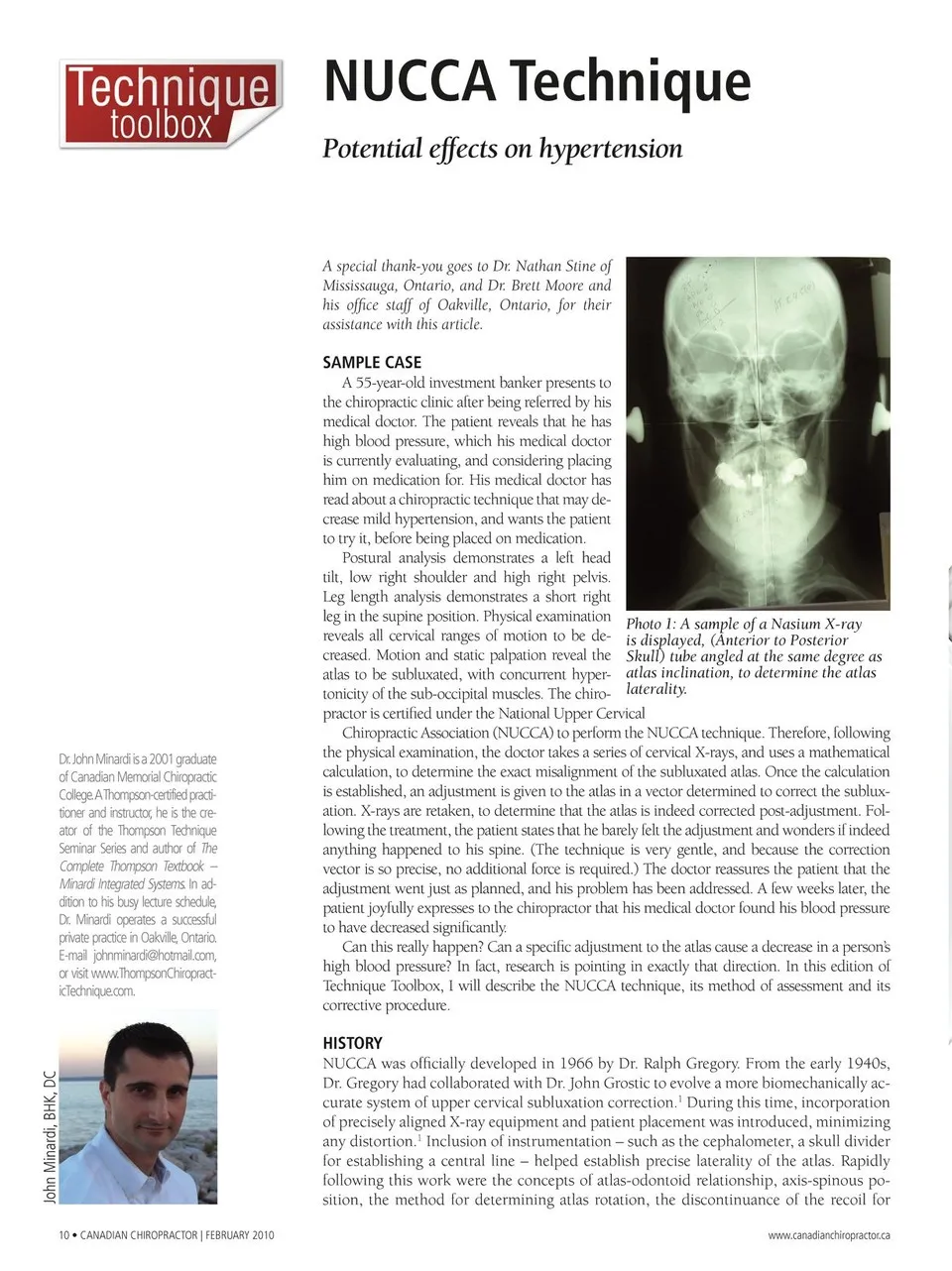
nUCCa Technique Potential effects on hypertension A special thank-you goes to Dr. Nathan Stine of Mississauga, Ontario, and Dr. Brett Moore and his office staff of Oakville, Ontario, for their assistance with this article. samPlE CasE A 55-year-old investment banker presents to the chiropractic clinic after being referred by his medical doctor. The patient reveals that he has high blood pressure, which his medical doctor is currently evaluating, and considering placing him on medication for. His medical doctor has read about a chiropractic technique that may de- crease mild hypertension, and wants the patient to try it, before being placed on medication. Postural analysis demonstrates a left head tilt, low right shoulder and high right pelvis. Leg length analysis demonstrates a short right leg in the supine position. Physical examination reveals all cervical ranges of motion to be de- creased. Motion and static palpation reveal the atlas to be subluxated, with concurrent hyper- tonicity of the sub-occipital muscles. The chiro- practor is certified under the National Upper Cervical Chiropractic Association (NUCCA) to perform the NUCCA technique. Therefore, following Photo 1: A sample of a Nasium X-ray is displayed, (Anterior to Posterior Skull) tube angled at the same degree as atlas inclination, to determine the atlas laterality. Dr. John Minardi is a 2001 graduate of Canadian Memorial Chiropractic College. A Thompson-certified practi- tioner and instructor, he is the cre- ator of the Thompson Technique Seminar Series and author of The Complete Thompson Textbook – Minardi Integrated Systems. In ad- dition to his busy lecture schedule, Dr. Minardi operates a successful private practice in Oakville, Ontario. E-mail [email protected], or visit www.ThompsonChiropract- icTechnique.com. the physical examination, the doctor takes a series of cervical X-rays, and uses a mathematical calculation, to determine the exact misalignment of the subluxated atlas. Once the calculation is established, an adjustment is given to the atlas in a vector determined to correct the sublux- ation. X-rays are retaken, to determine that the atlas is indeed corrected post-adjustment. Fol- lowing the treatment, the patient states that he barely felt the adjustment and wonders if indeed anything happened to his spine. (The technique is very gentle, and because the correction vector is so precise, no additional force is required.) The doctor reassures the patient that the adjustment went just as planned, and his problem has been addressed. A few weeks later, the patient joyfully expresses to the chiropractor that his medical doctor found his blood pressure to have decreased significantly. Can this really happen? Can a specific adjustment to the atlas cause a decrease in a person’s high blood pressure? In fact, research is pointing in exactly that direction. In this edition of Technique Toolbox, I will describe the NUCCA technique, its method of assessment and its corrective procedure. HisTory NUCCA was officially developed in 1966 by Dr. Ralph Gregory. From the early 1940s, Dr. Gregory had collaborated with Dr. John Grostic to evolve a more biomechanically ac- curate system of upper cervical subluxation correction.1 During this time, incorporation of precisely aligned X-ray equipment and patient placement was introduced, minimizing any distortion.1 Inclusion of instrumentation – such as the cephalometer, a skull divider for establishing a central line – helped establish precise laterality of the atlas. Rapidly following this work were the concepts of atlas-odontoid relationship, axis-spinous po- sition, the method for determining atlas rotation, the discontinuance of the recoil for 10 • CANADIAN CHIROPRACTOR | FEBRUARY 2010 www.canadianchiropractor.ca John Minardi, BHK, DC
Chiropractic + Naturopathic Doctor February 2010: Page 10