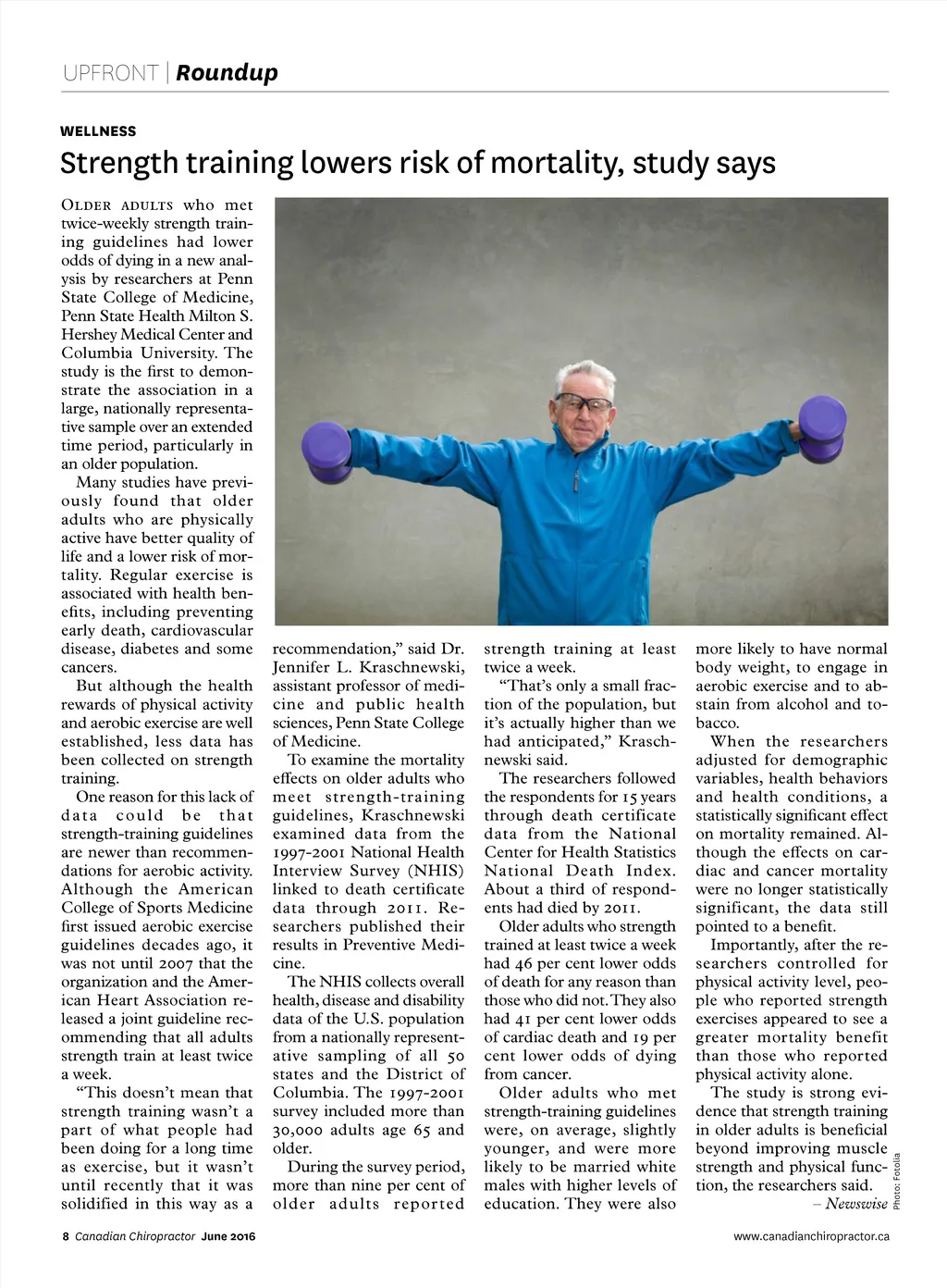
UPFRONT | Roundup WELLNESS Strength training lowers risk of mortality, study says Older adults who met twice-weekly strength train-ing guidelines had lower odds of dying in a new anal-ysis by researchers at Penn State College of Medicine, Penn State Health Milton S. Hershey Medical Center and Columbia University. The study is the first to demon-strate the association in a large, nationally representa-tive sample over an extended time period, particularly in an older population. Many studies have previ-ously found that older adults who are physically active have better quality of life and a lower risk of mor-tality. Regular exercise is associated with health ben-efits, including preventing early death, cardiovascular disease, diabetes and some cancers. But although the health rewards of physical activity and aerobic exercise are well established, less data has been collected on strength training. One reason for this lack of data could be that strength-training guidelines are newer than recommen-dations for aerobic activity. Although the American College of Sports Medicine first issued aerobic exercise guidelines decades ago, it was not until 2007 that the organization and the Amer-ican Heart Association re-leased a joint guideline rec-ommending that all adults strength train at least twice a week. “This doesn’t mean that strength training wasn’t a part of what people had been doing for a long time as exercise, but it wasn’t until recently that it was solidified in this way as a 8 Canadian Chiropractor June 2016 recommendation,” said Dr. Jennifer L. Kraschnewski, assistant professor of medi-cine and public health sciences, Penn State College of Medicine. To examine the mortality effects on older adults who meet strength-training guidelines, Kraschnewski examined data from the 1997-2001 National Health Interview Survey (NHIS) linked to death certificate data through 2011. Re-searchers published their results in Preventive Medi-cine. The NHIS collects overall health, disease and disability data of the U.S. population from a nationally represent-ative sampling of all 50 states and the District of Columbia. The 1997-2001 survey included more than 30,000 adults age 65 and older. During the survey period, more than nine per cent of older adults repor ted strength training at least twice a week. “That’s only a small frac-tion of the population, but it’s actually higher than we had anticipated,” Krasch-newski said. The researchers followed the respondents for 15 years through death certificate data from the National Center for Health Statistics National Death Index. About a third of respond-ents had died by 2011. Older adults who strength trained at least twice a week had 46 per cent lower odds of death for any reason than those who did not. They also had 41 per cent lower odds of cardiac death and 19 per cent lower odds of dying from cancer. Older adults who met strength-training guidelines were, on average, slightly younger, and were more likely to be married white males with higher levels of education. They were also more likely to have normal body weight, to engage in aerobic exercise and to ab-stain from alcohol and to-bacco. When the researchers adjusted for demographic variables, health behaviors and health conditions, a statistically significant effect on mortality remained. Al-though the effects on car-diac and cancer mortality were no longer statistically significant, the data still pointed to a benefit. Importantly, after the re-searchers controlled for physical activity level, peo-ple who reported strength exercises appeared to see a greater mortality benefit than those who reported physical activity alone. The study is strong evi-dence that strength training in older adults is beneficial beyond improving muscle strength and physical func-tion, the researchers said. – Newswise www.canadianchiropractor.ca Photo: Fotolia
Chiropractic + Naturopathic Doctor June 2016: Page 8