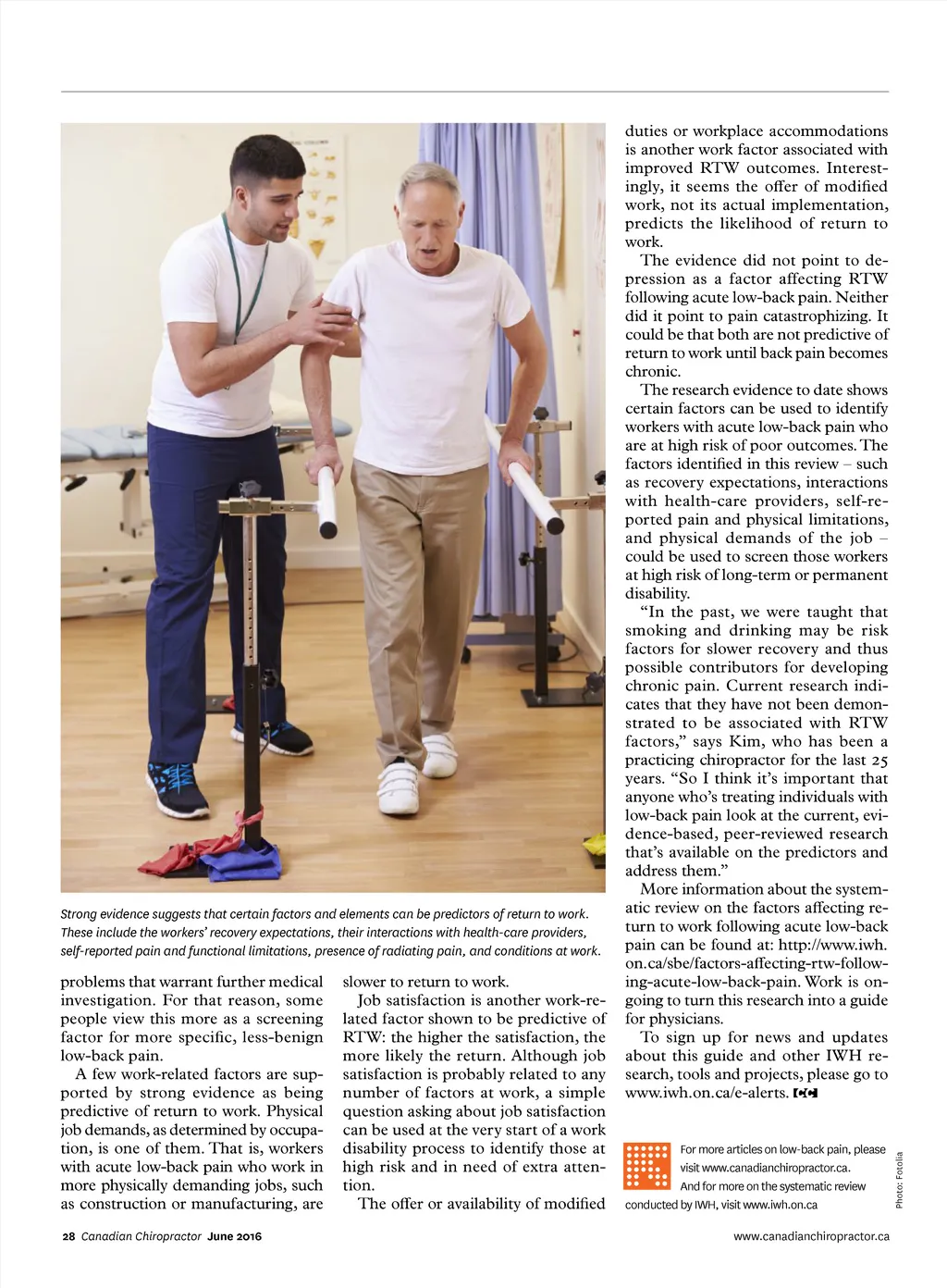
Strong evidence suggests that certain factors and elements can be predictors of return to work. These include the workers’ recovery expectations, their interactions with health-care providers, self-reported pain and functional limitations, presence of radiating pain, and conditions at work. problems that warrant further medical investigation. For that reason, some people view this more as a screening factor for more specific, less-benign low-back pain. A few work-related factors are sup-ported by strong evidence as being predictive of return to work. Physical job demands, as determined by occupa-tion, is one of them. That is, workers with acute low-back pain who work in more physically demanding jobs, such as construction or manufacturing, are 28 Canadian Chiropractor June 2016 slower to return to work. Job satisfaction is another work-re-lated factor shown to be predictive of RTW: the higher the satisfaction, the more likely the return. Although job satisfaction is probably related to any number of factors at work, a simple question asking about job satisfaction can be used at the very start of a work disability process to identify those at high risk and in need of extra atten-tion. The offer or availability of modified duties or workplace accommodations is another work factor associated with improved RTW outcomes. Interest-ingly, it seems the offer of modified work, not its actual implementation, predicts the likelihood of return to work. The evidence did not point to de-pression as a factor affecting RTW following acute low-back pain. Neither did it point to pain catastrophizing. It could be that both are not predictive of return to work until back pain becomes chronic. The research evidence to date shows certain factors can be used to identify workers with acute low-back pain who are at high risk of poor outcomes. The factors identified in this review – such as recovery expectations, interactions with health-care providers, self-re-ported pain and physical limitations, and physical demands of the job – could be used to screen those workers at high risk of long-term or permanent disability. “In the past, we were taught that smoking and drinking may be risk factors for slower recovery and thus possible contributors for developing chronic pain. Current research indi-cates that they have not been demon-strated to be associated with RTW factors,” says Kim, who has been a practicing chiropractor for the last 25 years. “So I think it’s important that anyone who’s treating individuals with low-back pain look at the current, evi-dence-based, peer-reviewed research that’s available on the predictors and address them.” More information about the system-atic review on the factors affecting re-turn to work following acute low-back pain can be found at: http://www.iwh. on.ca/sbe/factors-affecting-rtw-follow-ing-acute-low-back-pain. Work is on-going to turn this research into a guide for physicians. To sign up for news and updates about this guide and other IWH re-search, tools and projects, please go to www.iwh.on.ca/e-alerts. For more articles on low-back pain, please visit www.canadianchiropractor.ca. And for more on the systematic review conducted by IWH, visit www.iwh.on.ca www.canadianchiropractor.ca Photo: Fotolia
Chiropractic + Naturopathic Doctor June 2016: Page 28