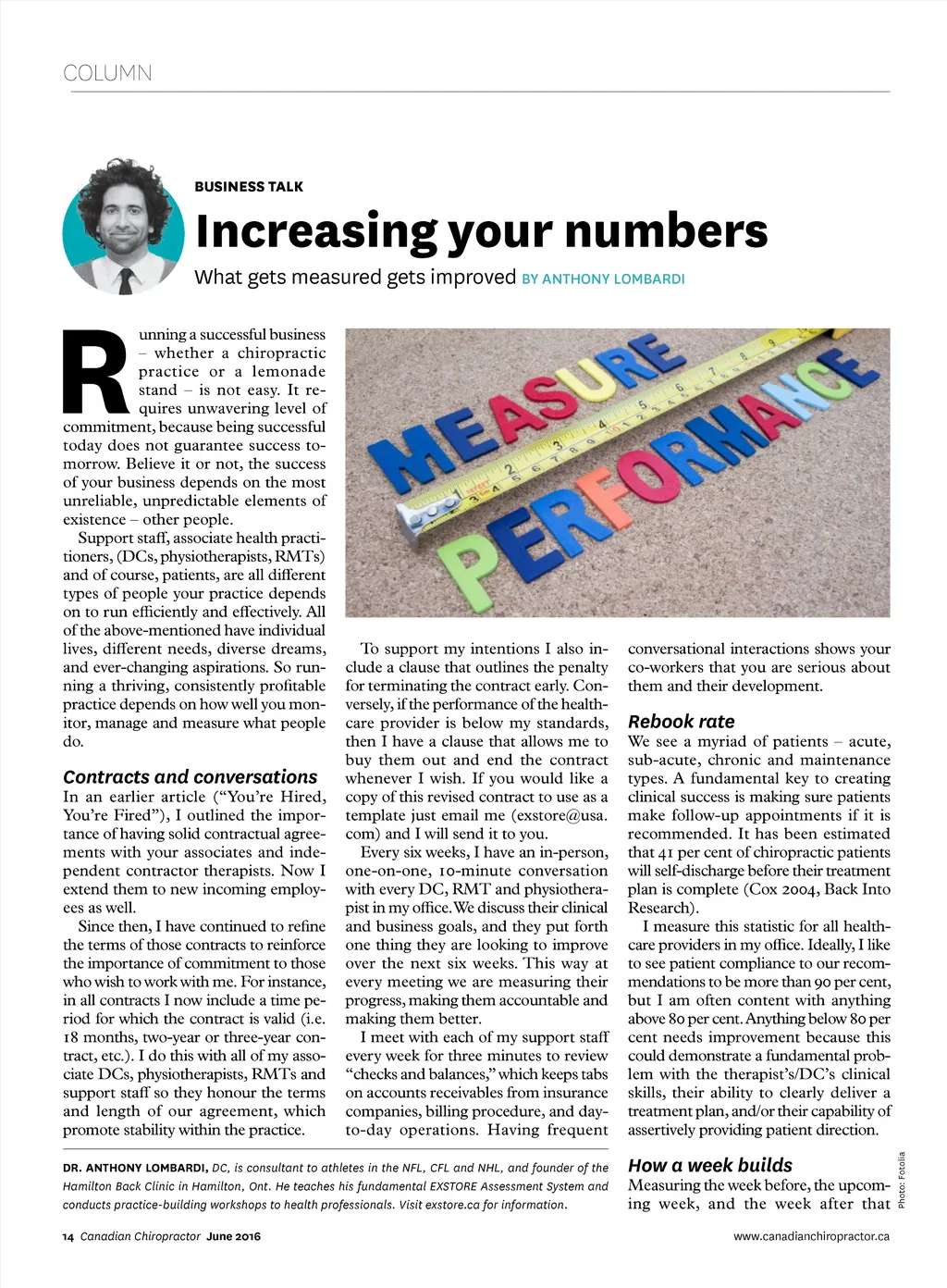
COLUMN BUSINESS TALK Increasing your numbers R What gets measured gets improved BY ANTHONY LOMBARDI unning a successful business – whether a chiropractic practice or a lemonade stand – is not easy. It re-quires unwavering level of commitment, because being successful today does not guarantee success to-morrow. Believe it or not, the success of your business depends on the most unreliable, unpredictable elements of existence – other people. Support staff, associate health practi-tioners, (DCs, physiotherapists, RMTs) and of course, patients, are all different types of people your practice depends on to run efficiently and effectively. All of the above-mentioned have individual lives, different needs, diverse dreams, and ever-changing aspirations. So run-ning a thriving, consistently profitable practice depends on how well you mon-itor, manage and measure what people do. Contracts and conversations In an earlier article (“You’re Hired, You’re Fired”), I outlined the impor-tance of having solid contractual agree-ments with your associates and inde-pendent contractor therapists. Now I extend them to new incoming employ-ees as well. Since then, I have continued to refine the terms of those contracts to reinforce the importance of commitment to those who wish to work with me. For instance, in all contracts I now include a time pe-riod for which the contract is valid (i.e. 18 months, two-year or three-year con-tract, etc.). I do this with all of my asso-ciate DCs, physiotherapists, RMTs and support staff so they honour the terms and length of our agreement, which promote stability within the practice. To support my intentions I also in-clude a clause that outlines the penalty for terminating the contract early. Con-versely, if the performance of the health-care provider is below my standards, then I have a clause that allows me to buy them out and end the contract whenever I wish. If you would like a copy of this revised contract to use as a template just email me (exstore@usa. com) and I will send it to you. Every six weeks, I have an in-person, one-on-one, 10-minute conversation with every DC, RMT and physiothera-pist in my office. We discuss their clinical and business goals, and they put forth one thing they are looking to improve over the next six weeks. This way at every meeting we are measuring their progress, making them accountable and making them better. I meet with each of my support staff every week for three minutes to review “checks and balances,” which keeps tabs on accounts receivables from insurance companies, billing procedure, and day-to-day operations. Having frequent conversational interactions shows your co-workers that you are serious about them and their development. Rebook rate We see a myriad of patients – acute, sub-acute, chronic and maintenance types. A fundamental key to creating clinical success is making sure patients make follow-up appointments if it is recommended. It has been estimated that 41 per cent of chiropractic patients will self-discharge before their treatment plan is complete (Cox 2004, Back Into Research). I measure this statistic for all health-care providers in my office. Ideally, I like to see patient compliance to our recom-mendations to be more than 90 per cent, but I am often content with anything above 80 per cent. Anything below 80 per cent needs improvement because this could demonstrate a fundamental prob-lem with the therapist’s/DC’s clinical skills, their ability to clearly deliver a treatment plan, and/or their capability of assertively providing patient direction. Measuring the week before, the upcom-ing week, and the week after that www.canadianchiropractor.ca Photo: Fotolia DR. ANTHONY LOMBARDI, DC, is consultant to athletes in the NFL, CFL and NHL, and founder of the Hamilton Back Clinic in Hamilton, Ont. He teaches his fundamental EXSTORE Assessment System and conducts practice-building workshops to health professionals. Visit exstore.ca for information. 14 Canadian Chiropractor June 2016 How a week builds
Chiropractic + Naturopathic Doctor June 2016: Page 14