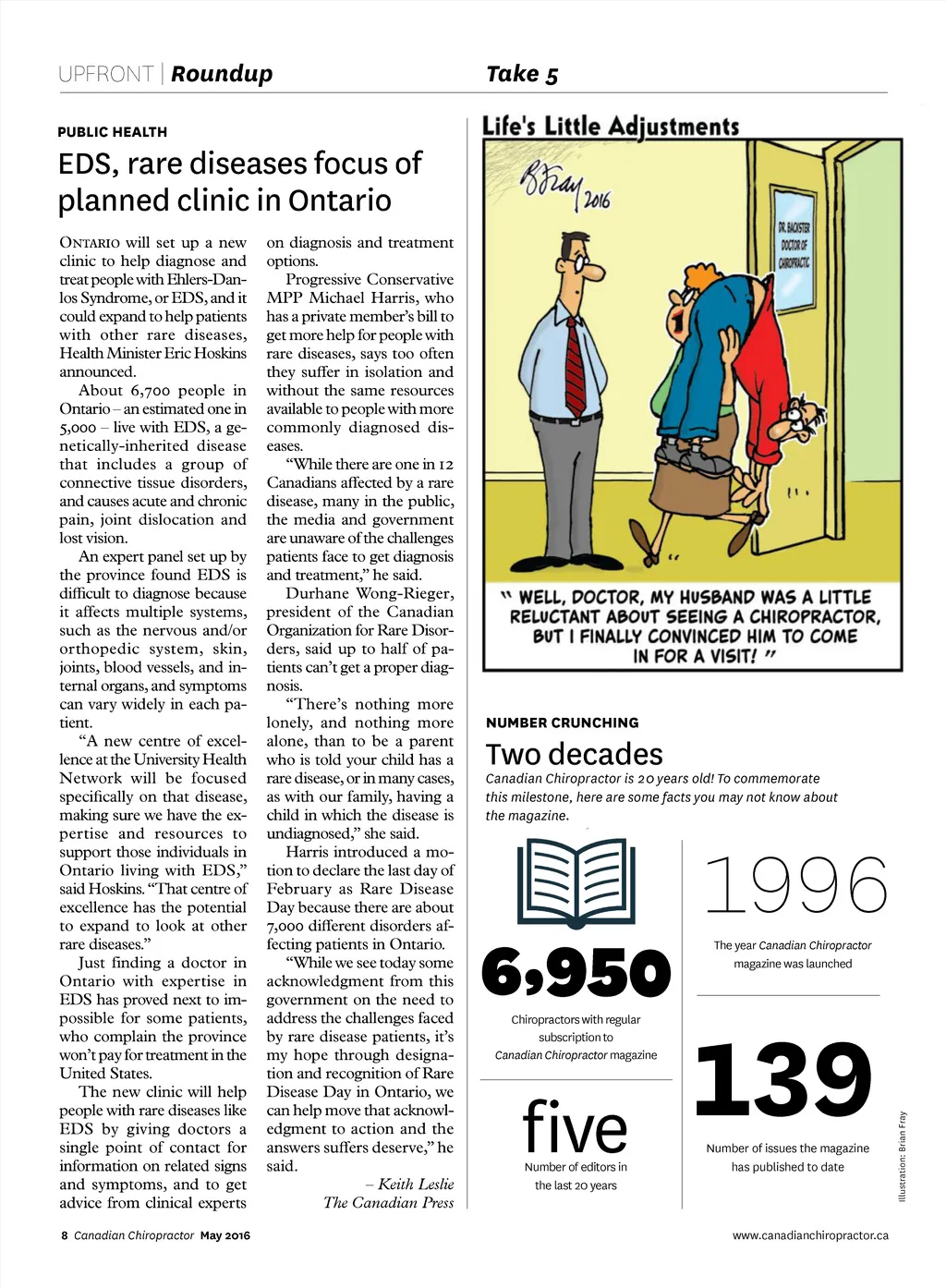
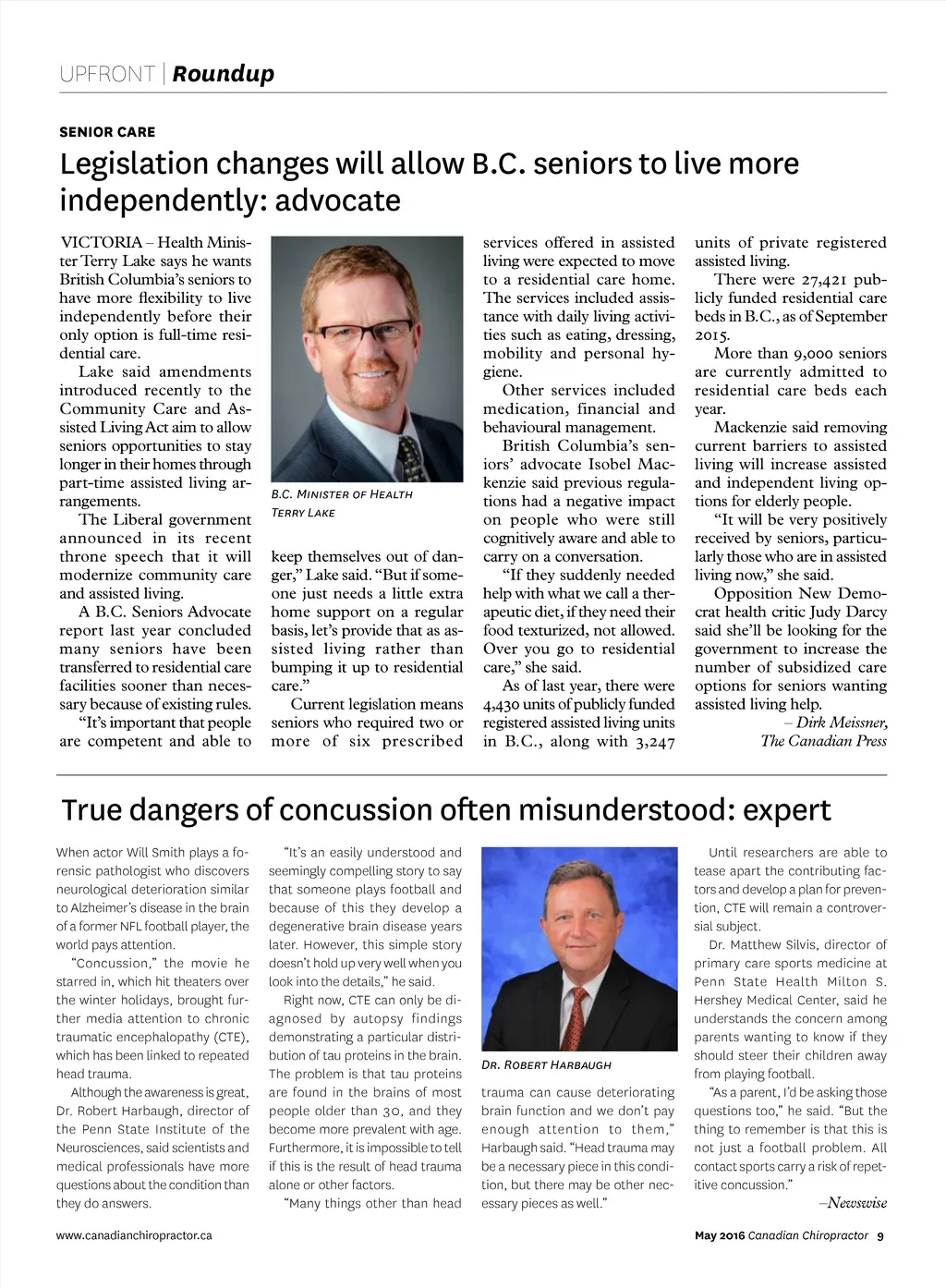
UPFRONT | Roundup SENIOR CARE Legislation changes will allow B.C. seniors to live more independently: advocate VICTORIA – Health Minis-ter Terry Lake says he wants British Columbia’s seniors to have more flexibility to live independently before their only option is full-time resi-dential care. Lake said amendments introduced recently to the Community Care and As-sisted Living Act aim to allow seniors opportunities to stay longer in their homes through part-time assisted living ar-rangements. The Liberal government announced in its recent throne speech that it will modernize community care and assisted living. A B.C. Seniors Advocate report last year concluded many seniors have been transferred to residential care facilities sooner than neces-sary because of existing rules. “It’s important that people are competent and able to services offered in assisted living were expected to move to a residential care home. The services included assis-tance with daily living activi-ties such as eating, dressing, mobility and personal hy-giene. Other services included medication, financial and behavioural management. British Columbia’s sen-iors’ advocate Isobel Mac-kenzie said previous regula-tions had a negative impact on people who were still cognitively aware and able to carry on a conversation. “If they suddenly needed help with what we call a ther-apeutic diet, if they need their food texturized, not allowed. Over you go to residential care,” she said. As of last year, there were 4,430 units of publicly funded registered assisted living units in B.C., along with 3,247 units of private registered assisted living. There were 27,421 pub-licly funded residential care beds in B.C., as of September 2015. More than 9,000 seniors are currently admitted to residential care beds each year. Mackenzie said removing current barriers to assisted living will increase assisted and independent living op-tions for elderly people. “It will be very positively received by seniors, particu-larly those who are in assisted living now,” she said. Opposition New Demo-crat health critic Judy Darcy said she’ll be looking for the government to increase the number of subsidized care options for seniors wanting assisted living help. – Dirk Meissner, The Canadian Press B.C. Minister of Health Terry Lake keep themselves out of dan-ger,” Lake said. “But if some-one just needs a little extra home support on a regular basis, let’s provide that as as-sisted living rather than bumping it up to residential care.” Current legislation means seniors who required two or more of six prescribed True dangers of concussion often misunderstood: expert When actor Will Smith plays a fo-rensic pathologist who discovers neurological deterioration similar to Alzheimer’s disease in the brain of a former NFL football player, the world pays attention. “Concussion,” the movie he starred in, which hit theaters over the winter holidays, brought fur-ther media attention to chronic traumatic encephalopathy (CTE), which has been linked to repeated head trauma. Although the awareness is great, Dr. Robert Harbaugh, director of the Penn State Institute of the Neurosciences, said scientists and medical professionals have more questions about the condition than they do answers. www.canadianchiropractor.ca “It’s an easily understood and seemingly compelling story to say that someone plays football and because of this they develop a degenerative brain disease years later. However, this simple story doesn’t hold up very well when you look into the details,” he said. Right now, CTE can only be di-agnosed by autopsy findings demonstrating a particular distri-bution of tau proteins in the brain. The problem is that tau proteins are found in the brains of most people older than 30, and they become more prevalent with age. Furthermore, it is impossible to tell if this is the result of head trauma alone or other factors. “Many things other than head Dr. Robert Harbaugh trauma can cause deteriorating brain function and we don’t pay enough attention to them,” Harbaugh said. “Head trauma may be a necessary piece in this condi-tion, but there may be other nec-essary pieces as well.” Until researchers are able to tease apart the contributing fac-tors and develop a plan for preven-tion, CTE will remain a controver-sial subject. Dr. Matthew Silvis, director of primary care sports medicine at Penn State Health Milton S. Hershey Medical Center, said he understands the concern among parents wanting to know if they should steer their children away from playing football. “As a parent, I’d be asking those questions too,” he said. “But the thing to remember is that this is not just a football problem. All contact sports carry a risk of repet-itive concussion.” –Newswise May 2016 Canadian Chiropractor 9
Chiropractic + Naturopathic Doctor May 2016: Page 9