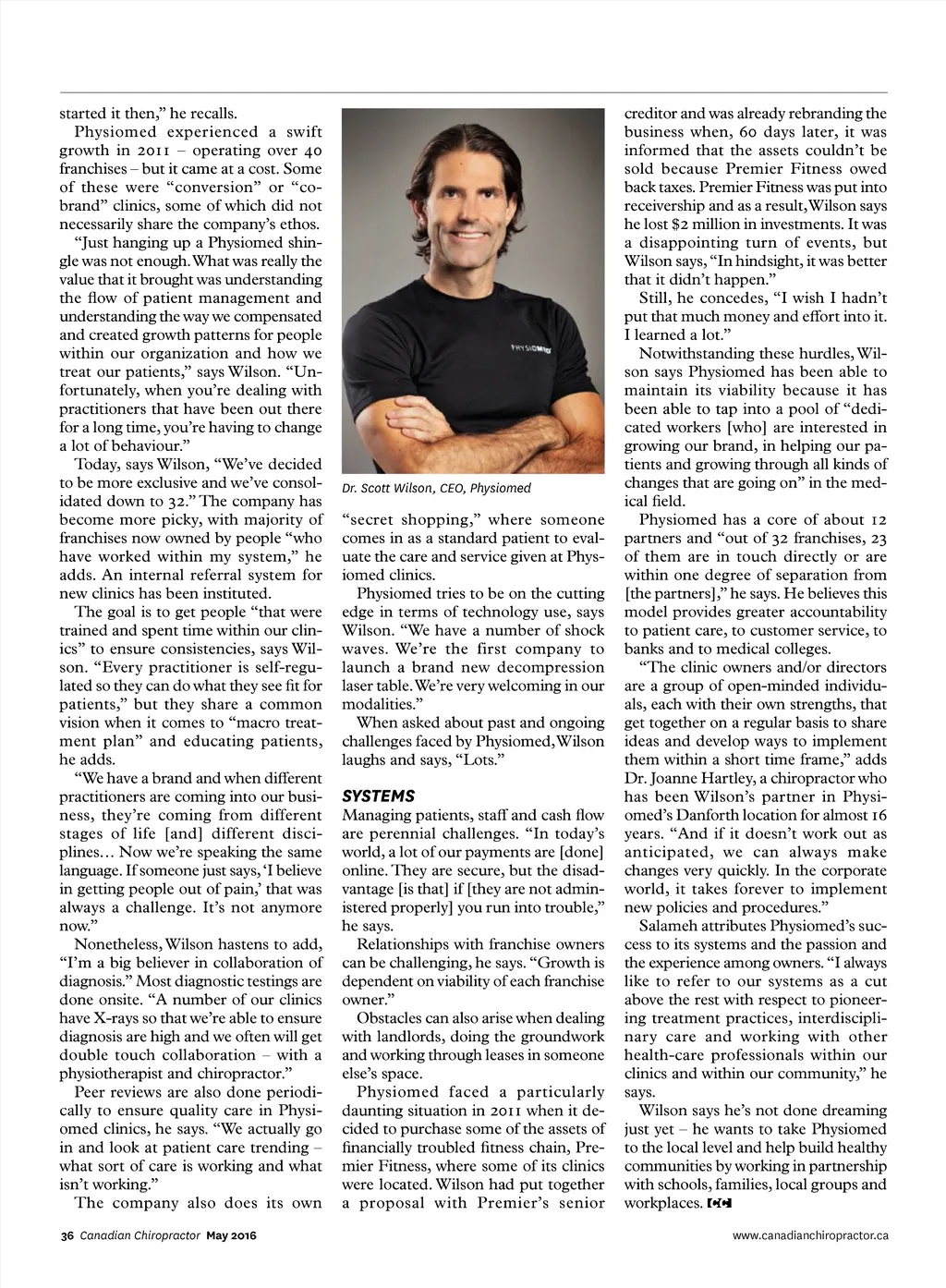
started it then,” he recalls. Physiomed experienced a swift growth in 2011 – operating over 40 franchises – but it came at a cost. Some of these were “conversion” or “co-brand” clinics, some of which did not necessarily share the company’s ethos. “Just hanging up a Physiomed shin-gle was not enough. What was really the value that it brought was understanding the flow of patient management and understanding the way we compensated and created growth patterns for people within our organization and how we treat our patients,” says Wilson. “Un-fortunately, when you’re dealing with practitioners that have been out there for a long time, you’re having to change a lot of behaviour.” Today, says Wilson, “We’ve decided to be more exclusive and we’ve consol-idated down to 32.” The company has become more picky, with majority of franchises now owned by people “who have worked within my system,” he adds. An internal referral system for new clinics has been instituted. The goal is to get people “that were trained and spent time within our clin-ics” to ensure consistencies, says Wil-son. “Every practitioner is self-regu-lated so they can do what they see fit for patients,” but they share a common vision when it comes to “macro treat-ment plan” and educating patients, he adds. “We have a brand and when different practitioners are coming into our busi-ness, they’re coming from different stages of life [and] different disci-plines… Now we’re speaking the same language. If someone just says, ‘I believe in getting people out of pain,’ that was always a challenge. It’s not anymore now.” Nonetheless, Wilson hastens to add, “I’m a big believer in collaboration of diagnosis.” Most diagnostic testings are done onsite. “A number of our clinics have X-rays so that we’re able to ensure diagnosis are high and we often will get double touch collaboration – with a physiotherapist and chiropractor.” Peer reviews are also done periodi-cally to ensure quality care in Physi-omed clinics, he says. “We actually go in and look at patient care trending – what sort of care is working and what isn’t working.” The company also does its own 36 Canadian Chiropractor May 2016 Dr. Scott Wilson, CEO, Physiomed “secret shopping,” where someone comes in as a standard patient to eval-uate the care and service given at Phys-iomed clinics. Physiomed tries to be on the cutting edge in terms of technology use, says Wilson. “We have a number of shock waves. We’re the first company to launch a brand new decompression laser table. We’re very welcoming in our modalities.” When asked about past and ongoing challenges faced by Physiomed, Wilson laughs and says, “Lots.” SYSTEMS Managing patients, staff and cash flow are perennial challenges. “In today’s world, a lot of our payments are [done] online. They are secure, but the disad-vantage [is that] if [they are not admin-istered properly] you run into trouble,” he says. Relationships with franchise owners can be challenging, he says. “Growth is dependent on viability of each franchise owner.” Obstacles can also arise when dealing with landlords, doing the groundwork and working through leases in someone else’s space. Physiomed faced a particularly daunting situation in 2011 when it de-cided to purchase some of the assets of financially troubled fitness chain, Pre-mier Fitness, where some of its clinics were located. Wilson had put together a proposal with Premier’s senior creditor and was already rebranding the business when, 60 days later, it was informed that the assets couldn’t be sold because Premier Fitness owed back taxes. Premier Fitness was put into receivership and as a result, Wilson says he lost $2 million in investments. It was a disappointing turn of events, but Wilson says, “In hindsight, it was better that it didn’t happen.” Still, he concedes, “I wish I hadn’t put that much money and effort into it. I learned a lot.” Notwithstanding these hurdles, Wil-son says Physiomed has been able to maintain its viability because it has been able to tap into a pool of “dedi-cated workers [who] are interested in growing our brand, in helping our pa-tients and growing through all kinds of changes that are going on” in the med-ical field. Physiomed has a core of about 12 partners and “out of 32 franchises, 23 of them are in touch directly or are within one degree of separation from [the partners],” he says. He believes this model provides greater accountability to patient care, to customer service, to banks and to medical colleges. “The clinic owners and/or directors are a group of open-minded individu-als, each with their own strengths, that get together on a regular basis to share ideas and develop ways to implement them within a short time frame,” adds Dr. Joanne Hartley, a chiropractor who has been Wilson’s partner in Physi-omed’s Danforth location for almost 16 years. “And if it doesn’t work out as anticipated, we can always make changes very quickly. In the corporate world, it takes forever to implement new policies and procedures.” Salameh attributes Physiomed’s suc-cess to its systems and the passion and the experience among owners. “I always like to refer to our systems as a cut above the rest with respect to pioneer-ing treatment practices, interdiscipli-nary care and working with other health-care professionals within our clinics and within our community,” he says. Wilson says he’s not done dreaming just yet – he wants to take Physiomed to the local level and help build healthy communities by working in partnership with schools, families, local groups and workplaces. www.canadianchiropractor.ca
Chiropractic + Naturopathic Doctor May 2016: Page 36