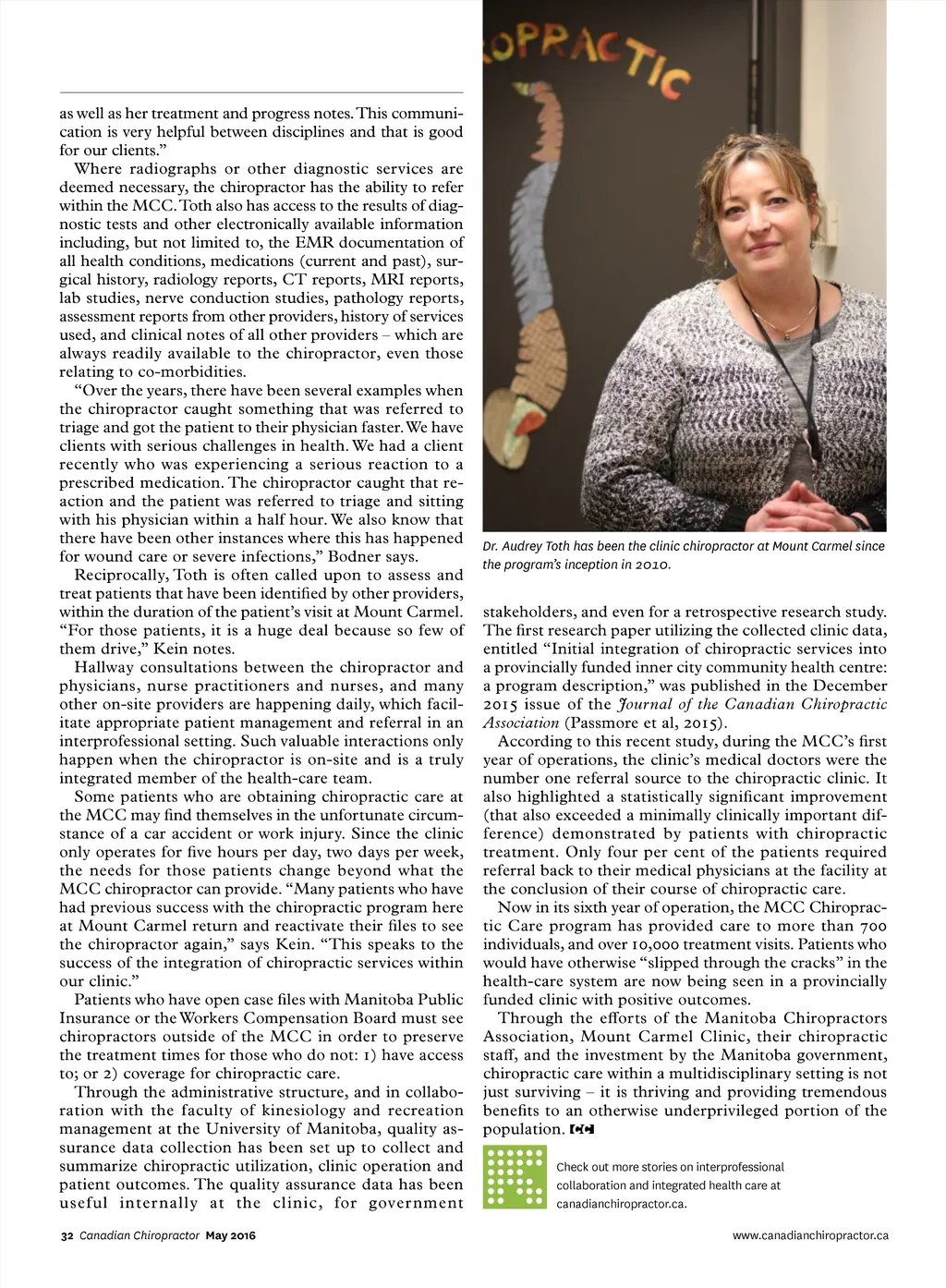
as well as her treatment and progress notes. This communi-cation is very helpful between disciplines and that is good for our clients.” Where radiographs or other diagnostic services are deemed necessary, the chiropractor has the ability to refer within the MCC. Toth also has access to the results of diag-nostic tests and other electronically available information including, but not limited to, the EMR documentation of all health conditions, medications (current and past), sur-gical history, radiology reports, CT reports, MRI reports, lab studies, nerve conduction studies, pathology reports, assessment reports from other providers, history of services used, and clinical notes of all other providers – which are always readily available to the chiropractor, even those relating to co-morbidities. “Over the years, there have been several examples when the chiropractor caught something that was referred to triage and got the patient to their physician faster. We have clients with serious challenges in health. We had a client recently who was experiencing a serious reaction to a prescribed medication. The chiropractor caught that re-action and the patient was referred to triage and sitting with his physician within a half hour. We also know that there have been other instances where this has happened for wound care or severe infections,” Bodner says. Reciprocally, Toth is often called upon to assess and treat patients that have been identified by other providers, within the duration of the patient’s visit at Mount Carmel. “For those patients, it is a huge deal because so few of them drive,” Kein notes. Hallway consultations between the chiropractor and physicians, nurse practitioners and nurses, and many other on-site providers are happening daily, which facil-itate appropriate patient management and referral in an interprofessional setting. Such valuable interactions only happen when the chiropractor is on-site and is a truly integrated member of the health-care team. Some patients who are obtaining chiropractic care at the MCC may find themselves in the unfortunate circum-stance of a car accident or work injury. Since the clinic only operates for five hours per day, two days per week, the needs for those patients change beyond what the MCC chiropractor can provide. “Many patients who have had previous success with the chiropractic program here at Mount Carmel return and reactivate their files to see the chiropractor again,” says Kein. “This speaks to the success of the integration of chiropractic services within our clinic.” Patients who have open case files with Manitoba Public Insurance or the Workers Compensation Board must see chiropractors outside of the MCC in order to preserve the treatment times for those who do not: 1) have access to; or 2) coverage for chiropractic care. Through the administrative structure, and in collabo-ration with the faculty of kinesiology and recreation management at the University of Manitoba, quality as-surance data collection has been set up to collect and summarize chiropractic utilization, clinic operation and patient outcomes. The quality assurance data has been useful inter nally at the clinic, for gover nment 32 Canadian Chiropractor May 2016 Dr. Audrey Toth has been the clinic chiropractor at Mount Carmel since the program’s inception in 2010. stakeholders, and even for a retrospective research study. The first research paper utilizing the collected clinic data, entitled “Initial integration of chiropractic services into a provincially funded inner city community health centre: a program description,” was published in the December 2015 issue of the Journal of the Canadian Chiropractic Association (Passmore et al, 2015). According to this recent study, during the MCC’s first year of operations, the clinic’s medical doctors were the number one referral source to the chiropractic clinic. It also highlighted a statistically significant improvement (that also exceeded a minimally clinically important dif-ference) demonstrated by patients with chiropractic treatment. Only four per cent of the patients required referral back to their medical physicians at the facility at the conclusion of their course of chiropractic care. Now in its sixth year of operation, the MCC Chiroprac-tic Care program has provided care to more than 700 individuals, and over 10,000 treatment visits. Patients who would have otherwise “slipped through the cracks” in the health-care system are now being seen in a provincially funded clinic with positive outcomes. Through the efforts of the Manitoba Chiropractors Association, Mount Carmel Clinic, their chiropractic staff, and the investment by the Manitoba government, chiropractic care within a multidisciplinary setting is not just surviving – it is thriving and providing tremendous benefits to an otherwise underprivileged portion of the population. Check out more stories on interprofessional collaboration and integrated health care at canadianchiropractor.ca. www.canadianchiropractor.ca
Chiropractic + Naturopathic Doctor May 2016: Page 32