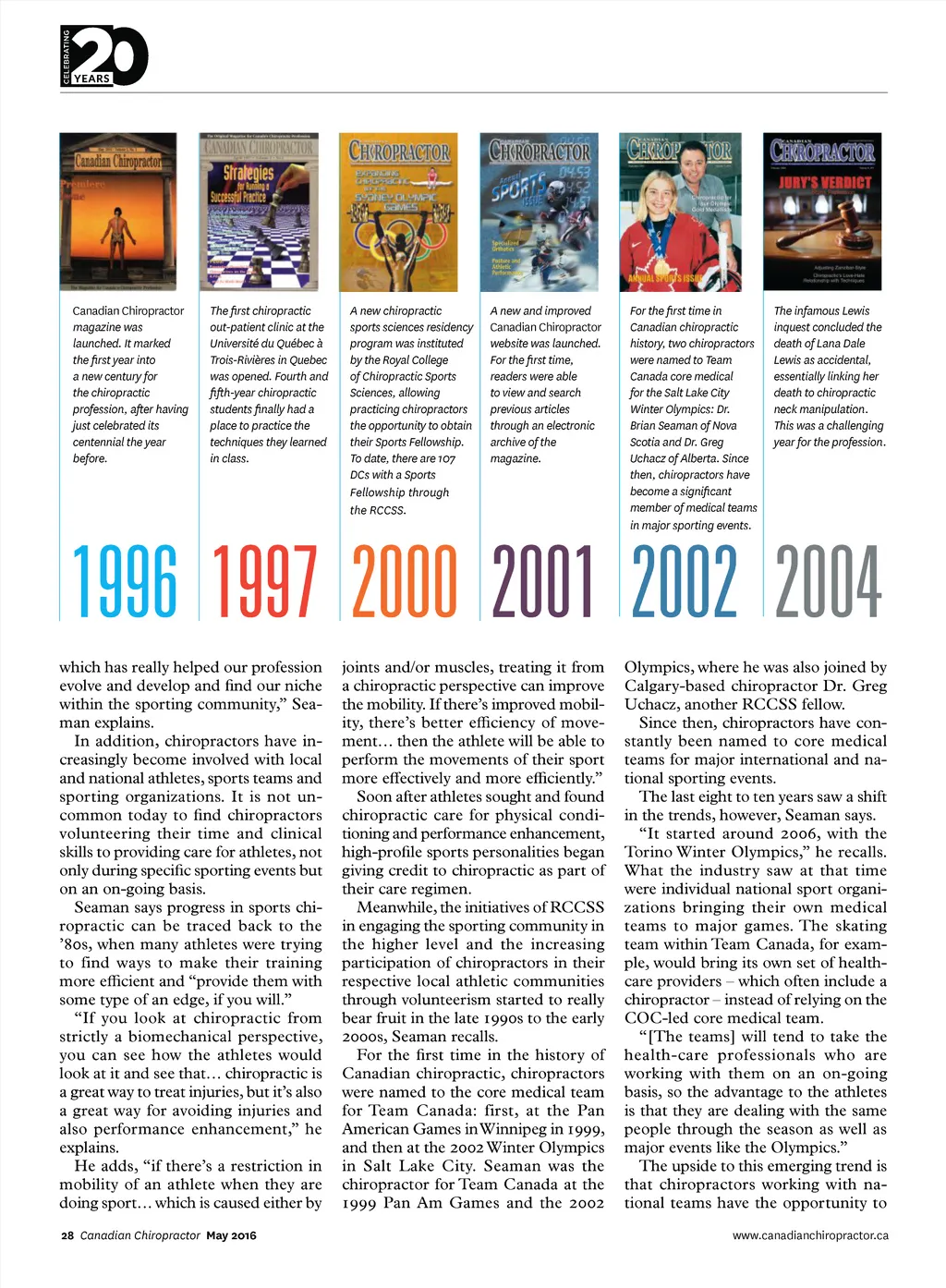
CMCC and St. Michael’s Hospital collaborate on a project to integrate chiropractic into primary care, hospital-based setting – a first of its kind for Ontario. The $600,000-project was funded by the Ministry of Health and Long Term Care. The establishment of a new chiropractic educational institution in British Columbia was approved by the British Columbia College of Chiropractors and the B.C. Chiropractic Association. The goal was to develop a university-based chiropractic program in the province. 2005 2008 2010 2011 2016 develop deeper relations with the ath-letes and the athletes have a greater appreciation for what the chiropractor can do for them on an on-going basis, Seaman explains. The downside, he points out, is that it creates lesser opportunities for DCs to participate in the already-shrinking core medical team. The last decade also saw chiropractic take more leadership roles in local and national sporting events. Seaman was named chair of medical services for the 2011 Canada Winter Games – the first-time a chiropractor assumed that post. More recently, Dr. Erik Klein, CEO of The Town Chiropractor in Saint John, N.B., was appointed director of medi-cal services for the 2014 Ford Women’s World Curling Championships. Seaman says it was a rewarding ex-perience. “It provided a lot of positive feedback for chiropractic care because a lot of health-care professions and a lot of the government-level [officials] aren’t used to seeing a chiropractor in that role.” challenging times for chiropractic. In 2002, British Columbia delisted chi-ropractic (and physiotherapy) from public funding. Ontario followed two years later, when it ceased funding for chiropractic services and physiother-apy. These delistings were done to save the public coffers hundreds of millions of dollars. At the time, the profession was naturally disappointed and saw the development as a setback for practice growth and public credibility. Lep-rich, however, believes that, in the long run, delisting chiropractic ser-vices from public funding actually “turned out to be a good thing.” Having practiced through both eras of publicly funded and unfunded chiropractic service, Leprich says the delisting of chiropractic allowed pa-tients to claim the full amount of the service through their extended health insurance. “When we had OHIP, I would have patients come into my office and say, ‘I have coverage for chiropractic through my work benefits program,’” Leprich recalls. But OHIP did not allow patients to access extended health benefits until OHIP allocation has been exhausted. For example, if OHIP paid $9.65 per treatment and a chiropractor’s charge is $12, pa-tients would have to pay the differ-ence out of their own pockets. “But when OHIP was taken away, these insurance companies now had the ability to step up and pay from first day – it was called, ‘first day coverage.’ They didn’t all do it at first, but now it’s pretty much universal.” Leprich notes, there are still some variances in coverage, as some pa-tients would be covered for 100 per cent of the treatment charge, some would be covered for 80 per cent, and then some have spousal coverage that allows them to claim the remaining amount on their spouse’s insurance. “Being delisted actually removed some of the financial barriers to peo-ple coming in [for chiropractic treat-ment],” Leprich says. In hindsight, although it became a big concern at the time, Leprich be-lieves defunding chiropractic did not have any significant impact on prac-tice in general. “I don’t miss it one bit,” he quips. May 2016 Canadian Chiropractor 29 The World Health Organization’s Global Burden of Disease 2010 report identified low back pain and spinal disorders as leading contributors to the global burden of disease. The report, published in 2012, positions chiropractic at the forefront of initiatives to find global solutions to these health-care challenges. For the first time, the Canada Winter Games event has named a chiropractor – Dr. Brian Seaman – chair of medical services for this national event, overseeing more than 20 sports events and 13 sports venues. Also in this year, the College of Chiropractic Sports Sciences was granted “Royal” distinction. Canadian Chiropractor magazine, the country’s premiere information resource for chiropractic professionals, celebrates 20 years of serving the profession! Delisting dilemma www.canadianchiropractor.ca The early 2000s also marked some
Chiropractic + Naturopathic Doctor May 2016: Page 29