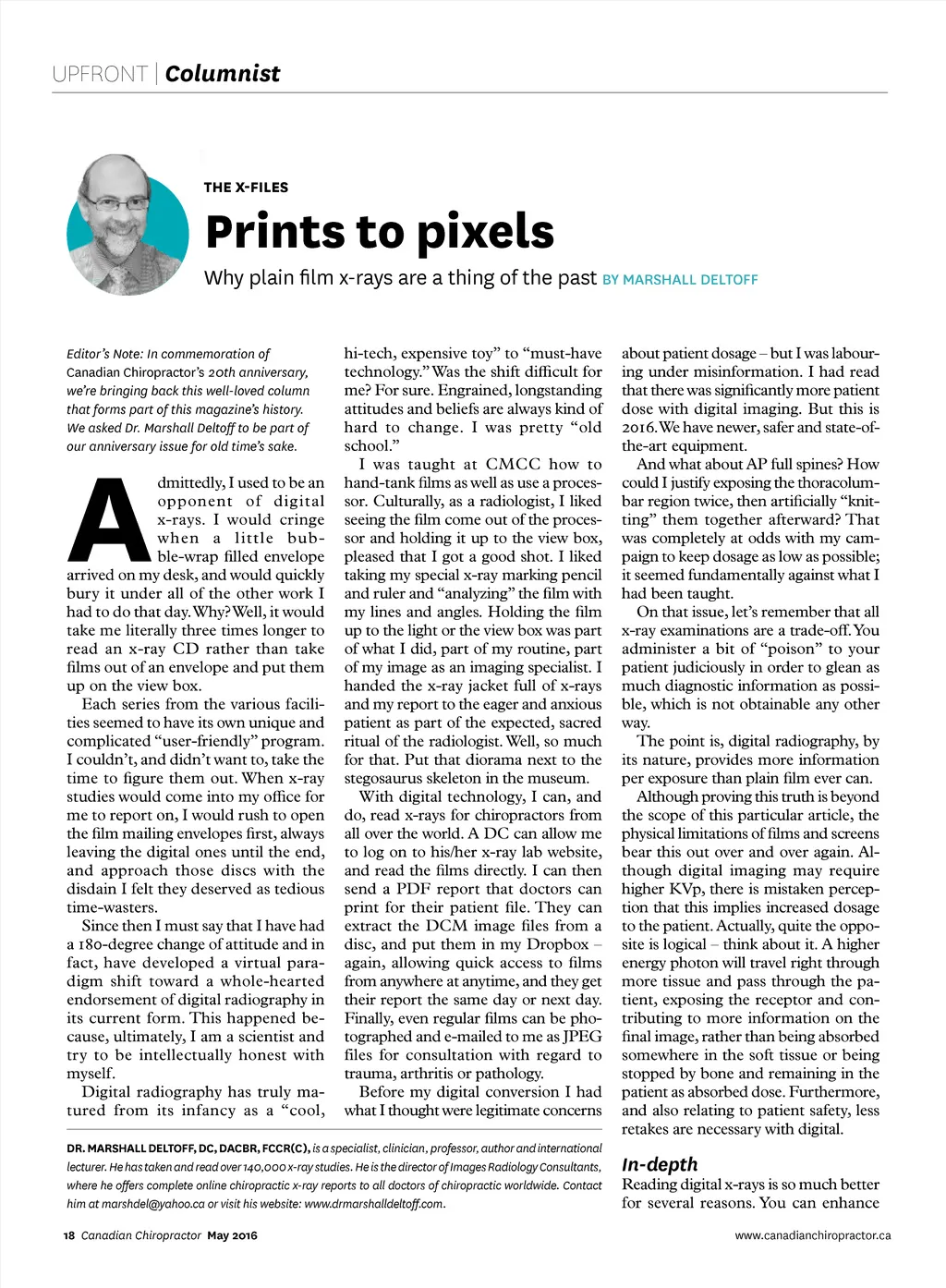
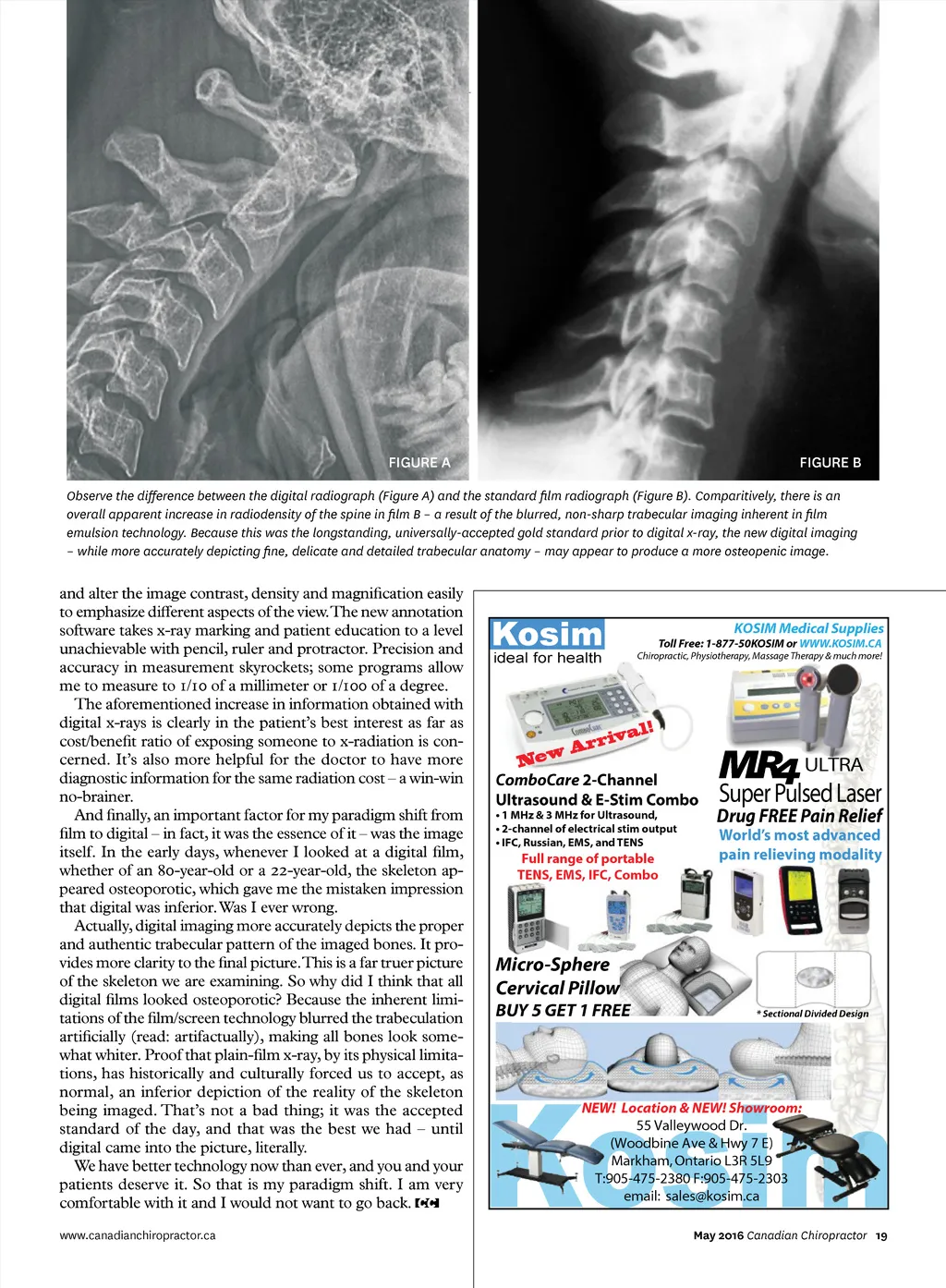
FIGURE A FIGURE B Observe the difference between the digital radiograph (Figure A) and the standard film radiograph (Figure B). Comparitively, there is an overall apparent increase in radiodensity of the spine in film B – a result of the blurred, non-sharp trabecular imaging inherent in film emulsion technology. Because this was the longstanding, universally-accepted gold standard prior to digital x-ray, the new digital imaging – while more accurately depicting fine, delicate and detailed trabecular anatomy – may appear to produce a more osteopenic image. and alter the image contrast, density and magnification easily to emphasize different aspects of the view. The new annotation software takes x-ray marking and patient education to a level unachievable with pencil, ruler and protractor. Precision and accuracy in measurement skyrockets; some programs allow me to measure to 1/10 of a millimeter or 1/100 of a degree. The aforementioned increase in information obtained with digital x-rays is clearly in the patient’s best interest as far as cost/benefit ratio of exposing someone to x-radiation is con-cerned. It’s also more helpful for the doctor to have more diagnostic information for the same radiation cost – a win-win no-brainer. And finally, an important factor for my paradigm shift from film to digital – in fact, it was the essence of it – was the image itself. In the early days, whenever I looked at a digital film, whether of an 80-year-old or a 22-year-old, the skeleton ap-peared osteoporotic, which gave me the mistaken impression that digital was inferior. Was I ever wrong. Actually, digital imaging more accurately depicts the proper and authentic trabecular pattern of the imaged bones. It pro-vides more clarity to the final picture. This is a far truer picture of the skeleton we are examining. So why did I think that all digital films looked osteoporotic? Because the inherent limi-tations of the film/screen technology blurred the trabeculation artificially (read: artifactually), making all bones look some-what whiter. Proof that plain-film x-ray, by its physical limita-tions, has historically and culturally forced us to accept, as normal, an inferior depiction of the reality of the skeleton being imaged. That’s not a bad thing; it was the accepted standard of the day, and that was the best we had – until digital came into the picture, literally. We have better technology now than ever, and you and your patients deserve it. So that is my paradigm shift. I am very comfortable with it and I would not want to go back. www.canadianchiropractor.ca Kosim ideal for health Chiropractic, Physiotherapy, Massage Therapy & much more! Toll Free: 1-877-50KOSIM or WWW.KOSIM.CA KOSIM M edical Supplies val! Arri w Ne ComboCare 2-Channel Ultrasound & E-Stim Combo • 1 MHz & 3 MHz for Ultrasound, • 2-channel of electrical stim output • IFC, Russian, EMS, and TENS ULTRA Drug FREE Pain Relief Super Pulsed Laser World’s most advanced pain relieving modality Full range of portable TENS, EMS, IFC , Combo Micro-Sphere Cervical Pillow BUY 5 GET 1 FREE * Sectional Divided Design NEW! Location & NEW! Showroom : 55 Valleywood Dr. (Woodbine Ave & Hwy 7 E) Markham, Ontario L3R 5L9 T:905-475-2380 F:905-475-2303 email: [email protected] May 2016 Canadian Chiropractor 19 CC_Kosim_May16_CSA.indd 1 2016-04-14 8:51 AM
Chiropractic + Naturopathic Doctor May 2016: Page 19