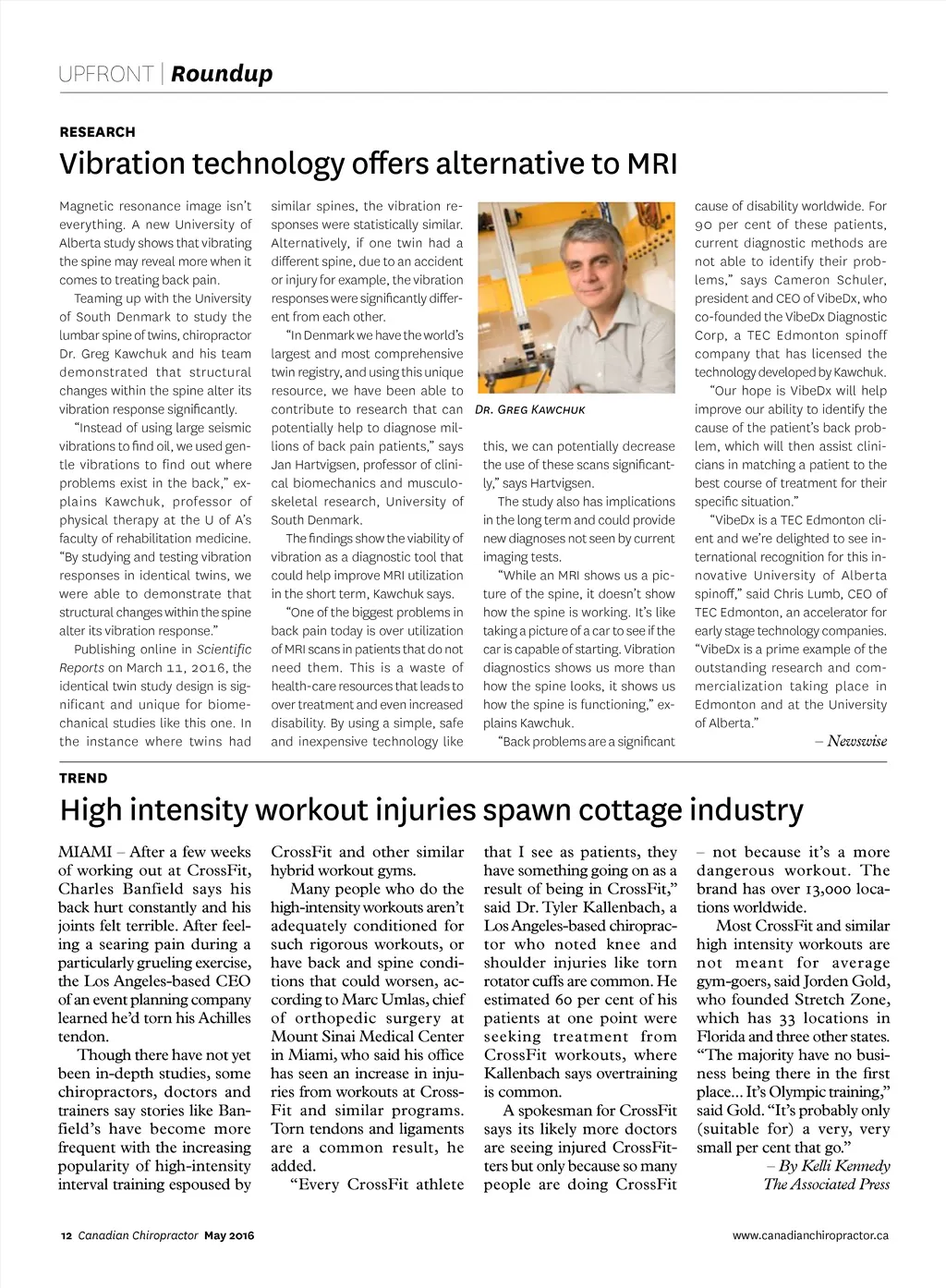
UPFRONT | Roundup RESEARCH Vibration technology offers alternative to MRI Magnetic resonance image isn’t everything. A new University of Alberta study shows that vibrating the spine may reveal more when it comes to treating back pain. Teaming up with the University of South Denmark to study the lumbar spine of twins, chiropractor Dr. Greg Kawchuk and his team demonstrated that structural changes within the spine alter its vibration response significantly. “Instead of using large seismic vibrations to find oil, we used gen-tle vibrations to find out where problems exist in the back,” ex-plains Kawchuk, professor of physical therapy at the U of A’s faculty of rehabilitation medicine. “By studying and testing vibration responses in identical twins, we were able to demonstrate that structural changes within the spine alter its vibration response.” Publishing online in Scientific Reports on March 11, 2016, the identical twin study design is sig-nificant and unique for biome-chanical studies like this one. In the instance where twins had similar spines, the vibration re-sponses were statistically similar. Alternatively, if one twin had a different spine, due to an accident or injury for example, the vibration responses were significantly differ-ent from each other. “In Denmark we have the world’s largest and most comprehensive twin registry, and using this unique resource, we have been able to contribute to research that can Dr. Greg Kawchuk potentially help to diagnose mil-lions of back pain patients,” says this, we can potentially decrease Jan Hartvigsen, professor of clini-the use of these scans significant-cal biomechanics and musculo-ly,” says Hartvigsen. skeletal research, University of The study also has implications South Denmark. in the long term and could provide The findings show the viability of new diagnoses not seen by current vibration as a diagnostic tool that imaging tests. could help improve MRI utilization “While an MRI shows us a pic-in the short term, Kawchuk says. ture of the spine, it doesn’t show “One of the biggest problems in how the spine is working. It’s like back pain today is over utilization taking a picture of a car to see if the of MRI scans in patients that do not car is capable of starting. Vibration need them. This is a waste of diagnostics shows us more than health-care resources that leads to how the spine looks, it shows us over treatment and even increased how the spine is functioning,” ex-disability. By using a simple, safe plains Kawchuk. and inexpensive technology like “Back problems are a significant cause of disability worldwide. For 90 per cent of these patients, current diagnostic methods are not able to identify their prob-lems,” says Cameron Schuler, president and CEO of VibeDx, who co-founded the VibeDx Diagnostic Corp, a TEC Edmonton spinoff company that has licensed the technology developed by Kawchuk. “Our hope is VibeDx will help improve our ability to identify the cause of the patient’s back prob-lem, which will then assist clini-cians in matching a patient to the best course of treatment for their specific situation.” “VibeDx is a TEC Edmonton cli-ent and we’re delighted to see in-ternational recognition for this in-novative University of Alberta spinoff,” said Chris Lumb, CEO of TEC Edmonton, an accelerator for early stage technology companies. “VibeDx is a prime example of the outstanding research and com-mercialization taking place in Edmonton and at the University of Alberta.” – Newswise TREND High intensity workout injuries spawn cottage industry MIAMI – After a few weeks of working out at CrossFit, Charles Banfield says his back hurt constantly and his joints felt terrible. After feel-ing a searing pain during a particularly grueling exercise, the Los Angeles-based CEO of an event planning company learned he’d torn his Achilles tendon. Though there have not yet been in-depth studies, some chiropractors, doctors and trainers say stories like Ban-field’s have become more frequent with the increasing popularity of high-intensity interval training espoused by 12 Canadian Chiropractor May 2016 CrossFit and other similar hybrid workout gyms. Many people who do the high-intensity workouts aren’t adequately conditioned for such rigorous workouts, or have back and spine condi-tions that could worsen, ac-cording to Marc Umlas, chief of orthopedic surgery at Mount Sinai Medical Center in Miami, who said his office has seen an increase in inju-ries from workouts at Cross-Fit and similar programs. Torn tendons and ligaments are a common result, he added. “Every CrossFit athlete that I see as patients, they have something going on as a result of being in CrossFit,” said Dr. Tyler Kallenbach, a Los Angeles-based chiroprac-tor who noted knee and shoulder injuries like torn rotator cuffs are common. He estimated 60 per cent of his patients at one point were seeking treatment from CrossFit workouts, where Kallenbach says overtraining is common. A spokesman for CrossFit says its likely more doctors are seeing injured CrossFit-ters but only because so many people are doing CrossFit – not because it’s a more dangerous workout. The brand has over 13,000 loca-tions worldwide. Most CrossFit and similar high intensity workouts are not meant for average gym-goers, said Jorden Gold, who founded Stretch Zone, which has 33 locations in Florida and three other states. “The majority have no busi-ness being there in the first place... It’s Olympic training,” said Gold. “It’s probably only (suitable for) a very, very small per cent that go.” – By Kelli Kennedy The Associated Press www.canadianchiropractor.ca
Chiropractic + Naturopathic Doctor May 2016: Page 12