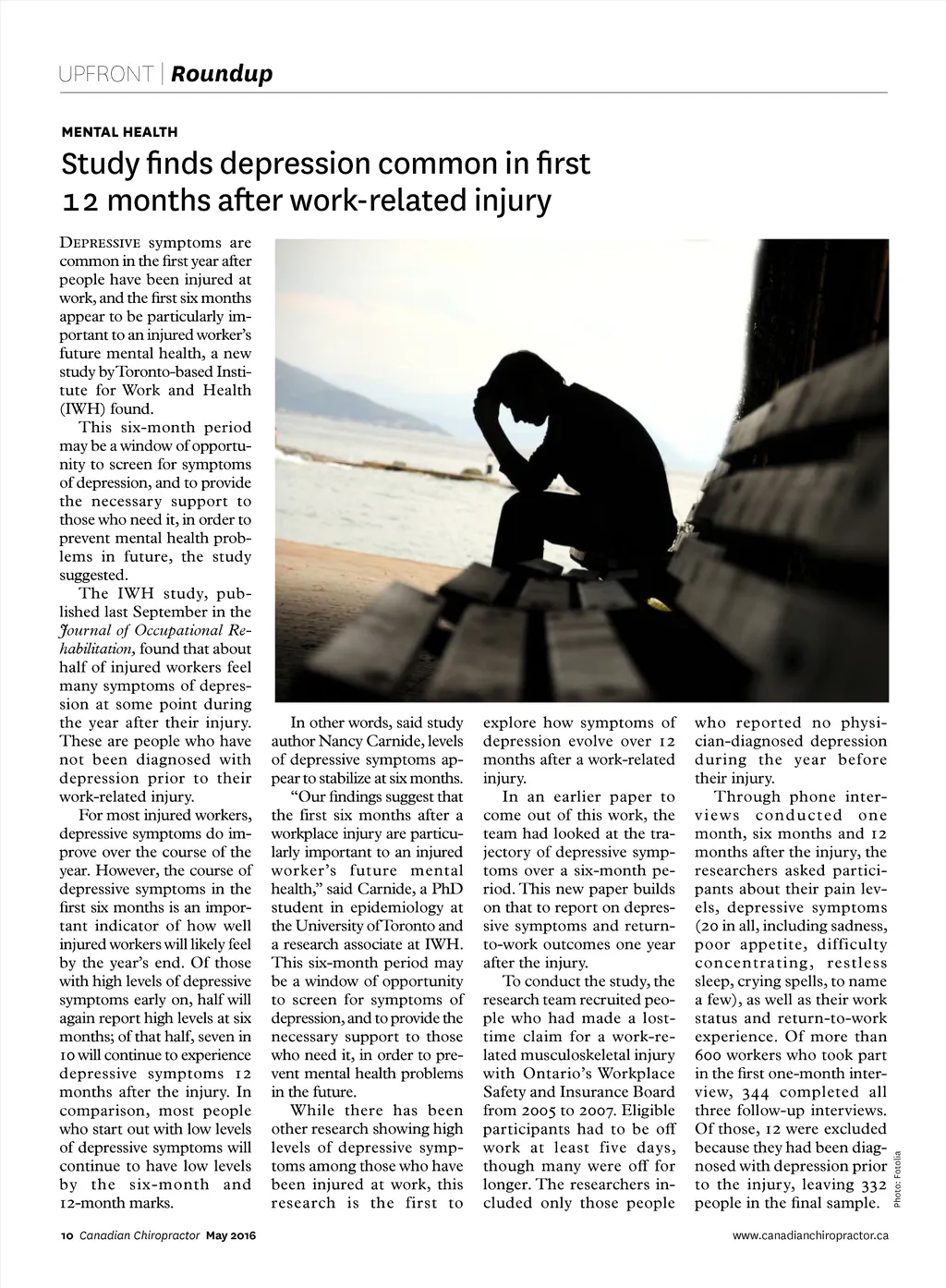
UPFRONT | Roundup RESEARCH Aging diminishes spinal cord regeneration after injury: study Older people are increas-ingly active, and this lifestyle shift has contributed to the rise in average age of a person experiencing a spinal cord injury. The changing demo-graphic calls for a better un-derstanding of how aging impacts recovery and repair after a spinal cord injury. Re-searchers at University of California, San Diego School of Medicine and University of British Columbia (UBC) have now determined that, in mice, age diminishes the abil-ity to regenerate axons, the brain’s communication wires in the spinal cord. The study was published March 31 in Cell Reports. “Since many central nerv-ous system diseases and disor-ders are age-related and are increasingly occurring in older populations, our study will likely have wide implications for both basic research and translational efforts on central nervous system dysfunction and restoration,” said senior author Binhai Zheng, associ-ate professor of neurosciences at UC San Diego School of Medicine. To examine how age af-fects regeneration, Zheng and colleagues removed the Pten gene in the neurons of both young and old mice (up to 18 months old), a molecular manipulation known to pro-mote regeneration in young adult mammals. The researchers found that, as in young mice, Pten deletion in neurons of older mice elicited the types of post-injury cellular responses that often indicate increased Who’s tracking your financial goals? By age 40 you should already have reached milestone targets for retirement savings, debt levels, net worth and children’s savings. Deletion of the Pten gene promotes axon regeneration in young but not old mice after spinal cord injury. How are you doing? regeneration. However, axons in older mice were far less able to regenerate beyond the in-jury site, which would be re-quired for any functional gains. In addition, older mice had increased signs of inflam-mation and other changes at injury sites, as compared to younger mice. These changes indicate that axons in older mice face a more difficult environment for regeneration. The researchers concluded that advancing age is associ-ated with a further decline in the mammalian central nerv-ous system’s ability to regen-erate axons. The team studied two different types of neurons and the results were similar. “The important implica-tion is that in our fight against paralysis, we ought to think about how to overcome the increased challenges in pro-moting repair and recovery in older individuals as well,” said co-senior author Dr. Wolfram Tetzlaff, professor at UBC and director of the Interna-tional Collaboration On Re-pair Discoveries, the spinal cord injury research centre of UBC and Vancouver Coastal Health Research Institute. – Newswise We know doctors. • For 25 years we have specialized in providing goal based, integrated personal financial plans for doctors and their families in Toronto. One plan that coordinates all aspects of your finances for better decision making, cost savings and integrated planning. One overall, fair, transparent fee. Professional experts (Chartered Accountants, Certified Financial Planners), not product brokers. Specialized knowledge about doctor compensation, career structure, tax planning and more. • • • • For a complimentary one hour meeting about your needs and our services, contact: Kurt Rosentreter CPA, CA, CFP, CLU, CIMA, FCSI, TEP, CIM, FMA Senior Financial Advisor, Manulife Securities Incorporated Certified Financial Planner, Manulife Securities Insurance Inc. 416.628.5761, ext 0 [email protected] www.kurtismycfo.com Follow Kurt’s financial tips on social media Photo: UC San Diego Health www.canadianchiropractor.ca CC_May16_Manulife_CSA.indd 1 May 2016 Canadian Chiropractor 11 2016-03-16 1:54 PM
Chiropractic + Naturopathic Doctor May 2016: Page 11