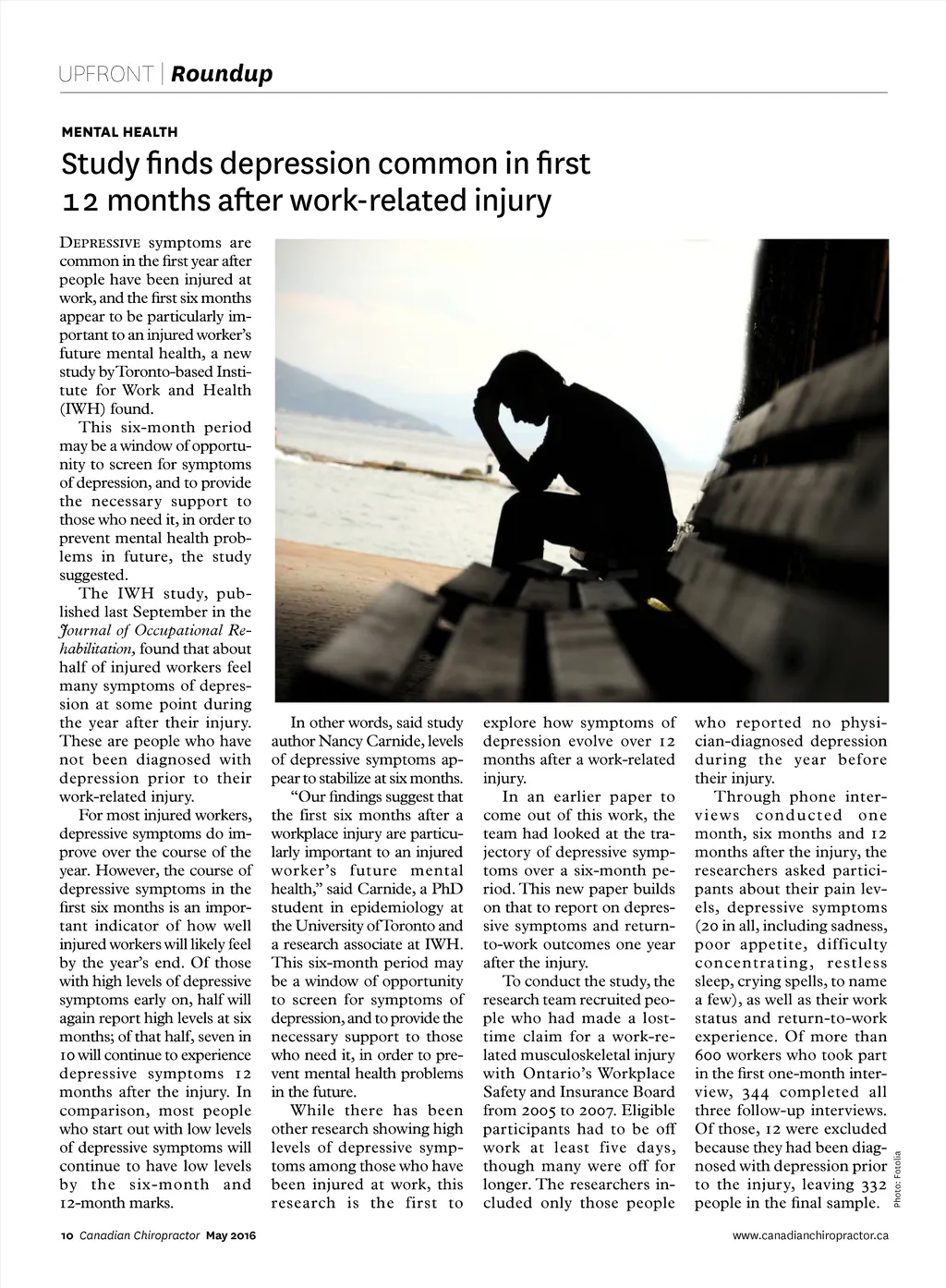
UPFRONT | Roundup MENTAL HEALTH Study finds depression common in first 12 months after work-related injury Depressive symptoms are common in the first year after people have been injured at work, and the first six months appear to be particularly im-portant to an injured worker’s future mental health, a new study by Toronto-based Insti-tute for Work and Health (IWH) found. This six-month period may be a window of opportu-nity to screen for symptoms of depression, and to provide the necessary support to those who need it, in order to prevent mental health prob-lems in future, the study suggested. The IWH study, pub-lished last September in the Journal of Occupational Re-habilitation, found that about half of injured workers feel many symptoms of depres-sion at some point during the year after their injury. These are people who have not been diagnosed with depression prior to their work-related injury. For most injured workers, depressive symptoms do im-prove over the course of the year. However, the course of depressive symptoms in the first six months is an impor-tant indicator of how well injured workers will likely feel by the year’s end. Of those with high levels of depressive symptoms early on, half will again report high levels at six months; of that half, seven in 10 will continue to experience depressive symptoms 12 months after the injury. In comparison, most people who start out with low levels of depressive symptoms will continue to have low levels by the six-month and 12-month marks. 10 Canadian Chiropractor May 2016 In other words, said study author Nancy Carnide, levels of depressive symptoms ap-pear to stabilize at six months. “Our findings suggest that the first six months after a workplace injury are particu-larly important to an injured worker’s future mental health,” said Carnide, a PhD student in epidemiology at the University of Toronto and a research associate at IWH. This six-month period may be a window of opportunity to screen for symptoms of depression, and to provide the necessary support to those who need it, in order to pre-vent mental health problems in the future. While there has been other research showing high levels of depressive symp-toms among those who have been injured at work, this research is the first to explore how symptoms of depression evolve over 12 months after a work-related injury. In an earlier paper to come out of this work, the team had looked at the tra-jectory of depressive symp-toms over a six-month pe-riod. This new paper builds on that to report on depres-sive symptoms and return-to-work outcomes one year after the injury. To conduct the study, the research team recruited peo-ple who had made a lost-time claim for a work-re-lated musculoskeletal injury with Ontario’s Workplace Safety and Insurance Board from 2005 to 2007. Eligible participants had to be off work at least five days, though many were off for longer. The researchers in-cluded only those people who reported no physi-cian-diagnosed depression during the year before their injury. Through phone inter-views conducted one month, six months and 12 months after the injury, the researchers asked partici-pants about their pain lev-els, depressive symptoms (20 in all, including sadness, poor appetite, difficulty concentrating , restless sleep, crying spells, to name a few), as well as their work status and return-to-work experience. Of more than 600 workers who took part in the first one-month inter-view, 344 completed all three follow-up interviews. Of those, 12 were excluded because they had been diag-nosed with depression prior to the injury, leaving 332 people in the final sample. www.canadianchiropractor.ca Photo: Fotolia
Chiropractic + Naturopathic Doctor May 2016: Page 10