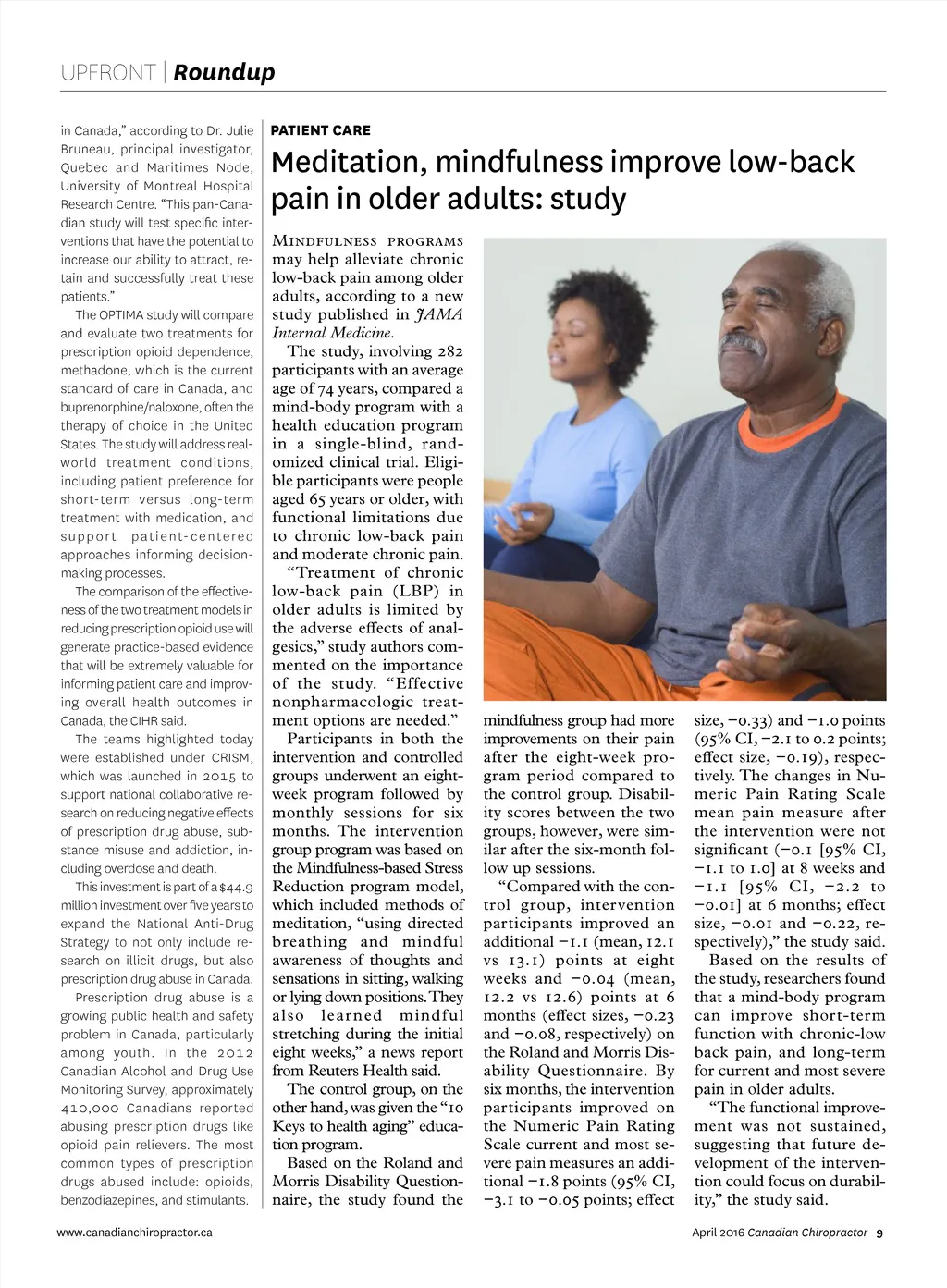
UPFRONT | Roundup in Canada,” according to Dr. Julie Bruneau, principal investigator, Quebec and Maritimes Node, University of Montreal Hospital Research Centre. “This pan-Cana-dian study will test specific inter-ventions that have the potential to increase our ability to attract, re-tain and successfully treat these patients.” The OPTIMA study will compare and evaluate two treatments for prescription opioid dependence, methadone, which is the current standard of care in Canada, and buprenorphine/naloxone, often the therapy of choice in the United States. The study will address real-world treatment conditions, including patient preference for short-term versus long-term treatment with medication, and support pa tient-cent ered approaches informing decision-making processes. The comparison of the effective-ness of the two treatment models in reducing prescription opioid use will generate practice-based evidence that will be extremely valuable for informing patient care and improv-ing overall health outcomes in Canada, the CIHR said. The teams highlighted today were established under CRISM, which was launched in 2015 to support national collaborative re-search on reducing negative effects of prescription drug abuse, sub-stance misuse and addiction, in-cluding overdose and death. This investment is part of a $44.9 million investment over five years to expand the National Anti-Drug Strategy to not only include re-search on illicit drugs, but also prescription drug abuse in Canada. Prescription drug abuse is a growing public health and safety problem in Canada, particularly among youth. In the 2012 Canadian Alcohol and Drug Use Monitoring Survey, approximately 410,000 Canadians reported abusing prescription drugs like opioid pain relievers. The most common types of prescription drugs abused include: opioids, benzodiazepines, and stimulants. www.canadianchiropractor.ca Meditation, mindfulness improve low-back pain in older adults: study Mindfulness programs may help alleviate chronic low-back pain among older adults, according to a new study published in JAMA Internal Medicine. The study, involving 282 participants with an average age of 74 years, compared a mind-body program with a health education program in a single-blind, rand-omized clinical trial. Eligi-ble participants were people aged 65 years or older, with functional limitations due to chronic low-back pain and moderate chronic pain. “Treatment of chronic low-back pain (LBP) in older adults is limited by the adverse effects of anal-gesics,” study authors com-mented on the importance of the study. “Effective nonpharmacologic treat-ment options are needed.” Participants in both the intervention and controlled groups underwent an eight-week program followed by monthly sessions for six months. The intervention group program was based on the Mindfulness-based Stress Reduction program model, which included methods of meditation, “using directed breathing and mindful awareness of thoughts and sensations in sitting, walking or lying down positions. They also lear ned mindful stretching during the initial eight weeks,” a news report from Reuters Health said. The control group, on the other hand, was given the “10 Keys to health aging” educa-tion program. Based on the Roland and Morris Disability Question-naire, the study found the PATIENT CARE mindfulness group had more improvements on their pain after the eight-week pro-gram period compared to the control group. Disabil-ity scores between the two groups, however, were sim-ilar after the six-month fol-low up sessions. “Compared with the con-trol group, intervention participants improved an additional −1.1 (mean, 12.1 vs 13.1) points at eight weeks and −0.04 (mean, 12.2 vs 12.6) points at 6 months (effect sizes, −0.23 and −0.08, respectively) on the Roland and Morris Dis-ability Questionnaire. By six months, the intervention participants improved on the Numeric Pain Rating Scale current and most se-vere pain measures an addi-tional −1.8 points (95% CI, −3.1 to −0.05 points; effect size, −0.33) and −1.0 points (95% CI, −2.1 to 0.2 points; effect size, −0.19), respec-tively. The changes in Nu-meric Pain Rating Scale mean pain measure after the intervention were not significant (−0.1 [95% CI, −1.1 to 1.0] at 8 weeks and −1.1 [95% CI, −2.2 to −0.01] at 6 months; effect size, −0.01 and −0.22, re-spectively),” the study said. Based on the results of the study, researchers found that a mind-body program can improve short-term function with chronic-low back pain, and long-term for current and most severe pain in older adults. “The functional improve-ment was not sustained, suggesting that future de-velopment of the interven-tion could focus on durabil-ity,” the study said. April 2016 Canadian Chiropractor 9
Chiropractic + Naturopathic Doctor April 2016: Page 9