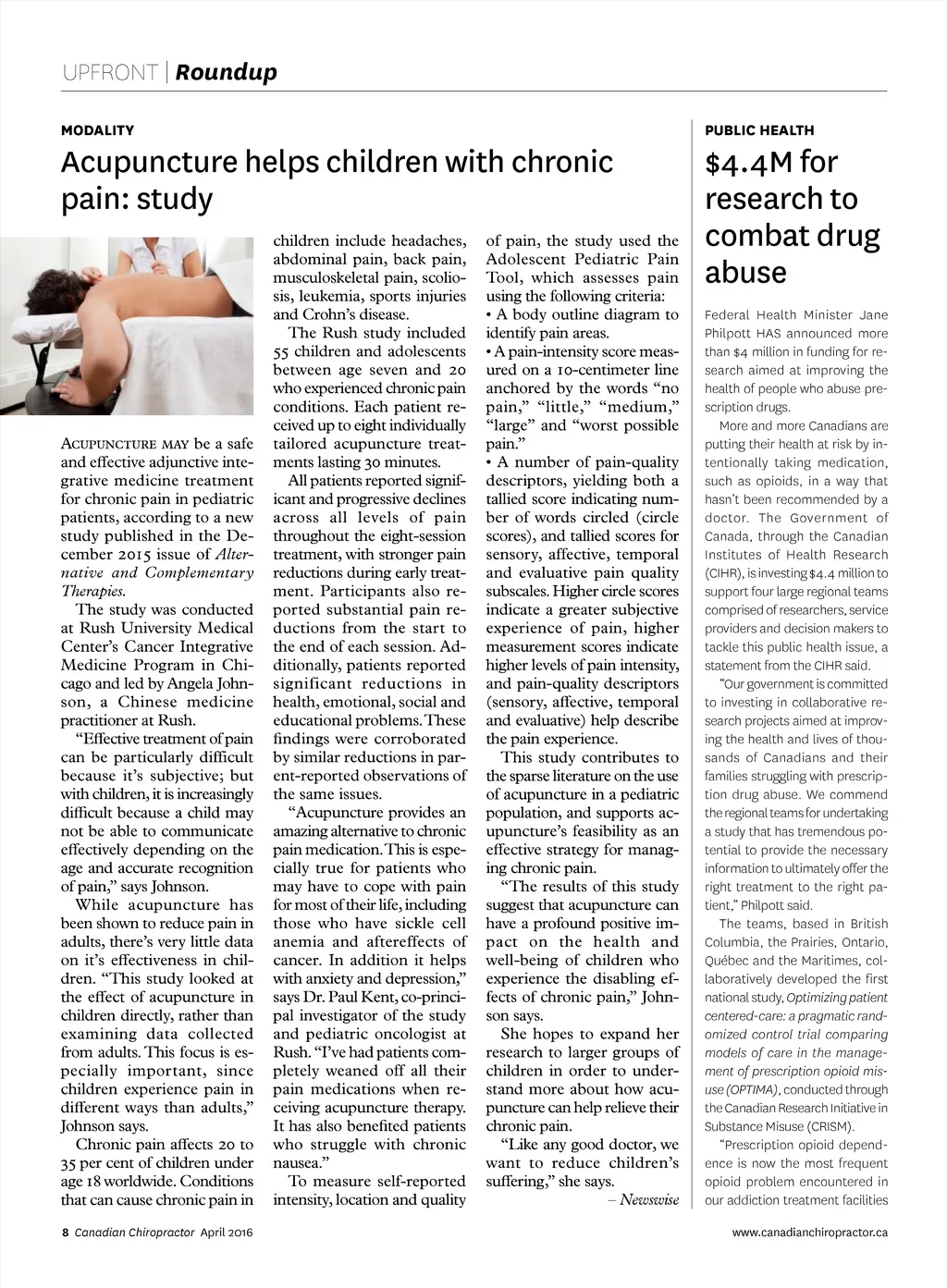
UPFRONT | Roundup MODALITY Acupuncture helps children with chronic pain: study children include headaches, abdominal pain, back pain, musculoskeletal pain, scolio-sis, leukemia, sports injuries and Crohn’s disease. The Rush study included 55 children and adolescents between age seven and 20 who experienced chronic pain conditions. Each patient re-ceived up to eight individually tailored acupuncture treat-ments lasting 30 minutes. All patients reported signif-icant and progressive declines across all levels of pain throughout the eight-session treatment, with stronger pain reductions during early treat-ment. Participants also re-ported substantial pain re-ductions from the start to the end of each session. Ad-ditionally, patients reported significant reductions in health, emotional, social and educational problems. These findings were corroborated by similar reductions in par-ent-reported observations of the same issues. “Acupuncture provides an amazing alternative to chronic pain medication. This is espe-cially true for patients who may have to cope with pain for most of their life, including those who have sickle cell anemia and aftereffects of cancer. In addition it helps with anxiety and depression,” says Dr. Paul Kent, co-princi-pal investigator of the study and pediatric oncologist at Rush. “I’ve had patients com-pletely weaned off all their pain medications when re-ceiving acupuncture therapy. It has also benefited patients who struggle with chronic nausea.” To measure self-reported intensity, location and quality of pain, the study used the Adolescent Pediatric Pain Tool, which assesses pain using the following criteria: • A body outline diagram to identify pain areas. • A pain-intensity score meas-ured on a 10-centimeter line anchored by the words “no pain,” “little,” “medium,” “large” and “worst possible pain.” • A number of pain-quality descriptors, yielding both a tallied score indicating num-ber of words circled (circle scores), and tallied scores for sensory, affective, temporal and evaluative pain quality subscales. Higher circle scores indicate a greater subjective experience of pain, higher measurement scores indicate higher levels of pain intensity, and pain-quality descriptors (sensory, affective, temporal and evaluative) help describe the pain experience. This study contributes to the sparse literature on the use of acupuncture in a pediatric population, and supports ac-upuncture’s feasibility as an effective strategy for manag-ing chronic pain. “The results of this study suggest that acupuncture can have a profound positive im-pact on the health and well-being of children who experience the disabling ef-fects of chronic pain,” John-son says. She hopes to expand her research to larger groups of children in order to under-stand more about how acu-puncture can help relieve their chronic pain. “Like any good doctor, we want to reduce children’s suffering,” she says. – Newswise PUBLIC HEALTH $4.4M for research to combat drug abuse Federal Health Minister Jane Philpott HAS announced more than $4 million in funding for re-search aimed at improving the health of people who abuse pre-scription drugs. More and more Canadians are putting their health at risk by in-tentionally taking medication, such as opioids, in a way that hasn’t been recommended by a doctor. The Government of Canada, through the Canadian Institutes of Health Research (CIHR), is investing $4.4 million to support four large regional teams comprised of researchers, service providers and decision makers to tackle this public health issue, a statement from the CIHR said. “Our government is committed to investing in collaborative re-search projects aimed at improv-ing the health and lives of thou-sands of Canadians and their families struggling with prescrip-tion drug abuse. We commend the regional teams for undertaking a study that has tremendous po-tential to provide the necessary information to ultimately offer the right treatment to the right pa-tient,” Philpott said. The teams, based in British Columbia, the Prairies, Ontario, Québec and the Maritimes, col-laboratively developed the first national study, Optimizing patient centered-care: a pragmatic rand-omized control trial comparing models of care in the manage-ment of prescription opioid mis-use (OPTIMA) , conducted through the Canadian Research Initiative in Substance Misuse (CRISM). “Prescription opioid depend-ence is now the most frequent opioid problem encountered in our addiction treatment facilities www.canadianchiropractor.ca Acupuncture may be a safe and effective adjunctive inte-grative medicine treatment for chronic pain in pediatric patients, according to a new study published in the De-cember 2015 issue of Alter-native and Complementary Therapies. The study was conducted at Rush University Medical Center’s Cancer Integrative Medicine Program in Chi-cago and led by Angela John-son, a Chinese medicine practitioner at Rush. “Effective treatment of pain can be particularly difficult because it’s subjective; but with children, it is increasingly difficult because a child may not be able to communicate effectively depending on the age and accurate recognition of pain,” says Johnson. While acupuncture has been shown to reduce pain in adults, there’s very little data on it’s effectiveness in chil-dren. “This study looked at the effect of acupuncture in children directly, rather than examining data collected from adults. This focus is es-pecially important, since children experience pain in different ways than adults,” Johnson says. Chronic pain affects 20 to 35 per cent of children under age 18 worldwide. Conditions that can cause chronic pain in 8 Canadian Chiropractor April 2016
Chiropractic + Naturopathic Doctor April 2016: Page 8