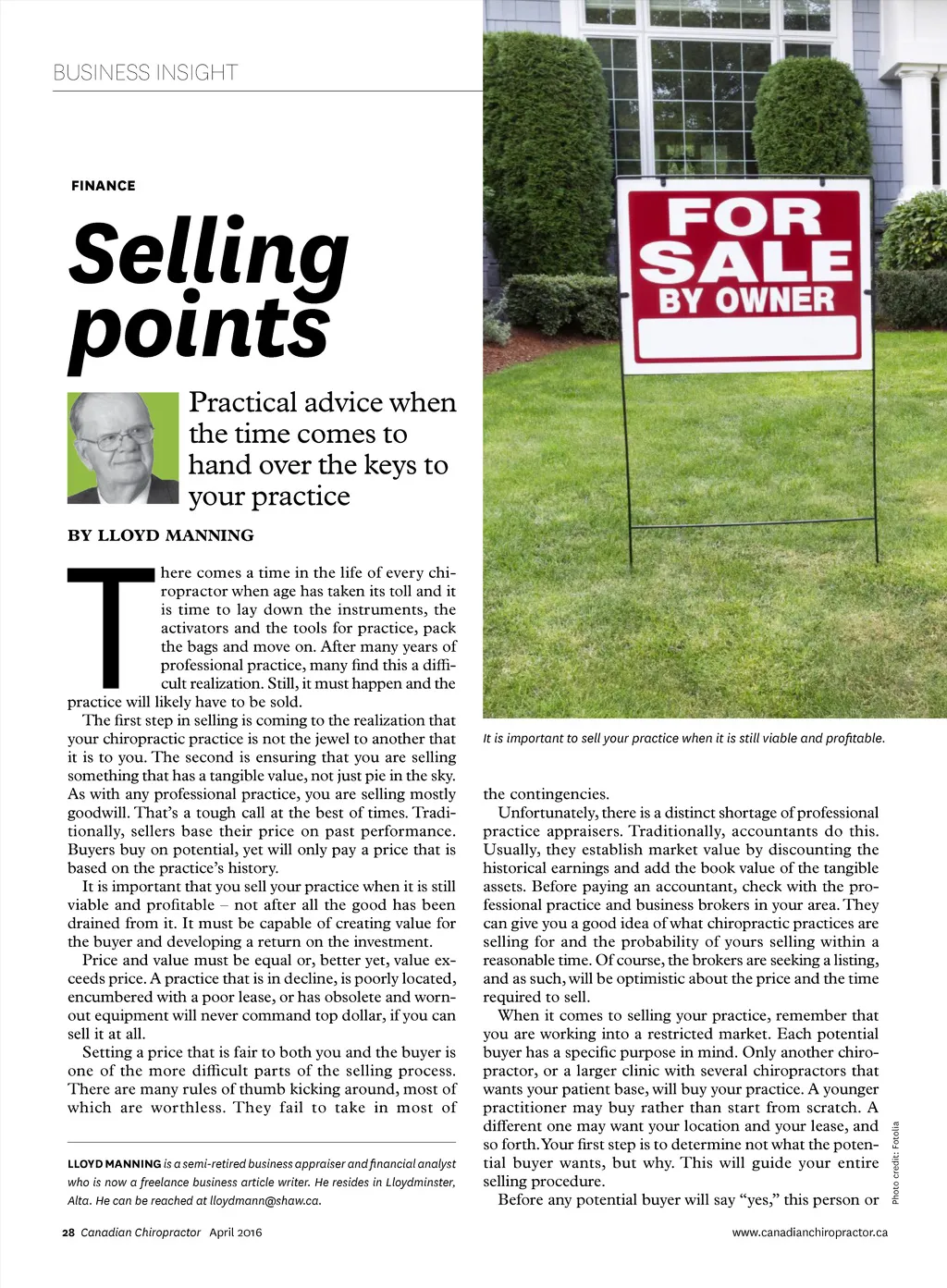
self sell. If not, employ the services of a professional prac-tice or business broker that has a sterling reputation, is well qualified and experienced. For this, you will pay a commis-sion, not less than five, but it could be as high as ten per cent of the selling price. Should you choose to self sell, you must do everything a broker would do, while managing your practice at the same time, making certain it doesn’t go into the tank while you are performing the selling function. You must get the word out to as many potential buyers as possible. Select appro-priate advertising media, prepare effective copy, and then advertise. You must develop a selling regimen that displays all of the good points. As for the bad points: don’t deny them, but don’t elaborate on them either. Be prepared to ward off dreamers and tire kickers. So, if you’re up for it, go for it. If not, use a broker but keep in mind they are not miracle workers. You are not selling a restaurant or a convenience store, but a specialized business that will attract only a specific class of buyers who are knowledgeable. “Setting a price that is fair to both you and the buyer is one of the more diffucult parts of the selling process.” clinic must have a complete understanding of what is being sold, that it meets his or her requirements, and overcomes the constraints. What is the reputation of the practice? What is the prin-cipal source of the patients? Are patients satisfied with the level of care given? Why is it being sold? The buyer will request a detailed demographic and patient analysis. What are the strong points? What services can be expanded and what should be downgraded? What is the potential for growth? You must convince this prospect that buying your practice is preferable to buying a competitor or starting a new practice. You must set the stage, ensure that all of the ducks are in order and that your practice is in condition to be sold. The most important detail is to have a minimum of five years income and expense statements ready for perusal. The positioning and competency of your staff is also vitally important – who will remain with the practice and who will not. The question always arises: should you sell your practice yourself or employ a broker? The principal objective is to obtain the best price with the most favourable terms in the shortest period of time, and with the least amount of strain. To obtain all of this, an expert professional practice or business broker – not necessarily an expert in chiropractic practice – is required. If you are that expert, by all means www.canadianchiropractor.ca Be careful about having your practice up for sale for too long. The word gets around and some will wonder what is wrong with it if the market exposure is lengthy. Before becoming too fixed on the asking-selling price, consider seller financing. By carrying back part of the purchase price you will probably get a better price and perhaps save some tax dollars. Still, ensure that the practice generates sufficient profit to make the payments and pro-vide a decent standard of living for the buyer. Verify that without secondary financing, the buyer has sufficient equity so that he or she cannot walk if things do not work out exactly as planned. Lastly, sell when your chiropractic practice has a strong and growing patient base, when it’s profitable, and when there is something there for the buyer. Too often, profes-sional practices and businesses are offered for sale when all the good is gone and nothing remains but the dregs. They are on the market month after month waiting for a foolish buyer who never comes. Eventually the owner folds his tent and steals off into the night. YOUR FEEDBACK IS NEEDED. Take part in our ongoing chiropractic market survey and be counted. Take the survey at www.surveymonkey.com/r/canadianchiropractor April 2016 Canadian Chiropractor 29
Chiropractic + Naturopathic Doctor April 2016: Page 29