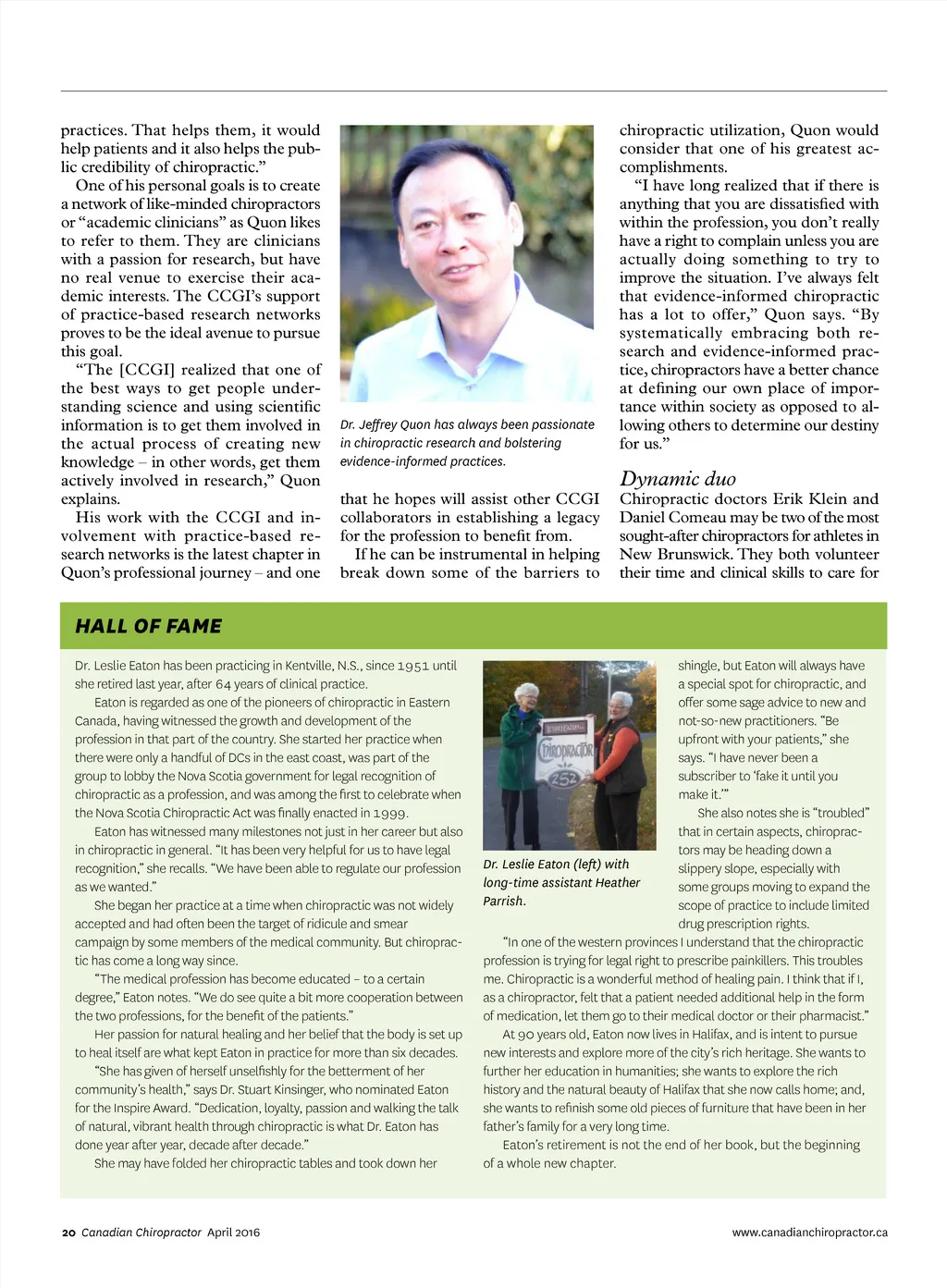
practices. That helps them, it would help patients and it also helps the pub-lic credibility of chiropractic.” One of his personal goals is to create a network of like-minded chiropractors or “academic clinicians” as Quon likes to refer to them. They are clinicians with a passion for research, but have no real venue to exercise their aca-demic interests. The CCGI’s support of practice-based research networks proves to be the ideal avenue to pursue this goal. “The [CCGI] realized that one of the best ways to get people under-standing science and using scientific information is to get them involved in the actual process of creating new knowledge – in other words, get them actively involved in research,” Quon explains. His work with the CCGI and in-volvement with practice-based re-search networks is the latest chapter in Quon’s professional journey – and one Dr. Jeffrey Quon has always been passionate in chiropractic research and bolstering evidence-informed practices. chiropractic utilization, Quon would consider that one of his greatest ac-complishments. “I have long realized that if there is anything that you are dissatisfied with within the profession, you don’t really have a right to complain unless you are actually doing something to try to improve the situation. I’ve always felt that evidence-informed chiropractic has a lot to offer,” Quon says. “By systematically embracing both re-search and evidence-informed prac-tice, chiropractors have a better chance at defining our own place of impor-tance within society as opposed to al-lowing others to determine our destiny for us.” that he hopes will assist other CCGI collaborators in establishing a legacy for the profession to benefit from. If he can be instrumental in helping break down some of the barriers to Dynamic duo Chiropractic doctors Erik Klein and Daniel Comeau may be two of the most sought-after chiropractors for athletes in New Brunswick. They both volunteer their time and clinical skills to care for HALL OF FAME Dr. Leslie Eaton has been practicing in Kentville, N.S., since 1951 until she retired last year, after 64 years of clinical practice. Eaton is regarded as one of the pioneers of chiropractic in Eastern Canada, having witnessed the growth and development of the profession in that part of the country. She started her practice when there were only a handful of DCs in the east coast, was part of the group to lobby the Nova Scotia government for legal recognition of chiropractic as a profession, and was among the first to celebrate when the Nova Scotia Chiropractic Act was finally enacted in 1999. Eaton has witnessed many milestones not just in her career but also in chiropractic in general. “It has been very helpful for us to have legal recognition,” she recalls. “We have been able to regulate our profession as we wanted.” She began her practice at a time when chiropractic was not widely accepted and had often been the target of ridicule and smear campaign by some members of the medical community. But chiroprac-tic has come a long way since. “The medical profession has become educated – to a certain degree,” Eaton notes. “We do see quite a bit more cooperation between the two professions, for the benefit of the patients.” Her passion for natural healing and her belief that the body is set up to heal itself are what kept Eaton in practice for more than six decades. “She has given of herself unselfishly for the betterment of her community’s health,” says Dr. Stuart Kinsinger, who nominated Eaton for the Inspire Award. “Dedication, loyalty, passion and walking the talk of natural, vibrant health through chiropractic is what Dr. Eaton has done year after year, decade after decade.” She may have folded her chiropractic tables and took down her shingle, but Eaton will always have a special spot for chiropractic, and offer some sage advice to new and not-so-new practitioners. “Be upfront with your patients,” she says. “I have never been a subscriber to ‘fake it until you make it.’” She also notes she is “troubled” that in certain aspects, chiroprac-tors may be heading down a Dr. Leslie Eaton (left) with slippery slope, especially with long-time assistant Heather some groups moving to expand the Parrish. scope of practice to include limited drug prescription rights. “In one of the western provinces I understand that the chiropractic profession is trying for legal right to prescribe painkillers. This troubles me. Chiropractic is a wonderful method of healing pain. I think that if I, as a chiropractor, felt that a patient needed additional help in the form of medication, let them go to their medical doctor or their pharmacist.” At 90 years old, Eaton now lives in Halifax, and is intent to pursue new interests and explore more of the city’s rich heritage. She wants to further her education in humanities; she wants to explore the rich history and the natural beauty of Halifax that she now calls home; and, she wants to refinish some old pieces of furniture that have been in her father’s family for a very long time. Eaton’s retirement is not the end of her book, but the beginning of a whole new chapter. 20 Canadian Chiropractor April 2016 www.canadianchiropractor.ca
Chiropractic + Naturopathic Doctor April 2016: Page 20