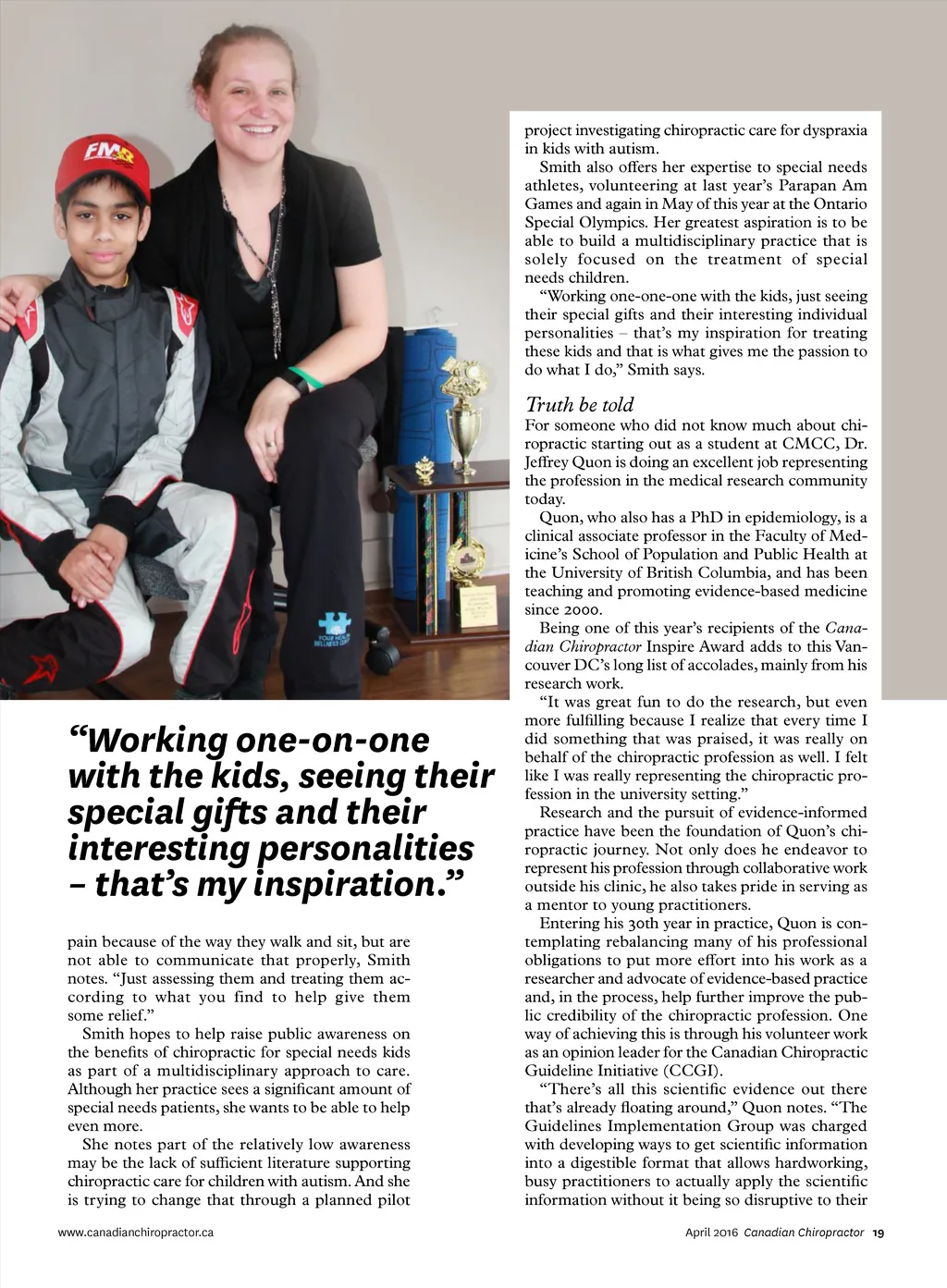
project investigating chiropractic care for dyspraxia in kids with autism. Smith also offers her expertise to special needs athletes, volunteering at last year’s Parapan Am Games and again in May of this year at the Ontario Special Olympics. Her greatest aspiration is to be able to build a multidisciplinary practice that is solely focused on the treatment of special needs children. “Working one-one-one with the kids, just seeing their special gifts and their interesting individual personalities – that’s my inspiration for treating these kids and that is what gives me the passion to do what I do,” Smith says. For someone who did not know much about chi-ropractic starting out as a student at CMCC, Dr. Jeffrey Quon is doing an excellent job representing the profession in the medical research community today. Quon, who also has a PhD in epidemiology, is a clinical associate professor in the Faculty of Med-icine’s School of Population and Public Health at the University of British Columbia, and has been teaching and promoting evidence-based medicine since 2000. Being one of this year’s recipients of the Cana-dian Chiropractor Inspire Award adds to this Van-couver DC’s long list of accolades, mainly from his research work. “It was great fun to do the research, but even more fulfilling because I realize that every time I did something that was praised, it was really on behalf of the chiropractic profession as well. I felt like I was really representing the chiropractic pro-fession in the university setting.” Research and the pursuit of evidence-informed practice have been the foundation of Quon’s chi-ropractic journey. Not only does he endeavor to represent his profession through collaborative work outside his clinic, he also takes pride in serving as a mentor to young practitioners. Entering his 30th year in practice, Quon is con-templating rebalancing many of his professional obligations to put more effort into his work as a researcher and advocate of evidence-based practice and, in the process, help further improve the pub-lic credibility of the chiropractic profession. One way of achieving this is through his volunteer work as an opinion leader for the Canadian Chiropractic Guideline Initiative (CCGI). “There’s all this scientific evidence out there that’s already floating around,” Quon notes. “The Guidelines Implementation Group was charged with developing ways to get scientific information into a digestible format that allows hardworking, busy practitioners to actually apply the scientific information without it being so disruptive to their April 2016 Canadian Chiropractor 19 Truth be told “Working one-on-one with the kids, seeing their special gifts and their interesting personalities – that’s my inspiration.” pain because of the way they walk and sit, but are not able to communicate that properly, Smith notes. “Just assessing them and treating them ac-cording to what you find to help give them some relief.” Smith hopes to help raise public awareness on the benefits of chiropractic for special needs kids as part of a multidisciplinary approach to care. Although her practice sees a significant amount of special needs patients, she wants to be able to help even more. She notes part of the relatively low awareness may be the lack of sufficient literature supporting chiropractic care for children with autism. And she is trying to change that through a planned pilot www.canadianchiropractor.ca
Chiropractic + Naturopathic Doctor April 2016: Page 19