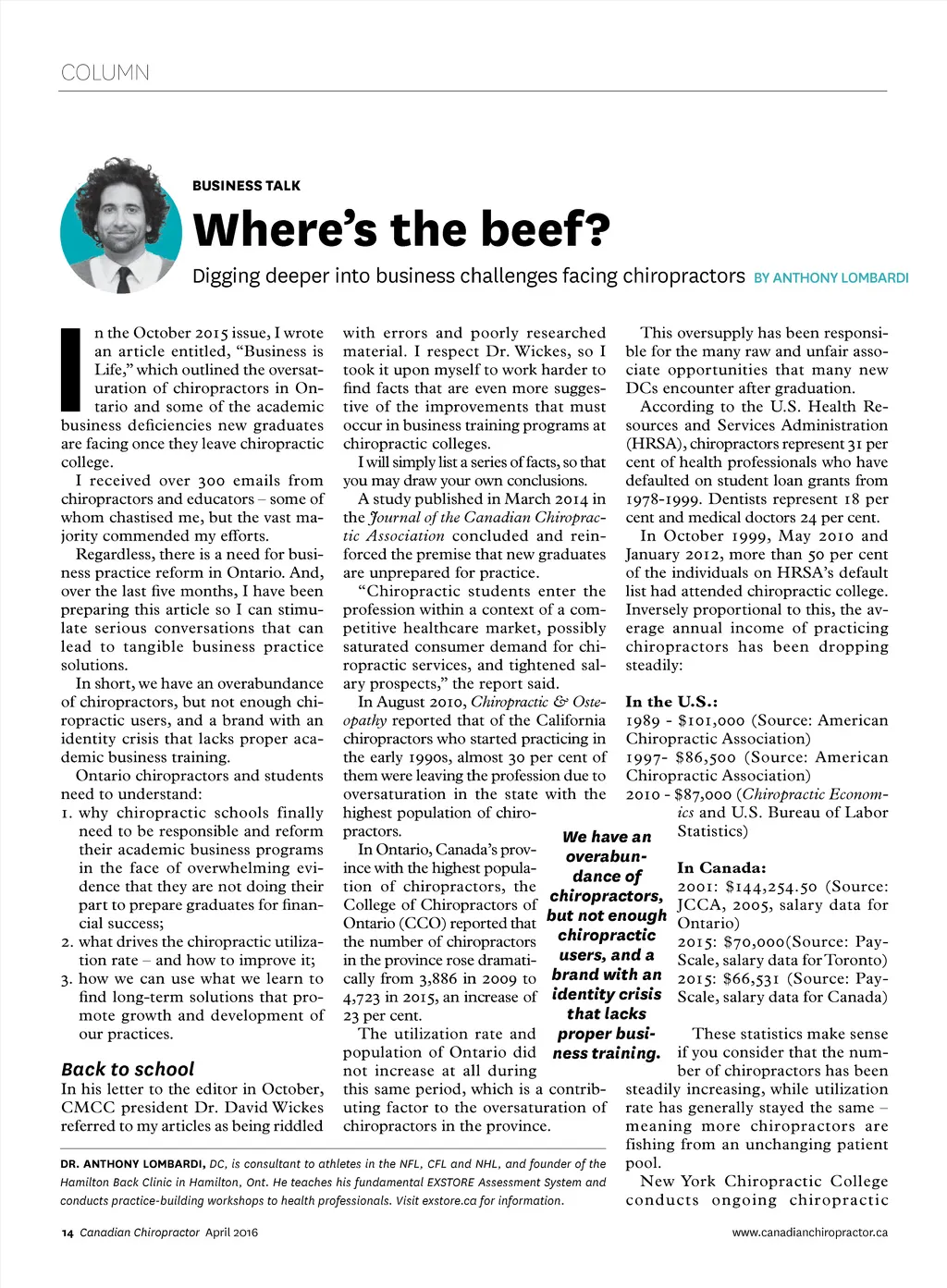
Are chiropractors getting sufficient entrepreneurial training to prepare them for real-world business challenges? college alumni surveys, which in-clude responses from alumni of nine other chiropractic institutions. The 2011 report – covering data from 2004, 2006 and 2008 – revealed that when respondents were asked to rate their preparedness for business and practice management on a five-point scale, with 1 being “not prepared” and 5 being “well prepared,” the overall rating was 2.02. In 2007, the same survey covering years 2000, 2002 and 2004, saw alumni give a business/practice man-agement rating of 1.95. What’s concerning is that the sur-vey echoes other surveys demonstrat-ing a drop in net DC income. The chiropractic college survey data of 2004 reported a net income range of US$75,000 to US$89,000. However, the 2008 alumni data reported net incomes in the US$45,000 to US$59,000 range. Why are loan default rates increas-ing and net DC incomes decreasing? To help me answer this question, I attempted to secure interviews with all of the chiropractic college presi-dents/executive directors from all of www.canadianchiropractor.ca the schools within a 400-kilometre radius of Ontario’s capital city of Toronto. Unfortunately, our leaders did not respond to my requests, ex-cept one who requested not to be asked any questions for this column. Don’t worry though, it seems chi-ropractic colleges are, in fact, indi-rectly getting the message. According to data from the U.S. Integrated Post-Secondary Educa-tion Data System (IPEDS), from 1995 to 2013 chiropractic college enrollment peaked at 15,000 students in 1996, and then dropped consist-ently until 2002 to an average of 9,957 students – a 33 per cent reduc-tion. Enrollment has remained flat since at an average of 9,980 from 2002 to 2013. Commenting on the issue, Dr. Dan Kr ueger, a chiropractor from Kelowna, B.C. notes, “I already had an MBA from the University of Cal-gary before attending chiropractic college. My specialization was in entrepreneurship and venture devel-opment. If anyone should feel com-fortable with ‘business,’ it should be somebody like myself. “It is precisely from that perspec-tive that I felt that our ‘business training’ in chiropractic school was minimal at best.” Despite all these data trends, our profession and your practices are full of undiscovered opportunities. As practitioners, we have the power to change things for the better, and I offer some recommendations on how we can help increase chiropractic utilization rate. I outline them in the online extension of this article. Visit Canadian Chiropractor’s web-site, www.canadianchiropractor.ca, for the full version of this article, including my recommendations on how I believe we can help increase chiropractic utilization rate. Help your practice grow by simply studying the business habits of Wal-mart, Starbucks and dentists. There is more to this article. Go online at www. canadianchiropractor.ca, type “Anthony Lombardi” in the search box to find the article. April 2016 Canadian Chiropractor 15 Photo: fotolia
Chiropractic + Naturopathic Doctor April 2016: Page 15