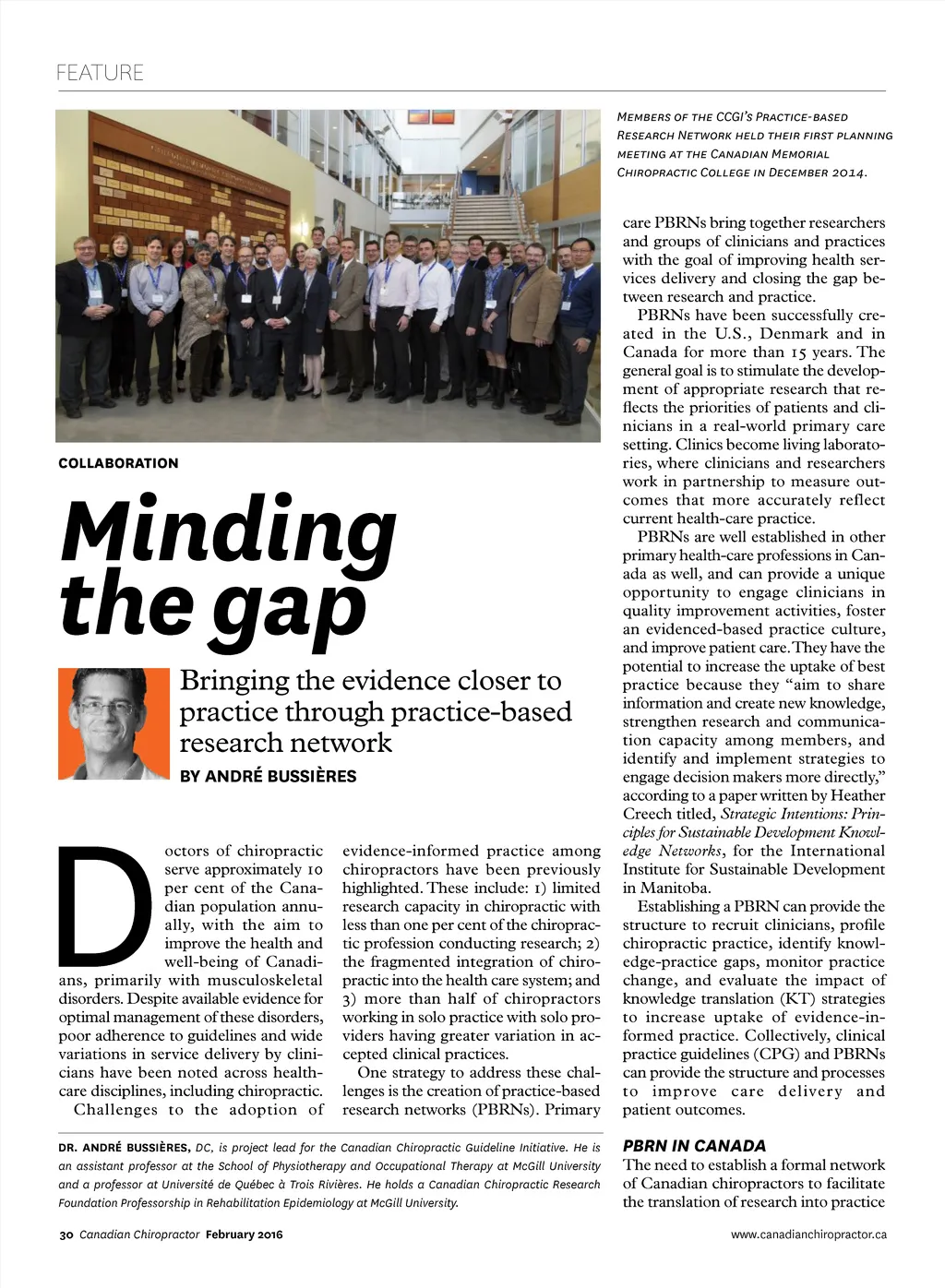
“PBRNs can provide a unique opportunity to engage clinicians in quality improvement activities, foster an evidence-based practice culture, and improve patient care.” has been recognized. In December 2014, the Canadian Chiropractic Guideline Initiative (CCGI) welcomed 32 researchers, practitioners, knowl-edge users and patient representatives to the first planning meeting of the CCGI Practice-Based Research Net-work held at Canadian Memorial Chi-ropractic College in Toronto. The National Chiropractic PBRN was launched soon after, with the estab-lishment of the advisory committee and the approval of a charter outlining the aim of the PBRN, which is to improve the quality and safety of patient care, primarily in the management of mus-culoskeletal conditions. The National Chiropractic PBRN is supported financially and administra-tively by the CCGI. Membership is open to patients (citizen engagement), clinicians (knowledge-users), leaders and decision-makers (provincial and national leaders in the chiropractic profession and decision-makers from insurance and government), and re-searchers including CPG developers and KT experts. A webpage with infor-mation on members, publications and presentations about the Research Net-work has been set up on the CCGI website (www.chiroguidelines.org). of interdisciplinary engagement be-tween community-based chiropractors and local medical and chiropractic researchers affiliated with a hospi-tal-based spine care program. The project concerns the implementation and evaluation of a simple spine-care pathway to increase specialists’ utiliza-tion of community chiropractors in the management of patients with acute and chronic non-specific low back pain (LBP). 2. In Nova Scotia, a team led by Dr. Jill Hayden and Dr. Peter Stilwell is launching a PBRN looking at imple-menting biopsychosocial assess-ment for LBP context. CPGs rec-ommend screening for psychosocial factors and appropriately managing patients with LBP. The aims of this PBRN are: to carry out a qualitative study using the Theoretical Domains Framework to assess Nova Scotian chiropractors’ awareness of CPG rec-ommendations about psychosocial factors in LBP patients; identify barri-ers and facilitators to the screening and management of psychosocial factors; develop a targeted intervention to ad-dress barriers and facilitators; imple-ment and assess intervention outcomes and expand the PBRN for education and research. 3. In Kingston, Ont., a team led by Dr. Simon French and Dr. Peter Beliveau has launched the Queen’s University PBRN. This team looks at observa-tional studies on chiropractic, rand-omized controlled trials (RCTs) and knowledge translation in the Kingston area. The aims of this study are: to further develop a network of chiro-practors interested in collaborating in practice-based research; facilitate a culture of inquiry and critical aware-ness in chiropractic practice; provide an avenue for knowledge translation activ-ities between academic chiropractors and practicing chiropractors; conduct practice-based research in local chiro-practic practices in order to better un-derstand the nature of chiropractic practice in eastern Ontario; and con-duct and participate in clinical and health care delivery research in the chiropractic care setting. 4. In Quebec, a team led by Dr. Mathieu Piché and Dr. André Bussières recently launched the Quebec Prac-tice-Based Research Network for clinical and KT research, looking at the delivery of evidence informed care in private practice and at the chiroprac-tic clinic of the Université du Québec à Trois-Rivières. This study aims to establish an infrastructure to conduct knowledge transfer (KT) research in Québec. The team of researchers is conducting a pilot RCT in collabora-tion with clinicians and patients assess-ing the feasibility of evaluating whether a KT strategy can increase the use of multimodal care to improve the man-agement of patients with neck pain. They are also interested in looking at factors that increase or decrease the effectiveness of chiropractic care in private practice, and assessing the role of expectations and other psychological factors on the evolution of acute and chronic musculoskeletal pain in pa-tients receiving chiropractic care. 5. In Guelph, Ont., a team led by Dr. John Srbely and Dr. John Riva is pre-paring to launch a PBRN looking at perceived barriers and facilitators for clinicians to the implementa-tion of evidence-informed practice in whiplash-associated disorders. This PBRN aims to support a two-way KT collaboration between basic scien-tists and practicing clinicians. 6. In Manitoba, a team led by Dr. Ste-ven Passmore is proposing a study of practice-based chiropractic utili-zation and outcomes, following referral from a hospital-based spine-care pathway. This proposed PBRN will aim to capture outcomes associated with conservative care for February 2016 Canadian Chiropractor 31 CURRENT PBRN ACTIVITIES Already, more than 150 practices have now been recruited to the PBRN pro-gram across Canada. To date, there are seven PBRNs in progress and in various stages of development. 1. The British Columbia Spine Flex Practice-Based Research Network led by Dr. Jeffrey Quon and Dr. Brian Arthur was established in the context www.canadianchiropractor.ca
Chiropractic + Naturopathic Doctor February 2016: Page 31