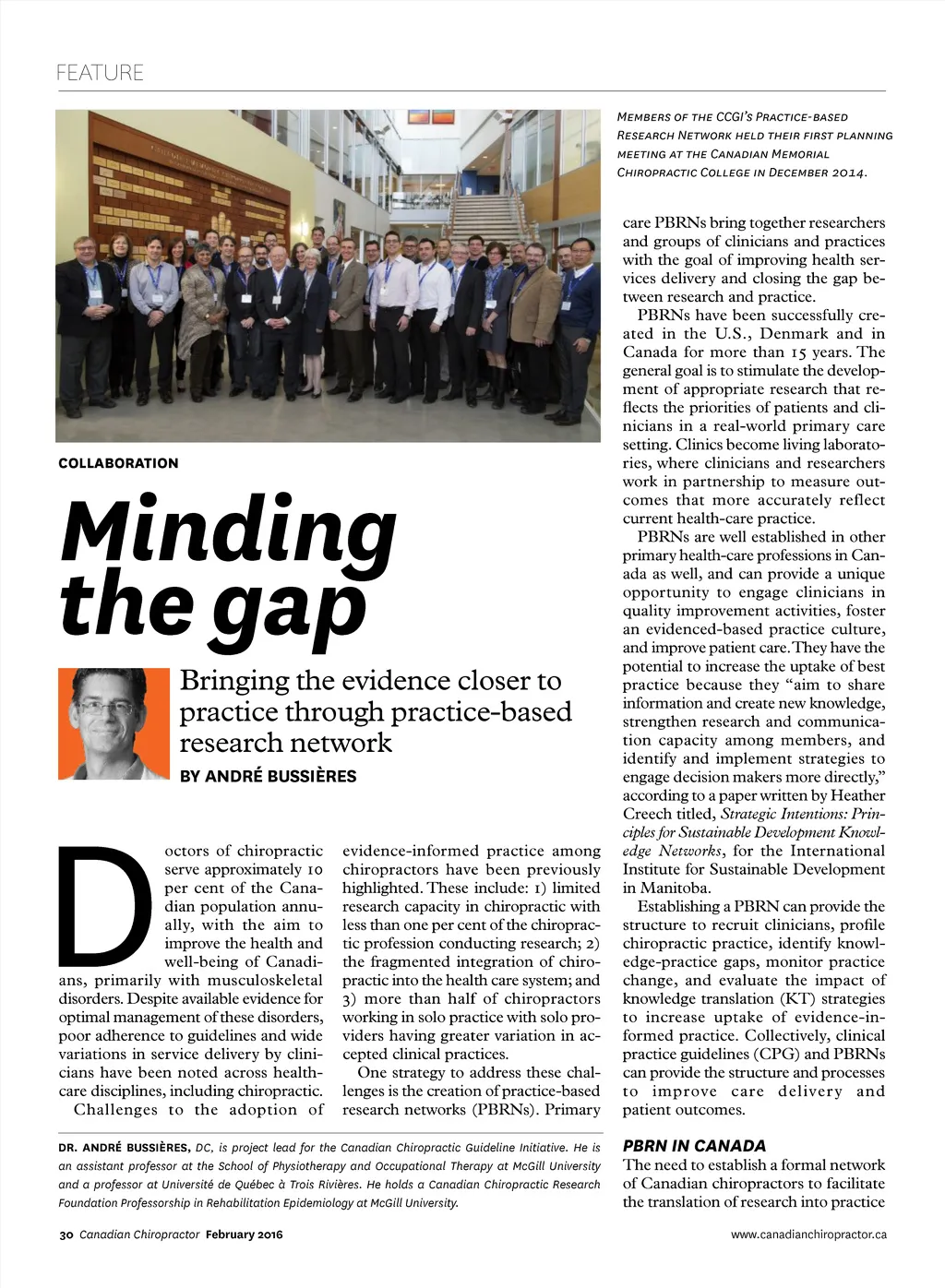
FEATURE Members of the CCGI’s Practice-based Research Network held their first planning meeting at the Canadian Memorial Chiropractic College in December 2014. COLLABORATION Minding the gap Bringing the evidence closer to practice through practice-based research network D BY ANDRÉ BUSSIÈRES octors of chiropractic serve approximately 10 per cent of the Cana-dian population annu-ally, with the aim to improve the health and well-being of Canadi-ans, primarily with musculoskeletal disorders. Despite available evidence for optimal management of these disorders, poor adherence to guidelines and wide variations in service delivery by clini-cians have been noted across health-care disciplines, including chiropractic. Challenges to the adoption of evidence-informed practice among chiropractors have been previously highlighted. These include: 1) limited research capacity in chiropractic with less than one per cent of the chiroprac-tic profession conducting research; 2) the fragmented integration of chiro-practic into the health care system; and 3) more than half of chiropractors working in solo practice with solo pro-viders having greater variation in ac-cepted clinical practices. One strategy to address these chal-lenges is the creation of practice-based research networks (PBRNs). Primary care PBRNs bring together researchers and groups of clinicians and practices with the goal of improving health ser-vices delivery and closing the gap be-tween research and practice. PBRNs have been successfully cre-ated in the U.S., Denmark and in Canada for more than 15 years. The general goal is to stimulate the develop-ment of appropriate research that re-flects the priorities of patients and cli-nicians in a real-world primary care setting. Clinics become living laborato-ries, where clinicians and researchers work in partnership to measure out-comes that more accurately reflect current health-care practice. PBRNs are well established in other primary health-care professions in Can-ada as well, and can provide a unique opportunity to engage clinicians in quality improvement activities, foster an evidenced-based practice culture, and improve patient care. They have the potential to increase the uptake of best practice because they “aim to share information and create new knowledge, strengthen research and communica-tion capacity among members, and identify and implement strategies to engage decision makers more directly,” according to a paper written by Heather Creech titled, Strategic Intentions: Prin-ciples for Sustainable Development Knowl-edge Networks , for the International Institute for Sustainable Development in Manitoba. Establishing a PBRN can provide the structure to recruit clinicians, profile chiropractic practice, identify knowl-edge-practice gaps, monitor practice change, and evaluate the impact of knowledge translation (KT) strategies to increase uptake of evidence-in-formed practice. Collectively, clinical practice guidelines (CPG) and PBRNs can provide the structure and processes to improve care deliver y and patient outcomes. DR. ANDRÉ BUSSIÈRES, DC, is project lead for the Canadian Chiropractic Guideline Initiative. He is an assistant professor at the School of Physiotherapy and Occupational Therapy at McGill University and a professor at Université de Québec à Trois Rivières. He holds a Canadian Chiropractic Research Foundation Professorship in Rehabilitation Epidemiology at McGill University. 30 Canadian Chiropractor February 2016 PBRN IN CANADA The need to establish a formal network of Canadian chiropractors to facilitate the translation of research into practice www.canadianchiropractor.ca
Chiropractic + Naturopathic Doctor February 2016: Page 30