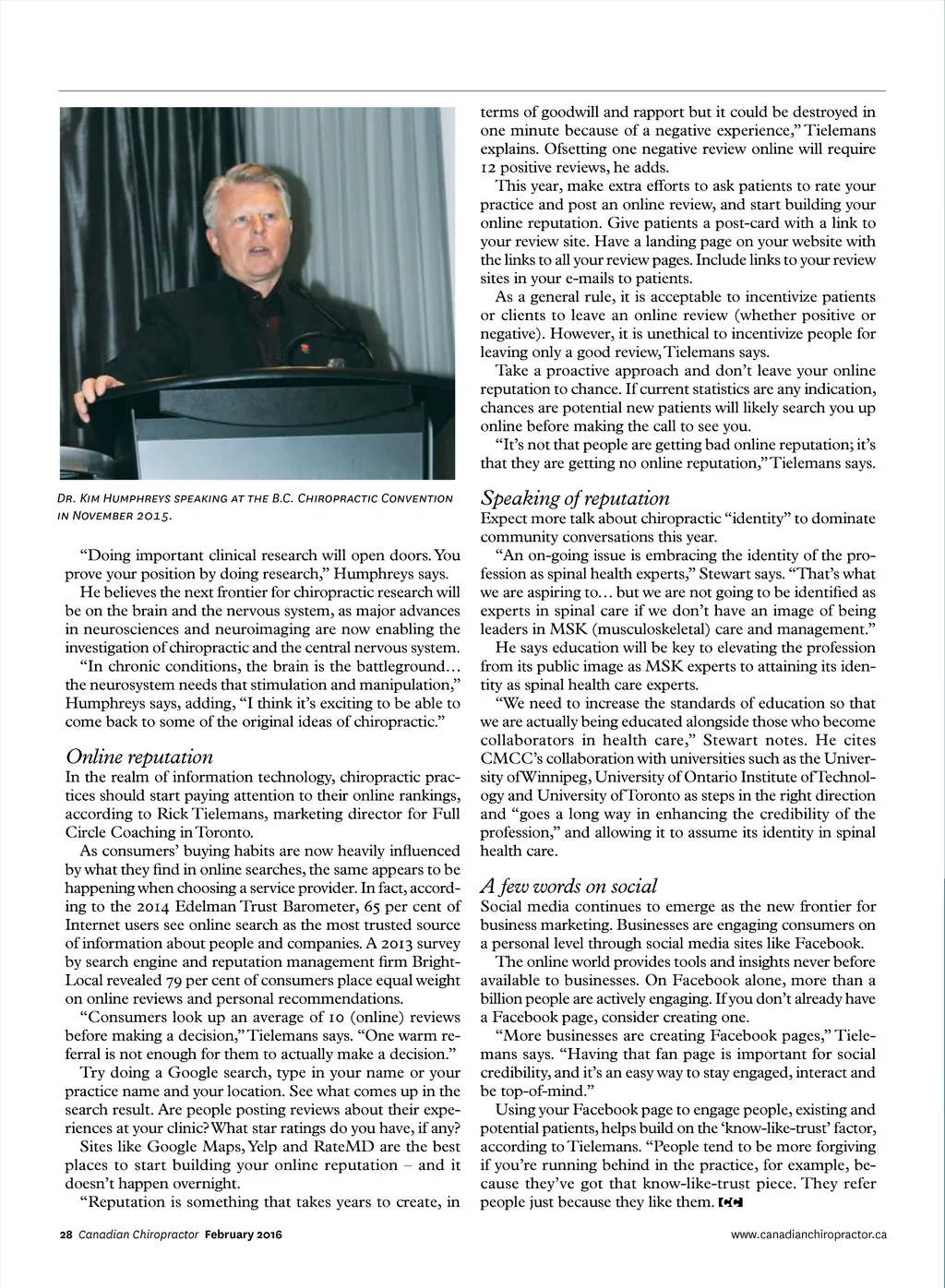
terms of goodwill and rapport but it could be destroyed in one minute because of a negative experience,” Tielemans explains. Ofsetting one negative review online will require 12 positive reviews, he adds. This year, make extra efforts to ask patients to rate your practice and post an online review, and start building your online reputation. Give patients a post-card with a link to your review site. Have a landing page on your website with the links to all your review pages. Include links to your review sites in your e-mails to patients. As a general rule, it is acceptable to incentivize patients or clients to leave an online review (whether positive or negative). However, it is unethical to incentivize people for leaving only a good review, Tielemans says. Take a proactive approach and don’t leave your online reputation to chance. If current statistics are any indication, chances are potential new patients will likely search you up online before making the call to see you. “It’s not that people are getting bad online reputation; it’s that they are getting no online reputation,” Tielemans says. Dr. Kim Humphreys speaking at the B.C. Chiropractic Convention in November 2015. Speaking of reputation “Doing important clinical research will open doors. You prove your position by doing research,” Humphreys says. He believes the next frontier for chiropractic research will be on the brain and the nervous system, as major advances in neurosciences and neuroimaging are now enabling the investigation of chiropractic and the central nervous system. “In chronic conditions, the brain is the battleground… the neurosystem needs that stimulation and manipulation,” Humphreys says, adding, “I think it’s exciting to be able to come back to some of the original ideas of chiropractic.” Online reputation In the realm of information technology, chiropractic prac-tices should start paying attention to their online rankings, according to Rick Tielemans, marketing director for Full Circle Coaching in Toronto. As consumers’ buying habits are now heavily influenced by what they find in online searches, the same appears to be happening when choosing a service provider. In fact, accord-ing to the 2014 Edelman Trust Barometer, 65 per cent of Internet users see online search as the most trusted source of information about people and companies. A 2013 survey by search engine and reputation management firm Bright-Local revealed 79 per cent of consumers place equal weight on online reviews and personal recommendations. “Consumers look up an average of 10 (online) reviews before making a decision,” Tielemans says. “One warm re-ferral is not enough for them to actually make a decision.” Try doing a Google search, type in your name or your practice name and your location. See what comes up in the search result. Are people posting reviews about their expe-riences at your clinic? What star ratings do you have, if any? Sites like Google Maps, Yelp and RateMD are the best places to start building your online reputation – and it doesn’t happen overnight. “Reputation is something that takes years to create, in 28 Canadian Chiropractor February 2016 Expect more talk about chiropractic “identity” to dominate community conversations this year. “An on-going issue is embracing the identity of the pro-fession as spinal health experts,” Stewart says. “That’s what we are aspiring to… but we are not going to be identified as experts in spinal care if we don’t have an image of being leaders in MSK (musculoskeletal) care and management.” He says education will be key to elevating the profession from its public image as MSK experts to attaining its iden-tity as spinal health care experts. “We need to increase the standards of education so that we are actually being educated alongside those who become collaborators in health care,” Stewart notes. He cites CMCC’s collaboration with universities such as the Univer-sity of Winnipeg, University of Ontario Institute of Technol-ogy and University of Toronto as steps in the right direction and “goes a long way in enhancing the credibility of the profession,” and allowing it to assume its identity in spinal health care. A few words on social Social media continues to emerge as the new frontier for business marketing. Businesses are engaging consumers on a personal level through social media sites like Facebook. The online world provides tools and insights never before available to businesses. On Facebook alone, more than a billion people are actively engaging. If you don’t already have a Facebook page, consider creating one. “More businesses are creating Facebook pages,” Tiele-mans says. “Having that fan page is important for social credibility, and it’s an easy way to stay engaged, interact and be top-of-mind.” Using your Facebook page to engage people, existing and potential patients, helps build on the ‘know-like-trust’ factor, according to Tielemans. “People tend to be more forgiving if you’re running behind in the practice, for example, be-cause they’ve got that know-like-trust piece. They refer people just because they like them. www.canadianchiropractor.ca
Chiropractic + Naturopathic Doctor February 2016: Page 28