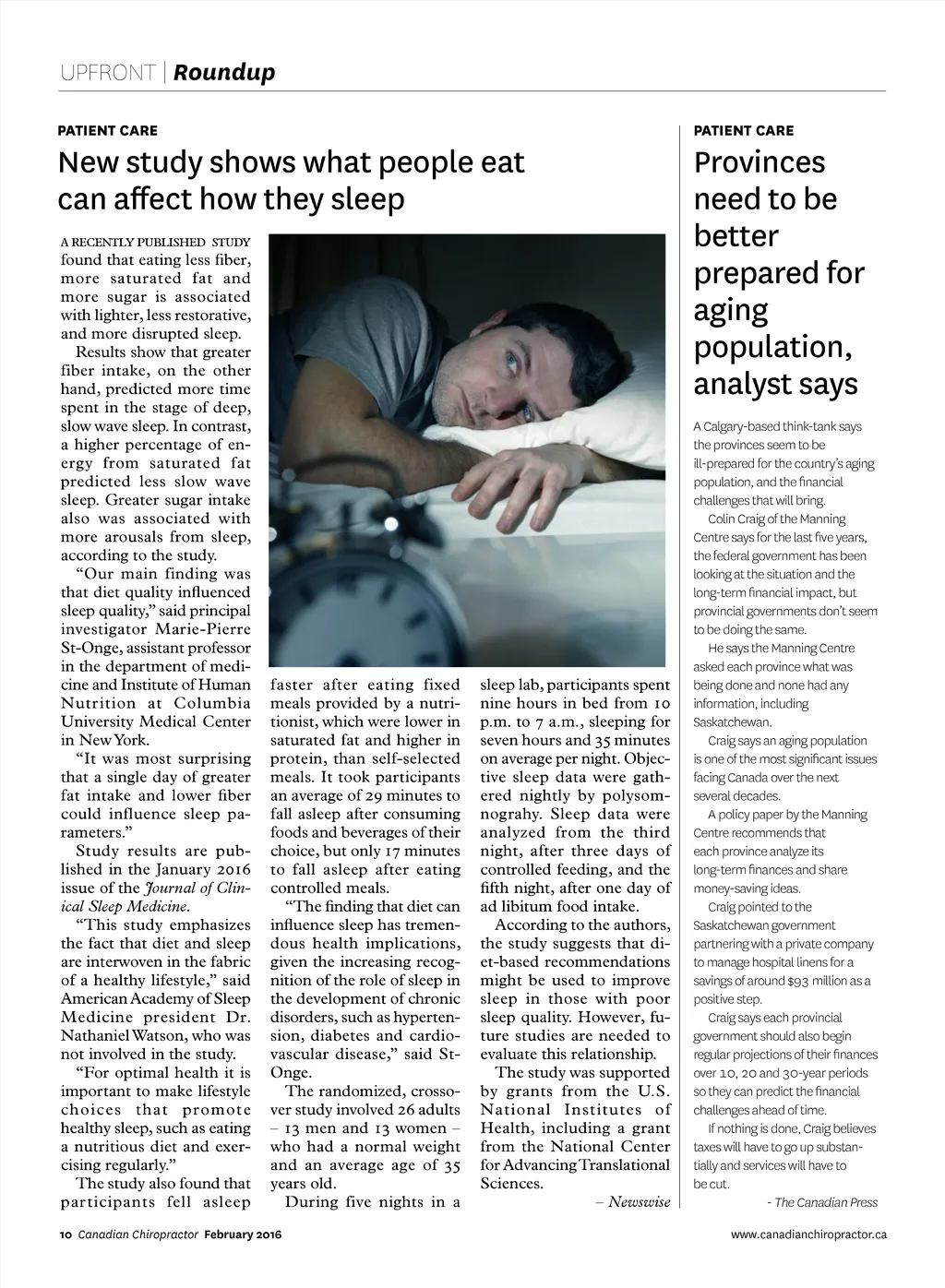
UPFRONT | Roundup PATIENT CARE New study shows what people eat can affect how they sleep a recently published study found that eating less fiber, more saturated fat and more sugar is associated with lighter, less restorative, and more disrupted sleep. Results show that greater fiber intake, on the other hand, predicted more time spent in the stage of deep, slow wave sleep. In contrast, a higher percentage of en-ergy from saturated fat predicted less slow wave sleep. Greater sugar intake also was associated with more arousals from sleep, according to the study. “Our main finding was that diet quality influenced sleep quality,” said principal investigator Marie-Pierre St-Onge, assistant professor in the department of medi-cine and Institute of Human Nutrition at Columbia University Medical Center in New York. “It was most surprising that a single day of greater fat intake and lower fiber could influence sleep pa-rameters.” Study results are pub-lished in the January 2016 issue of the Journal of Clin-ical Sleep Medicine. “This study emphasizes the fact that diet and sleep are interwoven in the fabric of a healthy lifestyle,” said American Academy of Sleep Medicine president Dr. Nathaniel Watson, who was not involved in the study. “For optimal health it is important to make lifestyle choices that promote healthy sleep, such as eating a nutritious diet and exer-cising regularly.” The study also found that par ticipants fell asleep PATIENT CARE Provinces need to be better prepared for aging population, analyst says A Calgary-based think-tank says the provinces seem to be ill-prepared for the country’s aging population, and the financial challenges that will bring. Colin Craig of the Manning Centre says for the last five years, the federal government has been looking at the situation and the long-term financial impact, but provincial governments don’t seem to be doing the same. He says the Manning Centre asked each province what was being done and none had any information, including Saskatchewan. Craig says an aging population is one of the most significant issues facing Canada over the next several decades. A policy paper by the Manning Centre recommends that each province analyze its long-term finances and share money-saving ideas. Craig pointed to the Saskatchewan government partnering with a private company to manage hospital linens for a savings of around $93 million as a positive step. Craig says each provincial government should also begin regular projections of their finances over 10, 20 and 30-year periods so they can predict the financial challenges ahead of time. If nothing is done, Craig believes taxes will have to go up substan-tially and services will have to be cut. -The Canadian Press www.canadianchiropractor.ca faster after eating fixed meals provided by a nutri-tionist, which were lower in saturated fat and higher in protein, than self-selected meals. It took participants an average of 29 minutes to fall asleep after consuming foods and beverages of their choice, but only 17 minutes to fall asleep after eating controlled meals. “The finding that diet can influence sleep has tremen-dous health implications, given the increasing recog-nition of the role of sleep in the development of chronic disorders, such as hyperten-sion, diabetes and cardio-vascular disease,” said St-Onge. The randomized, crosso-ver study involved 26 adults – 13 men and 13 women – who had a normal weight and an average age of 35 years old. During five nights in a sleep lab, participants spent nine hours in bed from 10 p.m. to 7 a.m., sleeping for seven hours and 35 minutes on average per night. Objec-tive sleep data were gath-ered nightly by polysom-nograhy. Sleep data were analyzed from the third night, after three days of controlled feeding, and the fifth night, after one day of ad libitum food intake. According to the authors, the study suggests that di-et-based recommendations might be used to improve sleep in those with poor sleep quality. However, fu-ture studies are needed to evaluate this relationship. The study was supported by grants from the U.S. National Institutes of Health, including a grant from the National Center for Advancing Translational Sciences. – Newswise 10 Canadian Chiropractor February 2016
Chiropractic + Naturopathic Doctor February 2016: Page 10