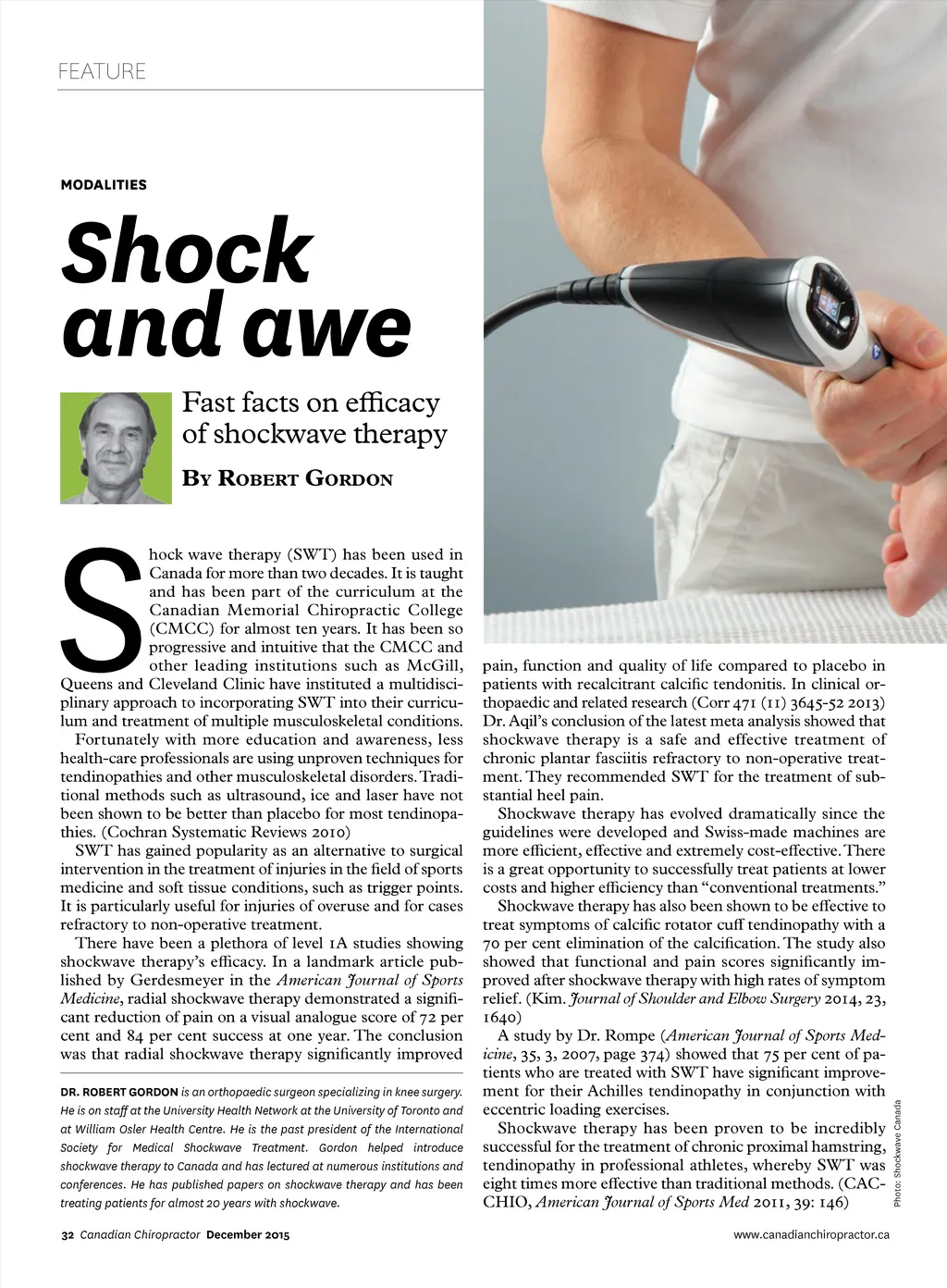
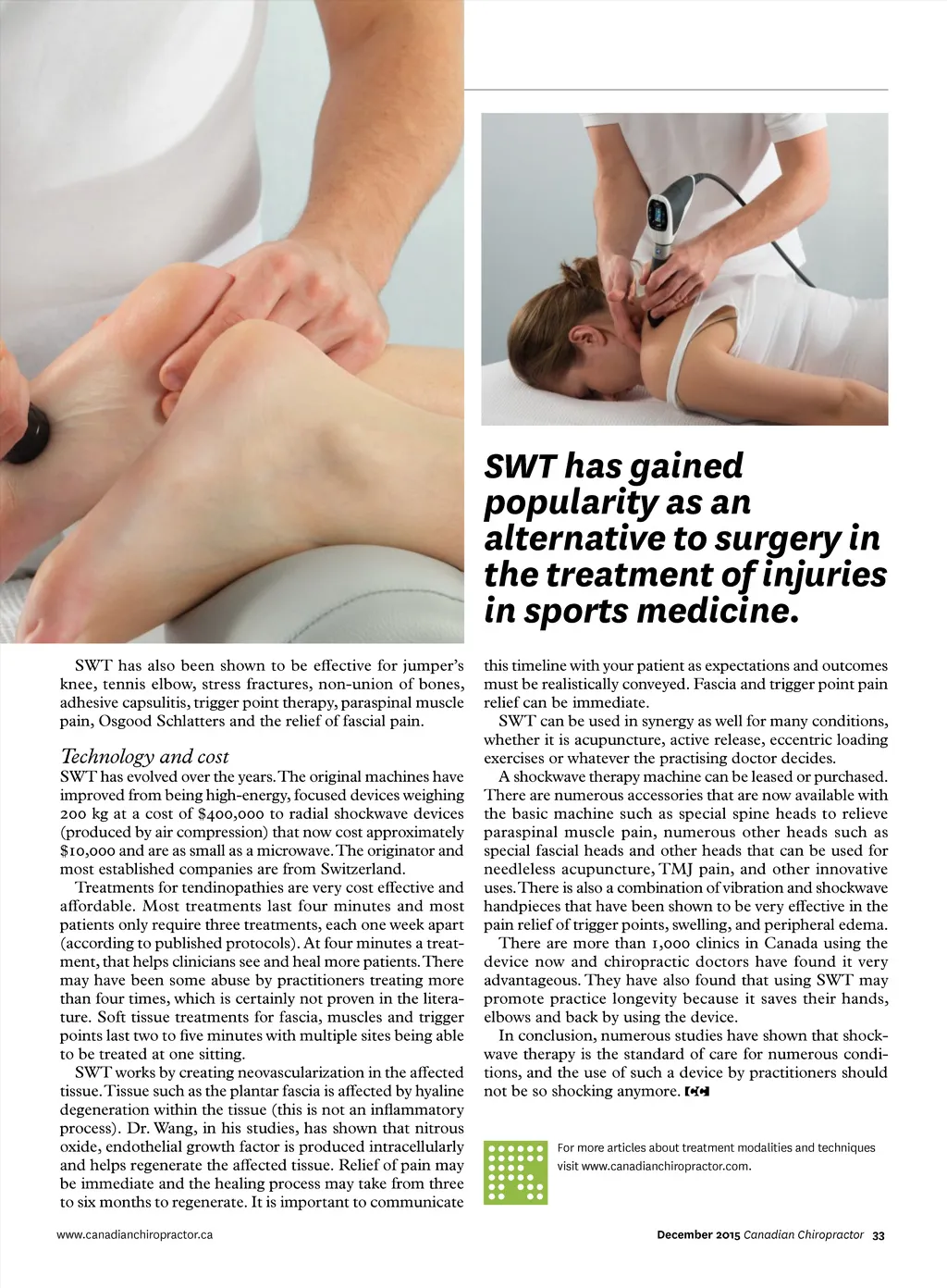
FEATURE MODALITIES Shock and awe Fast facts on efficacy of shockwave therapy S B y R oBeRt G oRdon hock wave therapy (SWT) has been used in Canada for more than two decades. It is taught and has been part of the curriculum at the Canadian Memorial Chiropractic College (CMCC) for almost ten years. It has been so progressive and intuitive that the CMCC and other leading institutions such as McGill, Queens and Cleveland Clinic have instituted a multidisci-plinary approach to incorporating SWT into their curricu-lum and treatment of multiple musculoskeletal conditions. Fortunately with more education and awareness, less health-care professionals are using unproven techniques for tendinopathies and other musculoskeletal disorders. Tradi-tional methods such as ultrasound, ice and laser have not been shown to be better than placebo for most tendinopa-thies. (Cochran Systematic Reviews 2010) SWT has gained popularity as an alternative to surgical intervention in the treatment of injuries in the field of sports medicine and soft tissue conditions, such as trigger points. It is particularly useful for injuries of overuse and for cases refractory to non-operative treatment. There have been a plethora of level 1A studies showing shockwave therapy’s efficacy. In a landmark article pub-lished by Gerdesmeyer in the American Journal of Sports Medicine , radial shockwave therapy demonstrated a signifi-cant reduction of pain on a visual analogue score of 72 per cent and 84 per cent success at one year. The conclusion was that radial shockwave therapy significantly improved DR. ROBERT GORDON is an orthopaedic surgeon specializing in knee surgery. He is on staff at the University Health Network at the University of Toronto and at William Osler Health Centre. He is the past president of the International Society for Medical Shockwave Treatment. Gordon helped introduce shockwave therapy to Canada and has lectured at numerous institutions and conferences. He has published papers on shockwave therapy and has been treating patients for almost 20 years with shockwave. 32 Canadian Chiropractor December 2015 pain, function and quality of life compared to placebo in patients with recalcitrant calcific tendonitis. In clinical or-thopaedic and related research (Corr 471 (11) 3645-52 2013) Dr. Aqil’s conclusion of the latest meta analysis showed that shockwave therapy is a safe and effective treatment of chronic plantar fasciitis refractory to non-operative treat-ment. They recommended SWT for the treatment of sub-stantial heel pain. Shockwave therapy has evolved dramatically since the guidelines were developed and Swiss-made machines are more efficient, effective and extremely cost-effective. There is a great opportunity to successfully treat patients at lower costs and higher efficiency than “conventional treatments.” Shockwave therapy has also been shown to be effective to treat symptoms of calcific rotator cuff tendinopathy with a 70 per cent elimination of the calcification. The study also showed that functional and pain scores significantly im-proved after shockwave therapy with high rates of symptom relief. (Kim. Journal of Shoulder and Elbow Surgery 2014, 23, 1640) A study by Dr. Rompe ( American Journal of Sports Med-icine , 35, 3, 2007, page 374) showed that 75 per cent of pa-tients who are treated with SWT have significant improve-ment for their Achilles tendinopathy in conjunction with eccentric loading exercises. Shockwave therapy has been proven to be incredibly successful for the treatment of chronic proximal hamstring, tendinopathy in professional athletes, whereby SWT was eight times more effective than traditional methods. (CAC-CHIO, American Journal of Sports Med 2011, 39: 146) www.canadianchiropractor.ca Photo: Shockwave Canada
Chiropractic + Naturopathic Doctor December 2015: Page 32