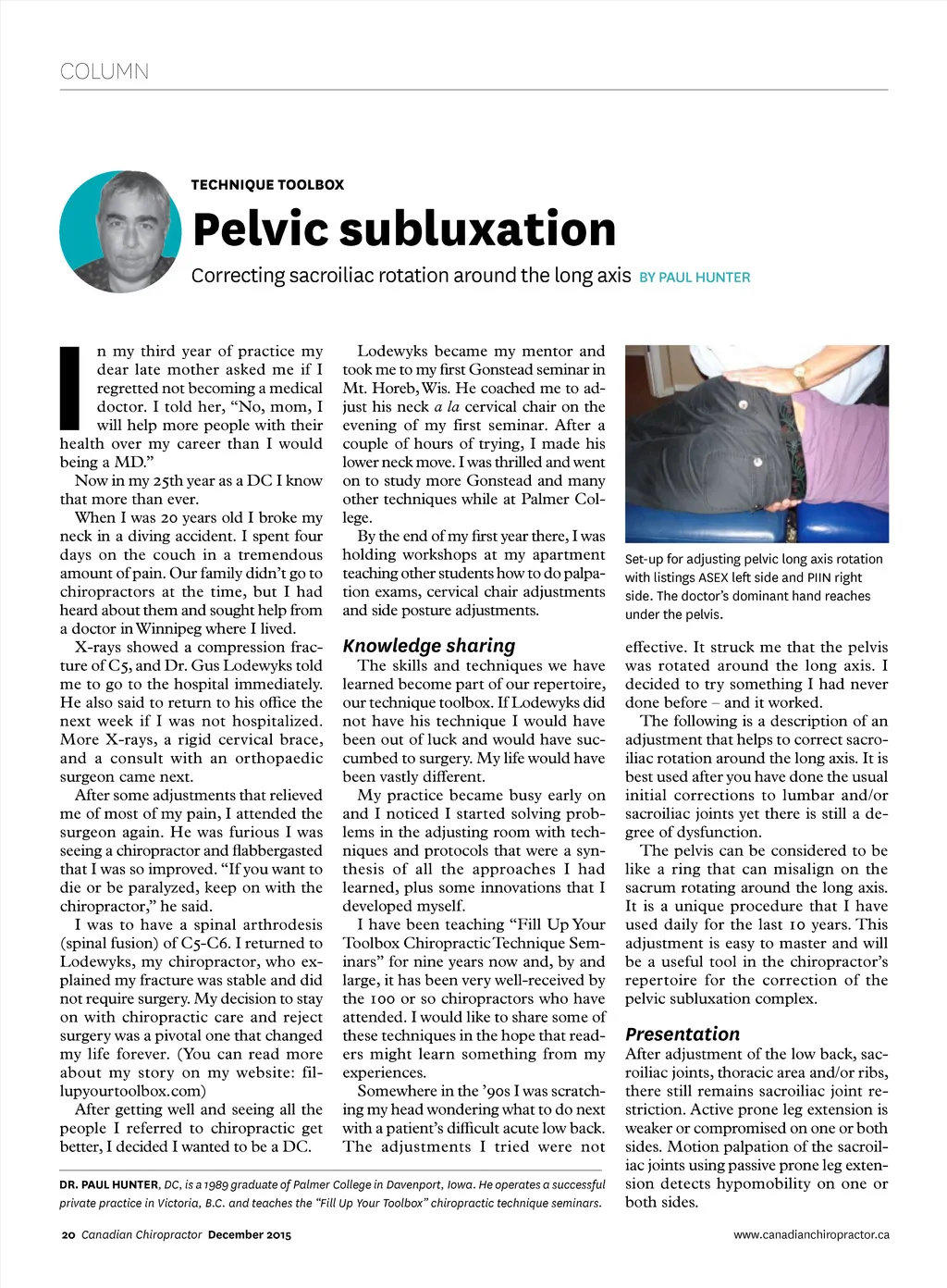
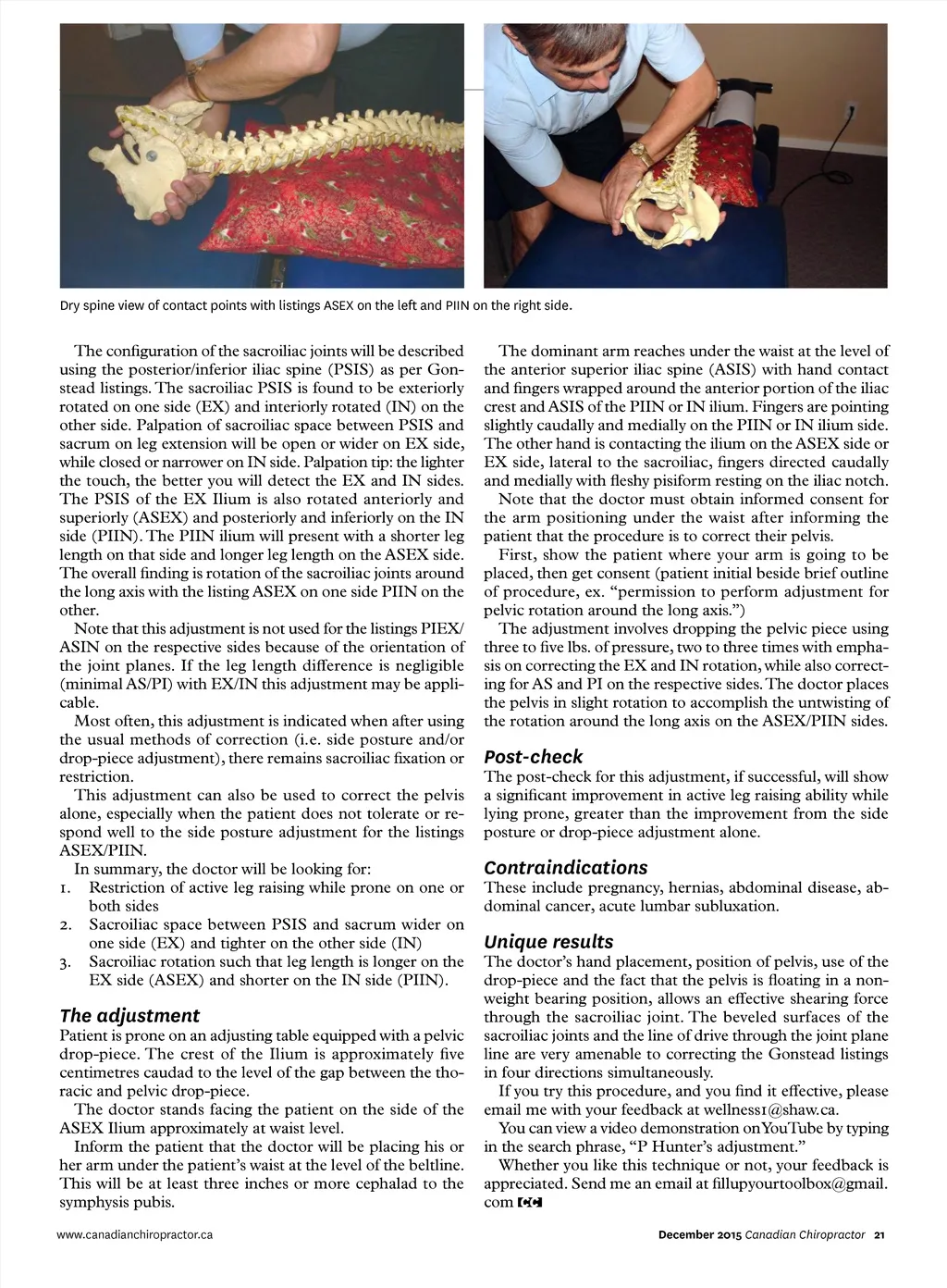
Dry spine view of contact points with listings ASEX on the left and PIIN on the right side. The configuration of the sacroiliac joints will be described using the posterior/inferior iliac spine (PSIS) as per Gon-stead listings. The sacroiliac PSIS is found to be exteriorly rotated on one side (EX) and interiorly rotated (IN) on the other side. Palpation of sacroiliac space between PSIS and sacrum on leg extension will be open or wider on EX side, while closed or narrower on IN side. Palpation tip: the lighter the touch, the better you will detect the EX and IN sides. The PSIS of the EX Ilium is also rotated anteriorly and superiorly (ASEX) and posteriorly and inferiorly on the IN side (PIIN). The PIIN ilium will present with a shorter leg length on that side and longer leg length on the ASEX side. The overall finding is rotation of the sacroiliac joints around the long axis with the listing ASEX on one side PIIN on the other. Note that this adjustment is not used for the listings PIEX/ ASIN on the respective sides because of the orientation of the joint planes. If the leg length difference is negligible (minimal AS/PI) with EX/IN this adjustment may be appli-cable. Most often, this adjustment is indicated when after using the usual methods of correction (i.e. side posture and/or drop-piece adjustment), there remains sacroiliac fixation or restriction. This adjustment can also be used to correct the pelvis alone, especially when the patient does not tolerate or re-spond well to the side posture adjustment for the listings ASEX/PIIN. In summary, the doctor will be looking for: 1. Restriction of active leg raising while prone on one or both sides 2. Sacroiliac space between PSIS and sacrum wider on one side (EX) and tighter on the other side (IN) 3. Sacroiliac rotation such that leg length is longer on the EX side (ASEX) and shorter on the IN side (PIIN). The dominant arm reaches under the waist at the level of the anterior superior iliac spine (ASIS) with hand contact and fingers wrapped around the anterior portion of the iliac crest and ASIS of the PIIN or IN ilium. Fingers are pointing slightly caudally and medially on the PIIN or IN ilium side. The other hand is contacting the ilium on the ASEX side or EX side, lateral to the sacroiliac, fingers directed caudally and medially with fleshy pisiform resting on the iliac notch. Note that the doctor must obtain informed consent for the arm positioning under the waist after informing the patient that the procedure is to correct their pelvis. First, show the patient where your arm is going to be placed, then get consent (patient initial beside brief outline of procedure, ex. “permission to perform adjustment for pelvic rotation around the long axis.”) The adjustment involves dropping the pelvic piece using three to five lbs. of pressure, two to three times with empha-sis on correcting the EX and IN rotation, while also correct-ing for AS and PI on the respective sides. The doctor places the pelvis in slight rotation to accomplish the untwisting of the rotation around the long axis on the ASEX/PIIN sides. Post-check The post-check for this adjustment, if successful, will show a significant improvement in active leg raising ability while lying prone, greater than the improvement from the side posture or drop-piece adjustment alone. Contraindications Unique results These include pregnancy, hernias, abdominal disease, ab-dominal cancer, acute lumbar subluxation. The doctor’s hand placement, position of pelvis, use of the drop-piece and the fact that the pelvis is floating in a non-weight bearing position, allows an effective shearing force through the sacroiliac joint. The beveled surfaces of the sacroiliac joints and the line of drive through the joint plane line are very amenable to correcting the Gonstead listings in four directions simultaneously. If you try this procedure, and you find it effective, please email me with your feedback at [email protected]. You can view a video demonstration on YouTube by typing in the search phrase, “P Hunter’s adjustment.” Whether you like this technique or not, your feedback is appreciated. Send me an email at fillupyourtoolbox@gmail. com December 2015 Canadian Chiropractor 21 The adjustment Patient is prone on an adjusting table equipped with a pelvic drop-piece. The crest of the Ilium is approximately five centimetres caudad to the level of the gap between the tho-racic and pelvic drop-piece. The doctor stands facing the patient on the side of the ASEX Ilium approximately at waist level. Inform the patient that the doctor will be placing his or her arm under the patient’s waist at the level of the beltline. This will be at least three inches or more cephalad to the symphysis pubis. www.canadianchiropractor.ca
Chiropractic + Naturopathic Doctor December 2015: Page 21