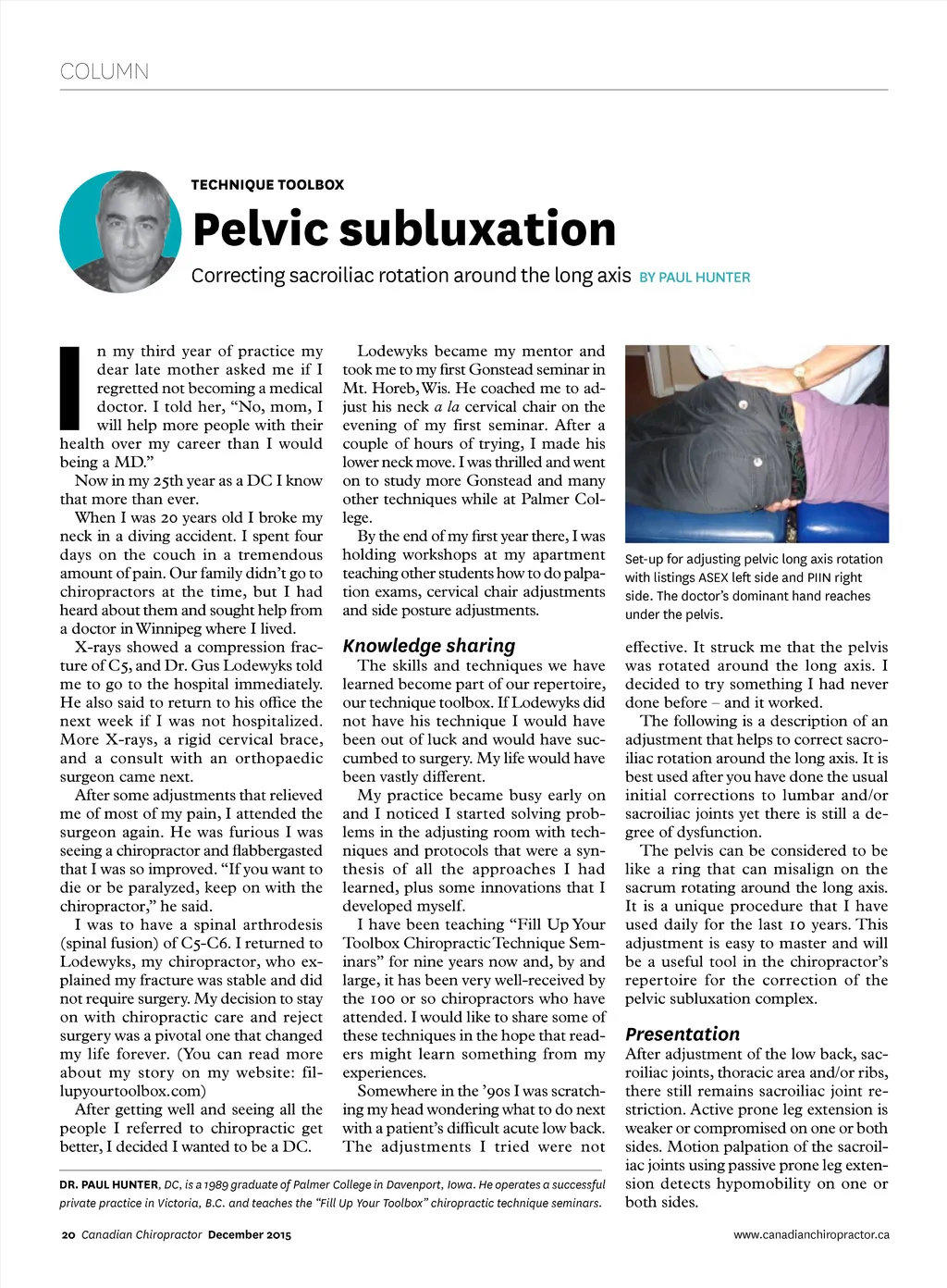
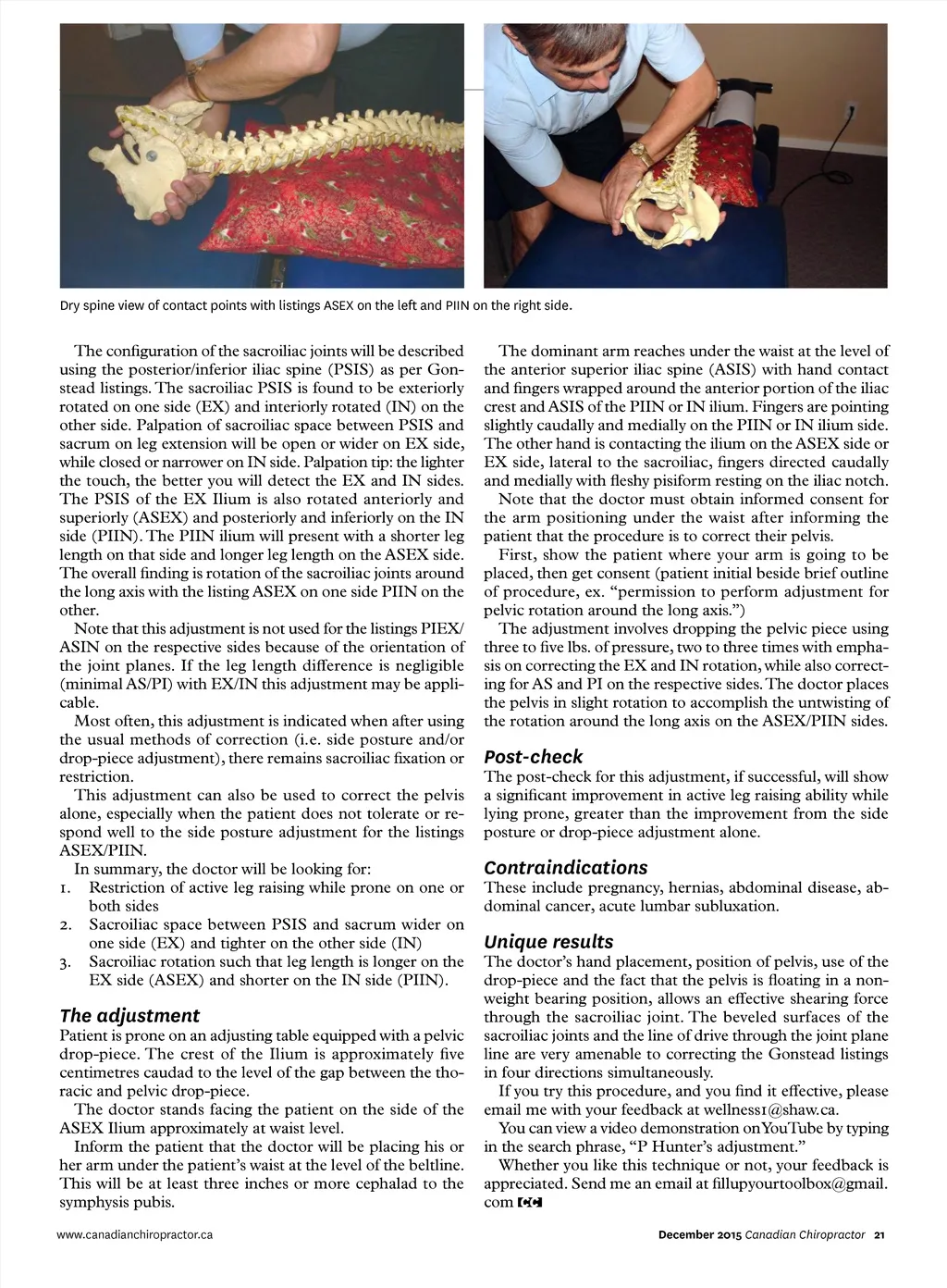
COLUMN TECHNIQUE TOOLBOX Pelvic subluxation I Correcting sacroiliac rotation around the long axis Lodewyks became my mentor and took me to my first Gonstead seminar in Mt. Horeb, Wis. He coached me to ad-just his neck a la cervical chair on the evening of my first seminar. After a couple of hours of trying, I made his lower neck move. I was thrilled and went on to study more Gonstead and many other techniques while at Palmer Col-lege. By the end of my first year there, I was holding workshops at my apartment teaching other students how to do palpa-tion exams, cervical chair adjustments and side posture adjustments. The skills and techniques we have learned become part of our repertoire, our technique toolbox. If Lodewyks did not have his technique I would have been out of luck and would have suc-cumbed to surgery. My life would have been vastly different. My practice became busy early on and I noticed I started solving prob-lems in the adjusting room with tech-niques and protocols that were a syn-thesis of all the approaches I had learned, plus some innovations that I developed myself. I have been teaching “Fill Up Your Toolbox Chiropractic Technique Sem-inars” for nine years now and, by and large, it has been very well-received by the 100 or so chiropractors who have attended. I would like to share some of these techniques in the hope that read-ers might learn something from my experiences. Somewhere in the ’90s I was scratch-ing my head wondering what to do next with a patient’s difficult acute low back. The adjustments I tried were not BY PAUL HUNTER n my third year of practice my dear late mother asked me if I regretted not becoming a medical doctor. I told her, “No, mom, I will help more people with their health over my career than I would being a MD.” Now in my 25th year as a DC I know that more than ever. When I was 20 years old I broke my neck in a diving accident. I spent four days on the couch in a tremendous amount of pain. Our family didn’t go to chiropractors at the time, but I had heard about them and sought help from a doctor in Winnipeg where I lived. X-rays showed a compression frac-ture of C5, and Dr. Gus Lodewyks told me to go to the hospital immediately. He also said to return to his office the next week if I was not hospitalized. More X-rays, a rigid cervical brace, and a consult with an orthopaedic surgeon came next. After some adjustments that relieved me of most of my pain, I attended the surgeon again. He was furious I was seeing a chiropractor and flabbergasted that I was so improved. “If you want to die or be paralyzed, keep on with the chiropractor,” he said. I was to have a spinal arthrodesis (spinal fusion) of C5-C6. I returned to Lodewyks, my chiropractor, who ex-plained my fracture was stable and did not require surgery. My decision to stay on with chiropractic care and reject surgery was a pivotal one that changed my life forever. (You can read more about my story on my website: fil-lupyourtoolbox.com) After getting well and seeing all the people I referred to chiropractic get better, I decided I wanted to be a DC. Set-up for adjusting pelvic long axis rotation with listings ASEX left side and PIIN right side. The doctor’s dominant hand reaches under the pelvis. Knowledge sharing effective. It struck me that the pelvis was rotated around the long axis. I decided to try something I had never done before – and it worked. The following is a description of an adjustment that helps to correct sacro-iliac rotation around the long axis. It is best used after you have done the usual initial corrections to lumbar and/or sacroiliac joints yet there is still a de-gree of dysfunction. The pelvis can be considered to be like a ring that can misalign on the sacrum rotating around the long axis. It is a unique procedure that I have used daily for the last 10 years. This adjustment is easy to master and will be a useful tool in the chiropractor’s repertoire for the correction of the pelvic subluxation complex. Presentation DR. PAUL HUNTER , DC, is a 1989 graduate of Palmer College in Davenport, Iowa. He operates a successful private practice in Victoria, B.C. and teaches the “Fill Up Your Toolbox” chiropractic technique seminars. 20 Canadian Chiropractor December 2015 After adjustment of the low back, sac-roiliac joints, thoracic area and/or ribs, there still remains sacroiliac joint re-striction. Active prone leg extension is weaker or compromised on one or both sides. Motion palpation of the sacroil-iac joints using passive prone leg exten-sion detects hypomobility on one or both sides. www.canadianchiropractor.ca
Chiropractic + Naturopathic Doctor December 2015: Page 20