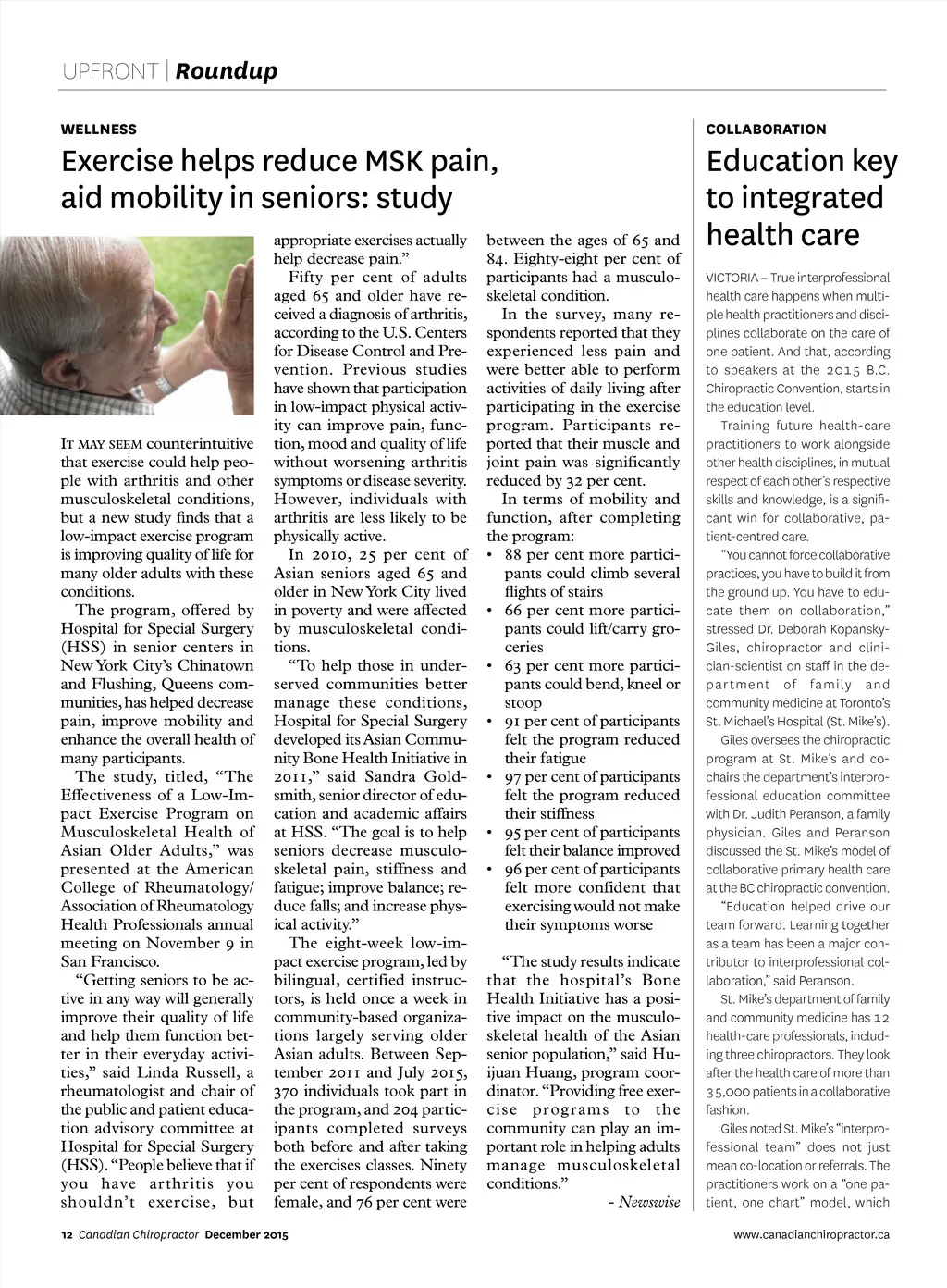
UPFRONT | Roundup WELLNESS Exercise helps reduce MSK pain, aid mobility in seniors: study appropriate exercises actually help decrease pain.” Fifty per cent of adults aged 65 and older have re-ceived a diagnosis of arthritis, according to the U.S. Centers for Disease Control and Pre-vention. Previous studies have shown that participation in low-impact physical activ-ity can improve pain, func-tion, mood and quality of life without worsening arthritis symptoms or disease severity. However, individuals with arthritis are less likely to be physically active. In 2010, 25 per cent of Asian seniors aged 65 and older in New York City lived in poverty and were affected by musculoskeletal condi-tions. “To help those in under-served communities better manage these conditions, Hospital for Special Surgery developed its Asian Commu-nity Bone Health Initiative in 2011,” said Sandra Gold-smith, senior director of edu-cation and academic affairs at HSS. “The goal is to help seniors decrease musculo-skeletal pain, stiffness and fatigue; improve balance; re-duce falls; and increase phys-ical activity.” The eight-week low-im-pact exercise program, led by bilingual, certified instruc-tors, is held once a week in community-based organiza-tions largely serving older Asian adults. Between Sep-tember 2011 and July 2015, 370 individuals took part in the program, and 204 partic-ipants completed surveys both before and after taking the exercises classes. Ninety per cent of respondents were female, and 76 per cent were between the ages of 65 and 84. Eighty-eight per cent of participants had a musculo-skeletal condition. In the survey, many re-spondents reported that they experienced less pain and were better able to perform activities of daily living after participating in the exercise program. Participants re-ported that their muscle and joint pain was significantly reduced by 32 per cent. In terms of mobility and function, after completing the program: • 88 per cent more partici-pants could climb several flights of stairs • 66 per cent more partici-pants could lift/carry gro-ceries • 63 per cent more partici-pants could bend, kneel or stoop • 91 per cent of participants felt the program reduced their fatigue • 97 per cent of participants felt the program reduced their stiffness • 95 per cent of participants felt their balance improved • 96 per cent of participants felt more confident that exercising would not make their symptoms worse “The study results indicate that the hospital’s Bone Health Initiative has a posi-tive impact on the musculo-skeletal health of the Asian senior population,” said Hu-ijuan Huang, program coor-dinator. “Providing free exer-cise prog rams to the community can play an im-portant role in helping adults manage musculoskeletal conditions.” -Newswise COLLABORATION Education key to integrated health care VICTORIA – True interprofessional health care happens when multi-ple health practitioners and disci-plines collaborate on the care of one patient. And that, according to speakers at the 2015 B.C. Chiropractic Convention, starts in the education level. Training future health-care practitioners to work alongside other health disciplines, in mutual respect of each other’s respective skills and knowledge, is a signifi-cant win for collaborative, pa-tient-centred care. “You cannot force collaborative practices, you have to build it from the ground up. You have to edu-cate them on collaboration,” stressed Dr. Deborah Kopansky-Giles, chiropractor and clini-cian-scientist on staff in the de-partment of family and community medicine at Toronto’s St. Michael’s Hospital (St. Mike’s). Giles oversees the chiropractic program at St. Mike’s and co-chairs the department’s interpro-fessional education committee with Dr. Judith Peranson, a family physician. Giles and Peranson discussed the St. Mike’s model of collaborative primary health care at the BC chiropractic convention. “Education helped drive our team forward. Learning together as a team has been a major con-tributor to interprofessional col-laboration,” said Peranson. St. Mike’s department of family and community medicine has 12 health-care professionals, includ-ing three chiropractors. They look after the health care of more than 35,000 patients in a collaborative fashion. Giles noted St. Mike’s “interpro-fessional team” does not just mean co-location or referrals. The practitioners work on a “one pa-tient, one chart” model, which www.canadianchiropractor.ca It may seem counterintuitive that exercise could help peo-ple with arthritis and other musculoskeletal conditions, but a new study finds that a low-impact exercise program is improving quality of life for many older adults with these conditions. The program, offered by Hospital for Special Surgery (HSS) in senior centers in New York City’s Chinatown and Flushing, Queens com-munities, has helped decrease pain, improve mobility and enhance the overall health of many participants. The study, titled, “The Effectiveness of a Low-Im-pact Exercise Program on Musculoskeletal Health of Asian Older Adults,” was presented at the American College of Rheumatology/ Association of Rheumatology Health Professionals annual meeting on November 9 in San Francisco. “Getting seniors to be ac-tive in any way will generally improve their quality of life and help them function bet-ter in their everyday activi-ties,” said Linda Russell, a rheumatologist and chair of the public and patient educa-tion advisory committee at Hospital for Special Surgery (HSS). “People believe that if you have ar thritis you shouldn’t exercise, but 12 Canadian Chiropractor December 2015
Chiropractic + Naturopathic Doctor December 2015: Page 12