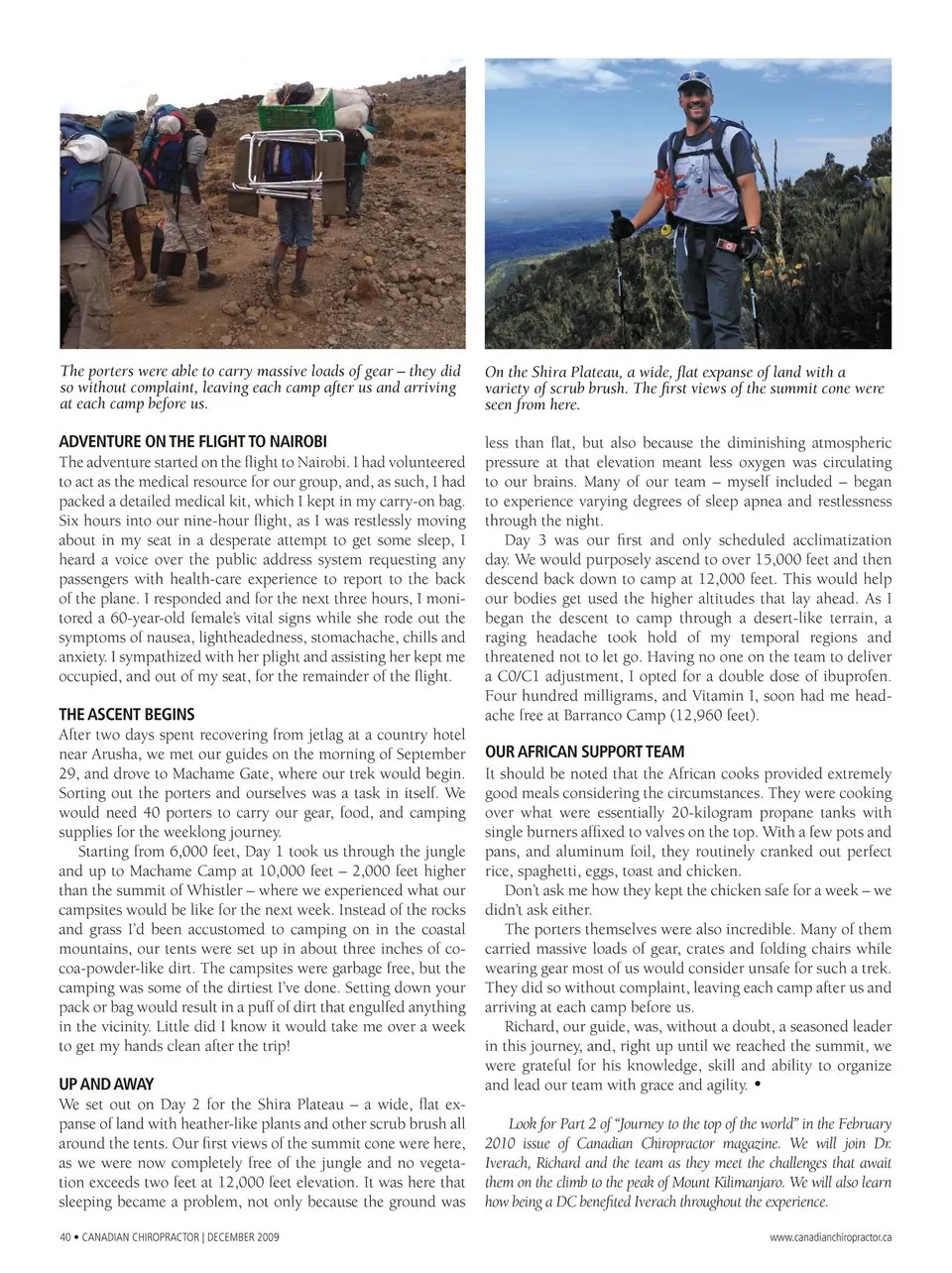
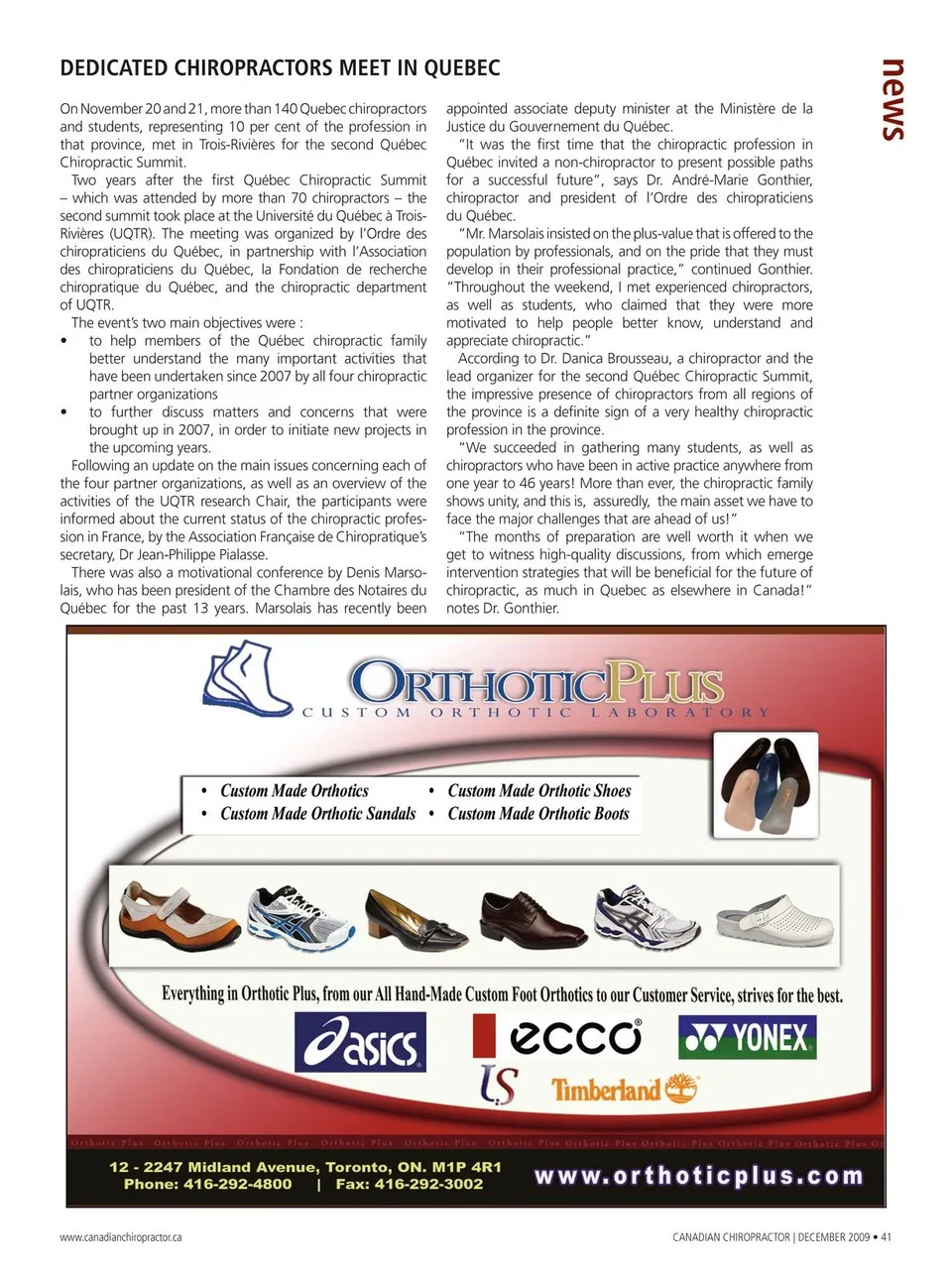
The porters were able to carry massive loads of gear – they did so without complaint, leaving each camp after us and arriving at each camp before us. ADVENTURE ON THE FLIGHT TO NAIRObI The adventure started on the flight to Nairobi. I had volunteered to act as the medical resource for our group, and, as such, I had packed a detailed medical kit, which I kept in my carry-on bag. Six hours into our nine-hour flight, as I was restlessly moving about in my seat in a desperate attempt to get some sleep, I heard a voice over the public address system requesting any passengers with health-care experience to report to the back of the plane. I responded and for the next three hours, I moni- tored a 60-year-old female’s vital signs while she rode out the symptoms of nausea, lightheadedness, stomachache, chills and anxiety. I sympathized with her plight and assisting her kept me occupied, and out of my seat, for the remainder of the flight. THE ASCENT bEGINS After two days spent recovering from jetlag at a country hotel near Arusha, we met our guides on the morning of September 29, and drove to Machame Gate, where our trek would begin. Sorting out the porters and ourselves was a task in itself. We would need 40 porters to carry our gear, food, and camping supplies for the weeklong journey. Starting from 6,000 feet, Day 1 took us through the jungle and up to Machame Camp at 10,000 feet – 2,000 feet higher than the summit of Whistler – where we experienced what our campsites would be like for the next week. Instead of the rocks and grass I’d been accustomed to camping on in the coastal mountains, our tents were set up in about three inches of co- coa-powder-like dirt. The campsites were garbage free, but the camping was some of the dirtiest I’ve done. Setting down your pack or bag would result in a puff of dirt that engulfed anything in the vicinity. Little did I know it would take me over a week to get my hands clean after the trip! UP AND AWAY We set out on Day 2 for the Shira Plateau – a wide, flat ex- panse of land with heather-like plants and other scrub brush all around the tents. Our first views of the summit cone were here, as we were now completely free of the jungle and no vegeta- tion exceeds two feet at 12,000 feet elevation. It was here that sleeping became a problem, not only because the ground was 40 • Canadian ChiropraCtor | dECEMBEr 2009 On the Shira Plateau, a wide, flat expanse of land with a variety of scrub brush. The first views of the summit cone were seen from here. less than flat, but also because the diminishing atmospheric pressure at that elevation meant less oxygen was circulating to our brains. Many of our team – myself included – began to experience varying degrees of sleep apnea and restlessness through the night. Day 3 was our first and only scheduled acclimatization day. We would purposely ascend to over 15,000 feet and then descend back down to camp at 12,000 feet. This would help our bodies get used the higher altitudes that lay ahead. As I began the descent to camp through a desert-like terrain, a raging headache took hold of my temporal regions and threatened not to let go. Having no one on the team to deliver a C0/C1 adjustment, I opted for a double dose of ibuprofen. Four hundred milligrams, and Vitamin I, soon had me head- ache free at Barranco Camp (12,960 feet). OUR AFRICAN SUPPORT TEAM It should be noted that the African cooks provided extremely good meals considering the circumstances. They were cooking over what were essentially 20-kilogram propane tanks with single burners affixed to valves on the top. With a few pots and pans, and aluminum foil, they routinely cranked out perfect rice, spaghetti, eggs, toast and chicken. Don’t ask me how they kept the chicken safe for a week – we didn’t ask either. The porters themselves were also incredible. Many of them carried massive loads of gear, crates and folding chairs while wearing gear most of us would consider unsafe for such a trek. They did so without complaint, leaving each camp after us and arriving at each camp before us. Richard, our guide, was, without a doubt, a seasoned leader in this journey, and, right up until we reached the summit, we were grateful for his knowledge, skill and ability to organize and lead our team with grace and agility. • Look for Part 2 of “Journey to the top of the world” in the February 2010 issue of Canadian Chiropractor magazine. We will join Dr. Iverach, Richard and the team as they meet the challenges that await them on the climb to the peak of Mount Kilimanjaro. We will also learn how being a DC benefited Iverach throughout the experience. www.canadianchiropractor.ca
Chiropractic + Naturopathic Doctor December 2009: Page 40